Mining madness
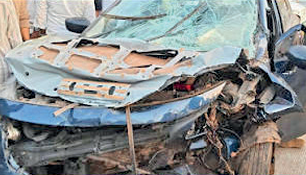
The hidden hand of the international market is making its impact felt deep in the interiors of Goa. With amazing regularity, accidents and deaths are being reported from the mining belt.
With every upward revision in the price and demand for ore, there is a further mad rush in interior Goa. Companies involved in mining are happy with the situation, and so are the locals who get transport contracts, or jobs. But the security and safety of the local communities cannot be taken for granted, regardless for how good the money might be for those in this business.
Media reports from the area have already blamed the police for turning a blind eye to the situation. Our politicians have more than let down the citizen. Even if it is hardly a secret that quite a few politicians have open — or not-so-open — stakes in the mining industry, including some as transport contractors, the class of elected politicians can hardly absolve themselves of their responsibility here.
Goa has seen more than an ore rush in recent years. GMOEA, the ore exporters’ body, points out that just approx 40,000 tonnes or ore were exported via Mormugao port in the 1940s. This touched 45.93 million tonnes in 2008-09, both ore of Goan and beyond-Goa origin. In the early 1960s, ore exports earned exporters around Rs 18.31 crore. Nearly five decades later, it earned its exporters — all in private hands — Rs 7400 crore, again to cite GMOEA figures.
Exporters have to spend more to build safety mechanisms in place. In the rush to make the fast buck, basic safety cannot be overlooked. There are much more critical voices highlighting the impact of mining now, than anytime in the past. Mineowners should see the writing on the wall, not attempt to merely blame “illegal” mining, and those contracted by them to carry the ore.
Citizens have become sharper in highlighting the price they pay for living around the ore-rich soil that Chinese and global economic growth is hungry for. For a change, fewer newspapers now are directly linked to the mining industry — the impact of which Herald has been long willing to focus on. At the same time, citizens are using new technologies, including GoogleMaps, to build awareness over the situation. For the officials to take on an ostrich-like attitude is an exercise in self-delusion.
Slow on education
Pondicherry (or, the Union Territory of Puducherry/Territoire de Pondichér) is comparable to Goa, specially in scale. Like Goa too, it has a different colonial history from the British link most of India shares.
Pondicherry is itself fast becoming an educational hub of southern India. It now has one central university, eight medical colleges, ten engineering colleges, three dental colleges, two law colleges, one veterinary college, one agricultural college, ten arts and science colleges, and five polytechnics. Other medical and engineering colleges, including one national institute of technology and a state-owned university, are believed to be in the queue! For the record, Pondicherry has a total are of just 492 km2 (190 sq mi) — spread out over Pondicherry itself, Karaikal, Mahéand Yana — and around a million inhabitants. If so few can sustain so many educational initiatives, then Goa indeeds has to think hard, and think fast.
But, while Pondicherry is seeing fast growth on this front, Goa is very reticent about encouraging a growth in its educational facilities. We shoot ourselves in the foot with arguments like “where will our youth get jobs” if we educated them well. This is a bizarre approach. Jobs, self-employment and creative endeavours will come only after our young people access good education. Even centres like Mangalore are finding it apt to lure students from Goa for courses offering degrees ranging from physiotherapy, to audiology and nursing.
Surely, Goa needs to learn from South India and build more institutions of its own. Even with limited students of our own, building educational capacity does make sense. Goa could be an educational hub. Certainly, Goa can do it. But only if there is the vision.