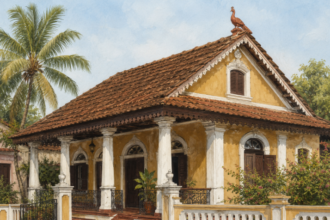
When a plague struck the City of Goa in 1570, the Jesuits were compelled to abandon the College of Saint Paul and relocate westwards. On the ruins of an old house situated on the Holy Mount, they built a new institution that became known as the New College of Saint Paul, later more commonly referred to as the College of Saint Roque.
The original house on the site had been constructed in 1524 by Pedro de Faria, a former captain of Malacca. It was later inherited by Dom Francisco de Marques Botelho, who sold it to the Jesuits in 1579. Initially, the Jesuits used this property as a sanatorium until 1585, when it was converted into a professed house with a novitiate. In 1610, the building was transformed into a college and officially named the New College of Saint Paul.

The newly built four-storied structure soon became renowned for its grand and distinctive architectural design. It stood as the largest religious edifice in the City of Goa. Within the College complex was a chapel dedicated to Saint Roque, which gave the institution its popular name. Additionally, the College included chapels honoring Our Lady of Conception and Saint Paul.
However, the Jesuits faced strong opposition from neighboring religious groups, especially the Augustinians, who had settled in Goa in 1572. The dispute was eventually resolved by the Government in Lisbon, which granted the Jesuits permission to construct the College, but under specific conditions. The new building was not to obstruct light, air, or the sea view enjoyed by adjacent properties, nor was it to serve as a church with confessionals. Furthermore, the Jesuits were restricted in their preaching: they could only deliver sermons on the feasts of Saints Peter and Paul, Our Lady of Conception, and those of the Society of Jesus. They were forbidden from preaching during Lent or on regular Sundays throughout the year.
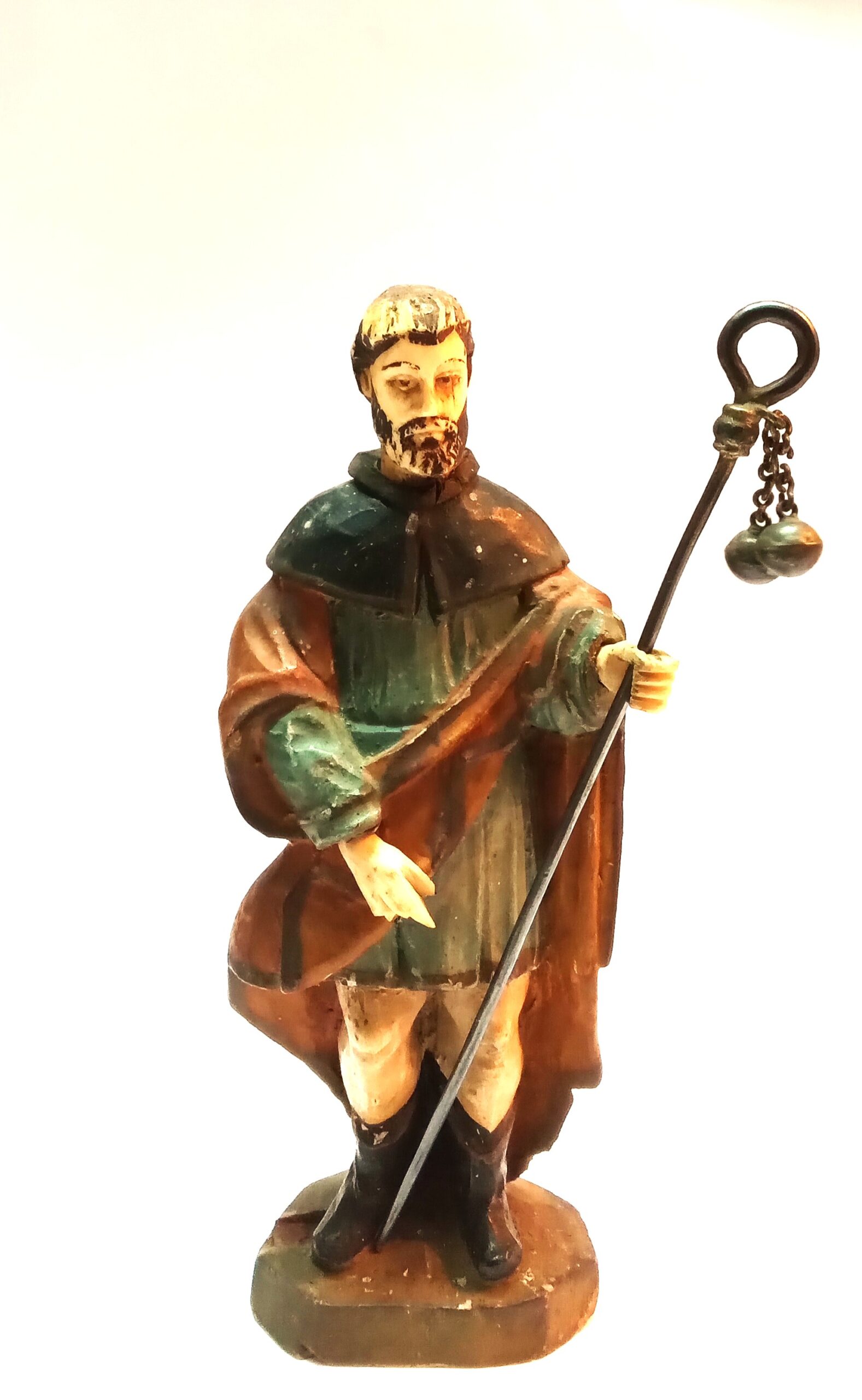
Saint Roque | Polychrome wood,bone & silver |19th Century | Private collection
The College of Saint Roque suffered a series of devastating fires over the years. In 1591, the novitiate was completely destroyed by fire. On June 26, 1617, another blaze consumed the College, claiming the life of Fr. Jerónimo Xavier, the great-grandnephew of Saint Francis Xavier. The building caught fire again on December 11, 1663, and yet again on January 6, 1675, when its roof was destroyed. Finally, in 1690, a lightning strike delivered the fatal blow to the church, marking the tragic decline of this once-magnificent institution.
By the end of the seventeenth century, the College housed 70 priests, while 25 more resided in the adjoining Professed House. Following the suppression of the Jesuits in 1759, the College was shut down. The premises were then taken over by the Royal Hospital, before its relocation to Panelim. Some years later, the same building served as military barracks.
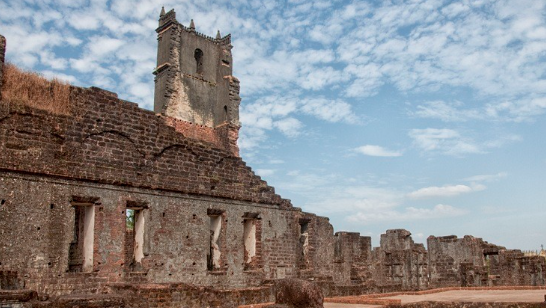
Towards the end of the eighteenth century, the structure began to deteriorate, and the government declined to allocate funds for its maintenance. The grand building gradually fell into ruin and eventually disappeared entirely. Its construction materials were later reused to build the military barracks in Panjim. Today, no trace remains of the once-glorious College of Saint Roque.