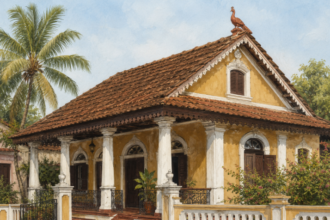
The site where the Basilica of Bom Jesus and the Professed House now stand was once called Terreiro dos Galos, a name derived from the cockfights held there that drew large crowds. These contests were banned in 1549 by the Viceroy, Matias de Albuquerque.
The Jesuits, who first arrived in Goa in 1542, owned four major establishments in Old Goa: the Collegio de S. Paulo, the Church of Bom Jesus with its adjoining residence, the Church of St. Roque with the Novitiate house, and a recreation house adorned with lovely fountains. Opinions varied regarding the need and placement of the Professed House, in relation to the College of St. Paul where the senior Jesuit authorities and professed members then resided. In 1583, General Father Mercurian tasked Provincial Alessandro Valignano with making the final decision after consulting his companions.

Although the Franciscans were the first religious order to arrive in Goa, rivalry soon developed once the Jesuits settled there. The Franciscans planned to build a convent for sisters on the very site chosen for the Professed House. However, the Jesuits refused to yield, and local authorities sided with them, leaving the Franciscans to appeal unsuccessfully to King Filipe I of Portugal.
Due to such disputes, Rome had long established mandatory distances between churches and convents known as inter cannae, one canna being roughly 2.5 meters. Pope Clement IV first set this distance at 300 cannae in 1256; by the 16th century, it had been reduced to 140 cannae.
The Jesuit headquarters in Rome sent architectural plans for the Casa Professa, but the Jesuit Provincial in Goa found them unsuited for local conditions. He opted instead for a European-style design adapted by the Italian architect Giovanni Battista Cairato. Construction was overseen by Brother Domingos Fernandes and chief engineer Júlio Simão of the Estado da Índia, assisted by Brother Luís Castanho and mason Diogo Ferrão. After the Jesuits’ expulsion, the Vincentians established a seminary in the building.
When construction of the Professed House began in 1585, fierce opposition arose from the Senate, the Santa Casa de Misericórdia, and the Franciscans. Had it not been for a clever maneuver by the Jesuits, their project would likely have been abandoned. Nevertheless, they were already residing there by January 12, 1586. The present structure represents only part of the original, which was destroyed by fire in 1663, rebuilt, and later damaged again by another blaze. The Professed House gained great significance as the residence of the Jesuit Provincial, senior members, and professed priests.
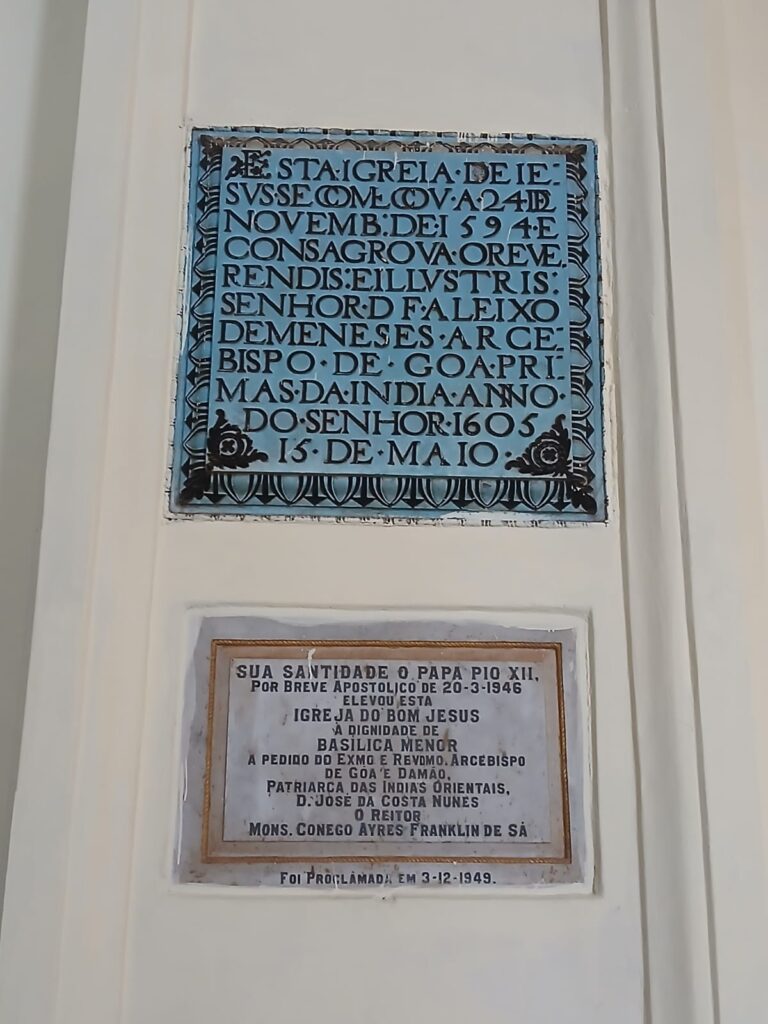
Attached to this residence stands the renowned Basilica of Bom Jesus, which enshrines the relics of St. Francis Xavier. Its foundation was laid in 1594, and it was consecrated in 1605 by Archbishop D. Fr. Aleixo de Menezes. Pope Pius XII elevated it to the rank of Minor Basilica in 1946. The church and adjoining residence were constructed under the direction of Brother Domingos Fernandes, assisted by Júlio Simão. Following the Jesuit expulsion in 1759, the property came under the Archbishop’s care; later, it housed a seminary. When that seminary closed, administration passed to a Canon, and today, it is managed by an Administrative Committee appointed by the Archbishop.
This church, built without a vault and designed with a single nave, faces west with an ornate façade featuring three graceful porticos surmounted by three large windows, three circular openings above them, and a richly decorated quadrangular top section bearing the Jesuit emblem. The façade blends five architectural styles: Ionic, Tuscan, Corinthian, Doric, and Composite.
At the entrance, two pillars hold up the choir loft, which bears two inscriptions one in Portuguese and one in Latin, recording the church’s foundation on November 24, 1594, and its consecration by Archbishop Aleixo de Menezes on May 15, 1605.
Near the pulpit stands the tomb of Dom Jerónimo Mascarenhas, founder of the church. Its bronze-gilt apex rests on two lion figures. Four relief panels depict his military exploits, and an inscription honors him as the former Captain of Cochin and Ormuz, noting that the church was built at his expense and dedicated to him by the Jesuits, who recorded his death in 1593.
The grand pulpit on the right side displays sculptures of the four Evangelists and four Doctors of the Church in bold relief, supported by seven figures representing the sacred number seven in Scripture. The church measures 65.1 meters in length and 40.6 meters in width at the transept.
The main altar features a gilded altarpiece with a 2.86-meter statue of St. Ignatius of Loyola, founder of the Jesuit order. Depicted in priestly vestments, his right hand raised and gaze lifted heavenward, he is shown at the moment of his exclamation, “How the earth disgusts me when I look toward heaven.” Below lies a later-added image of Bom Jesus, and above, a sculpture of the Holy Trinity with the Jesuit emblem beneath it.
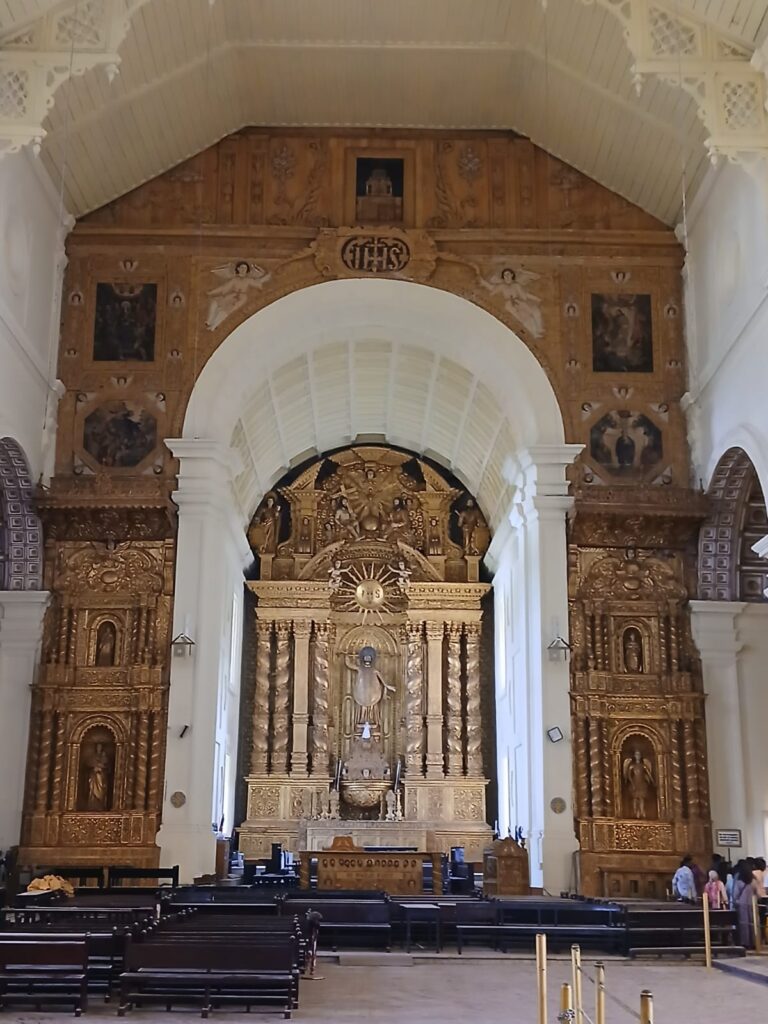
The side altars are dedicated to St. Michael and Our Lady of Hope. Each arm of the transept has a vaulted chapel: the left once honored St. Francis Borgia, patron of Portugal and its colonies, and the right enshrined St. Francis Xavier. In 1622, St. Francis Borgia’s image was moved to the side altar, while Xavier’s relics were placed in his chapel. In 1655, these relics were permanently installed in their current chapel, and the tabernacle formerly there was moved to the Borgia Chapel.
From 1779 onward, the cerimonia de posse the installation ceremony of the Viceroys and Governors took place in this church. During this ritual, the Bishop solemnly handed the staff of office to the Governor, who would return it at the end of his tenure.
The passage leading to the sacristy features nine beautiful canvases. The richly carved teak door of the sacristy depicts Saints Peter, Paul, Ignatius, and Xavier in deep relief, surrounded by intricate foliage patterns. This sacristy, the largest and most ornate in Goa, has a vaulted ceiling with fine stucco work and contains eight elaborately carved black-wood chests with gilt label plates. The current sacristy replaced an earlier one in 1653. Inside are twelve painted wooden panels of the Apostles, among other artworks, commissioned by Fr. Gonçalo Martins and painted in Cochin.
A pure silver statue of St. Francis Xavier, crafted in 1670 and gifted by Francisca Sopranis of Italy, stands there. She offered 4,800 xerafins toward its creation as a votive gift, with additional expenses met by Provincial António Botelho. The bust of this statue was featured on a special Indian postage stamp issued during the 1974 Exposition along with the silver casket.
The inscription on its pedestal reads in Latin, dedicating the statue to “the most holy Apostle of the Indies” by Francisca de Sopranis, a Genoese noblewoman and wife of Urbano Durati, who later became a nun known as Maria Francisca Xaveria at the Monastery of the Incarnation.
At the end of the sacristy lies the Chapel of Our Lady of Sorrows, adorned with azulejos tiles brought from the sacristies of the Churches of St. Francis of Assisi and St. Augustine. This chapel was funded by Baltazar da Veiga of Lisbon.
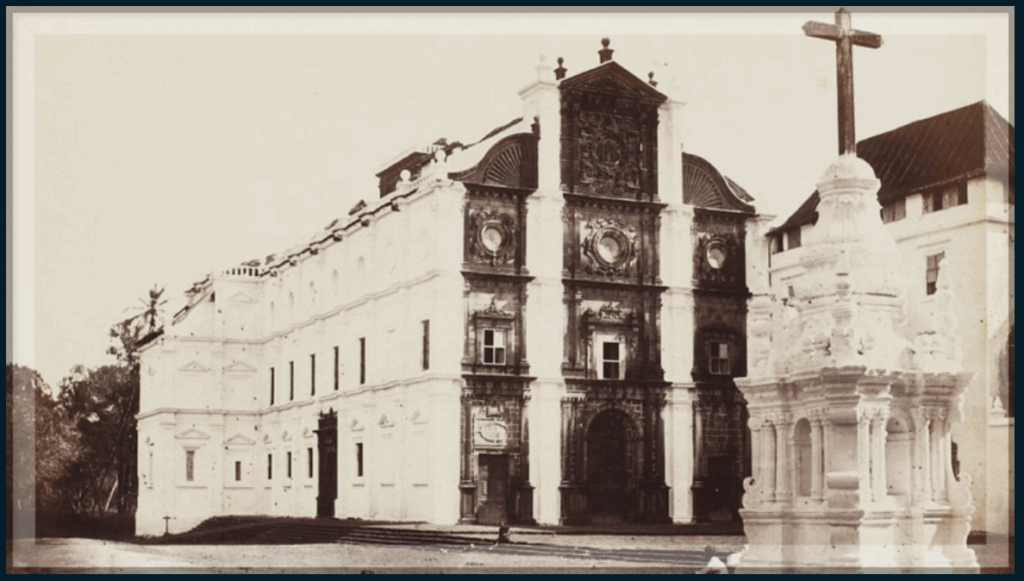
The flying buttresses, on the northern side of the basilica were incorporated during the latter part of the 19th century. In the early 1950s, the renowned Portuguese restorer Baltazar da Silva Castro undertook the significant task of removing the white plaster from the basilica, resulting in a striking alteration of its external façade by revealing the underlying laterite stone.