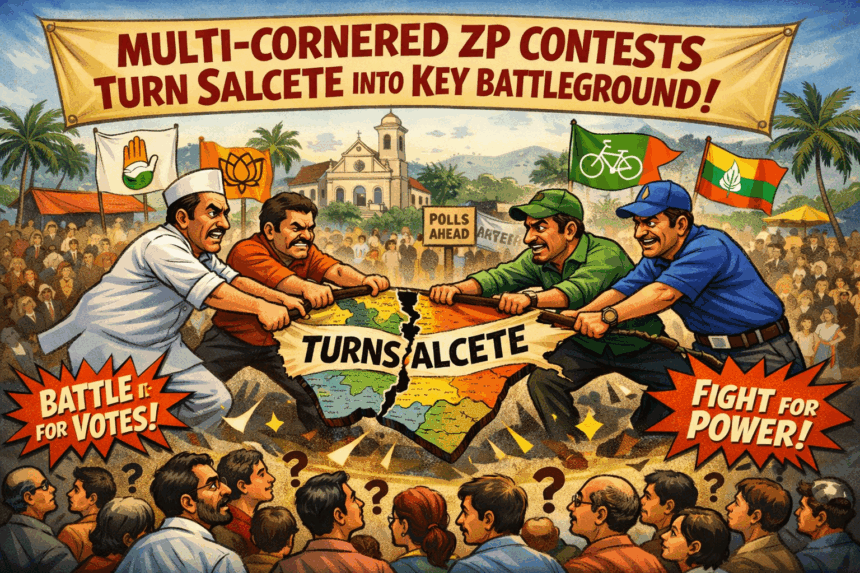
The zilla panchayat (ZP) battle in Salcete has emerged as one of the most complex and closely watched con tests in the ongoing local body elections, with frag mented fights, prominent candidates and competing party strategies converging across all nine constituen cies in the taluka. What distinguishes Sal cete from many other re gions is the absence of straightforward two-way contests. Instead, most seats are witnessing trian gular — and in some cases multi-cornered — battles involving the Congress, the Goa Forward Party (GFP), the Aam Aadmi Party (AAP), the BJP, and a clutch of influential independents, making outcomes difficult to predict. A key factor reshaping the contests is the understand ing between the Congress and GFP, under which the Congress is contesting eight of the nine seats while ced ing Raia to GFP. In Raia, the GFP candidate faces a stiff challenge from AAP and in dependents, turning what might otherwise have been a straight fight into a tightly contested triangular battle. In constituencies such as Nuvem, Colva and Curtorim, the Congress finds itself locked in three-cornered contests with AAP and inde pendents, with local equa tions and candidate profiles expected to play a decisive role. Benaulim, meanwhile, has drawn attention due to the presence of multiple parties and independents, including candidates with past political experience, raising the likelihood of sig nificant vote-splitting. Velim and Davorlim are also shaping up as com petitive seats, with AAP attempting to expand its footprint while the Con gress seeks to consolidate its traditional support base. In Guirdolim, where the BJP had secured a win in the previous ZP elections, the party is focused on retain ing the seat amid resistance from Congress-backed can didates and independents. Beyond constituency-level arithmetic, parties are view ing Salcete as a crucial politi cal test. The Congress, which has historically dominated the taluka, is keen to demon strate that its improved per formance in the recent Lok Sabha elections can be rep licated at the ZP level. Party leaders see Salcete as central to reinforcing claims of reviv al in South Goa. The GFP, for its part, is treating Raia as a symbol ic battleground, with a win there seen as a breakthrough in a taluka long dominated by larger parties. The party has projected the contest as a test of its relevance within alliance politics, particularly in its core belt. AAP is approaching Sal cete with a dual objective — defending constituencies where it has already made inroads and expanding into new areas such as Colva, Nu vem and Velim. Its campaign has focused on local issues and anti-establishment sen timent to counter the Con gress–GFP understanding. The BJP, while not con testing all seats directly, has adopted a selective and targeted strategy in Salcete. With senior leaders, includ ing Chief Minister Pramod Sawant, campaigning in the taluka, the party is focused on retaining seats such as Guirdolim and Davorlim, while extending support to friendly independents else where. Adding further complex ity are candidates from smaller parties such as the Revolutionary Goans Party (RGP) and the Nationalist Congress Party (NCP), along with independents, some of whom have previously served as ZP members or chairpersons. Their ability to attract personal votes is expected to influence out comes, particularly in close ly fought constituencies. As campaigning inten sifies, Salcete has come to represent more than just a cluster of nine ZP seats. The results here are likely to be read as an indicator of shift ing political alignments, the effectiveness of alliance strategies and the extent to which emerging parties can challenge established players. With opposition strength spread across multiple par ties rather than concentrat ed in one, Salcete reflects a divided and competitive political landscape. Wheth er this fragmentation bene fits the Congress, challeng ers such as AAP and GFP, or enables the BJP to retain pockets of influence will only become clear when the votes are counted.
Activists urge voters to treat ZP polls as crucial test for Goa

Civil society members have appealed to voters to approach the up coming Zilla Panchayat (ZP) elections with seriousness, describing the December 20 polls as a decisive moment that could shape Goa’s polit ical direction in the run-up to the 2027 Assembly elections. At a media interaction, the speakers stressed that they were neither endorsing nor opposing any candidate, but were urging voters to make informed choices based on integrity, accountability and commitment to protecting Goa’s land, environment and social fabric. Adv Pratima Coutinho also spoke at the briefing. Social activist Fr Eremito Rebello said recent develop ments had damaged Goa’s image at the national level, pointing to governance fail ures highlighted by incidents such as the Arpora fire. He said the situation reflected deeper systemic problems and called on citizens to elect representatives who would work sincerely for the state’s long-term welfare. Rebello maintained that the respon sibility lay with voters to independently assess who deserved to represent them. Konkani artiste Rajdeep Naik said corruption and a weakening law-and-order environment had further eroded public confidence. He alleged that intimidation and violence were increas ingly being used against those who raised their voic es against wrongdoing. Em phasising the importance of the ZP elections, Naik warned voters against treat ing the polls casually, saying decisions taken now would have a direct bearing on the political outcome in 2027. Drawing a sporting anal ogy, Naik likened the ZP elections to a qualifying match, saying Goa could not afford to falter at this stage if it hoped to move towards cleaner governance. He urged voters across religious and social communities to reflect carefully on whether their chosen representa tives would stand with them when it mattered most. Activist Anthony D’Silva raised concerns over the state government’s Mhaje Ghar scheme, alleging that it legitimised illegal encroach ments on government and Comunidade land. He ques tioned whether law-abiding citizens, who had followed due process to purchase land and build homes, were being disadvantaged for ad hering to the law, while vio lators were rewarded. D’Sil va urged voters to factor in the broader implications of such policies while casting their ballots.