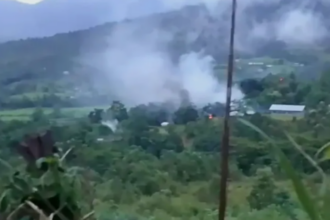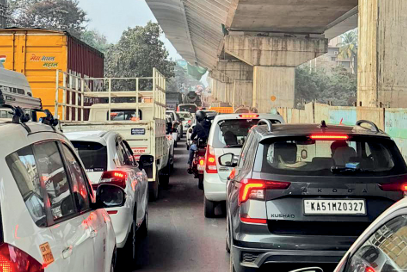
Daily commut ing on the Panjim–Ma pusa stretch has turned into a grinding ordeal, with chronic congestion, choking dust and cha otic traffic management testing the patience and health of motorists and residents alike. What is already one of North Goa’s most stressful cor ridors is now set to face even greater strain with the closure of two key road stretches under Phase-I infrastructure works from January 2 to March 2, 2026. Long queues of vehicles routine ly clog the Porvorim stretch, reducing peak hour movement to a crawl. The situation is aggra vated by loose soil and exposed surfaces along the construction zone, with continuous vehicu lar movement throwing up thick clouds of dust that linger in the air for hours.
Two-wheeler riders and pedestrians are among the worst affected, reporting breathing difficulties and eye irritation, while residents complain of deteriorating air quality and persistent discomfort. Traffic conditions deteriorated sharply on New Year’s Eve as festive traffic and tourist movement poured onto an already burdened highway. The failure of traffic sig nals at the O’Coqueiro junction brought traffic to a near standstill, while the presence of just two traffic police men proved woefully inadequate to manage the volume. Vehicles spilled onto road shoulders, compounding safe ty risks and prolonging delays. Motorists reported extended bottlenecks between Mall de Goa and the O’Coqueiro junction in both di rections, while CHOGM Road also witnessed bump er-to-bumper traffic as revelers headed towards the coastal belt. What should have been routine journeys stretched into long, exhausting waits. “I had to cross Porvorim on New Year’s night, and the situation was completely chaotic. The signals were not working, and there were only two policemen at the O’Coqueiro junction. There were three to four rows of vehicles on both sides of the road, and some people were even using the shoulders. It was dangerous — any one could have fallen,” said Panjim resident Antony Fer nandes. For daily commuters, the problem is no longer occa sional but relentless. Meghna Shirodkar from Guirim, who travels to Panjim every day, described the worsen ing conditions: “There is a lot of dust. I cover my face to avoid breathing it in and have to wash my clothes daily because they get dirty. The stretch from Majestic Pride to the O’Coqueiro junction is the worst affected. Some times it takes 30 to 45 minutes to cover a distance that would otherwise take just five to ten minutes.” The impact extends beyond commuters. Business es along the stretch say operations have been hit hard since flyover construction began. A restaurant owner said dust accumulation and reduced road width have made it difficult to function. “There is a lot of dust, and we have to clean tables frequently. The road width has been reduced, and there is no space for parking. We hope the work is completed soon,” he said. Evening hours remain the most punishing. “The jam usually starts around 4 pm and continues till about 8 pm. With it being the tourism season, the number of ve hicles has increased. More traffic police are needed to regulate traffic and control unruly motorists,” said Jiten dra Kumar, a security guard posted in the area. Amid these conditions, the North Goa Collector has an nounced the closure of two road stretches under Phase-I works from January 2 to March 2, 2026 — a move that has raised serious concerns among commuters and trade bodies. The closures cover the stretch from P16 near ODP Road to P20 near Daman de Goa, and from P61 near Kadamba Restaurant to P55 near the O’Coqueiro junction at Porvorim. While one lane will remain open for traffic from Mapusa to Panjim, restrictions on heavy vehicles and narrowed carriageways are expected to in tensify congestion. Although emergency lanes have been earmarked and contractors directed to deploy traffic marshals, com muters fear these measures may fall short on a corri dor that already struggles under daily traffic volumes. Diversion routes are to be kept motorable, and bridge segment transport will be restricted to non-daytime hours, but the effectiveness of on-ground enforcement remains a concern. Reflecting wider anxiety, the Goa Chamber of Com merce and Industry has urged the district administra tion to defer the closure until January 5, warning that any disruption during peak tourist movement could severely damage traffic flow and Goa’s tourism image. The chamber has pointed out that the Porvorim–Mapu sa road is a critical arterial link to Mopa International Airport, major tourism hubs, Thivim railway station and interstate routes. With congestion already crippling daily life on the Panjim–Mapusa stretch, commuters now brace for a tougher two months ahead — fearing that without ro bust traffic management, the closures could push an al ready overstretched corridor into near gridlock.