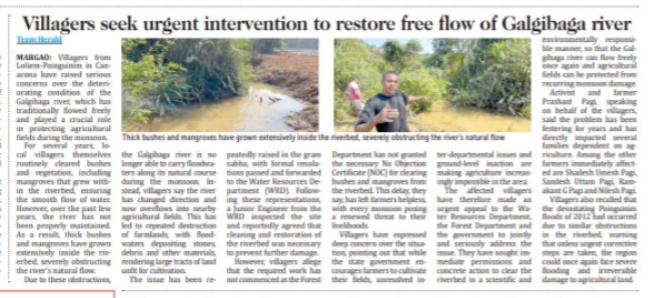
Villagers from Loliem-Poinguinim in Canacona have raised serious concerns over the deteriorating condition of the Galgibaga river, which has traditionally flowed freely and played a crucial role in protecting agricultural fields during the monsoon.
For several years, local villagers themselves routinely cleared bushes and vegetation, including mangroves that grew within the riverbed, ensuring the smooth flow of water.

However, over the past few years, the river has not been properly maintained. As a result, thick bushes and mangroves have grown extensively inside the riverbed, severely obstructing the river’s natural flow.
Due to these obstructions, the Galgibaga river is no longer able to carry floodwaters along its natural course during the monsoon. Instead, villagers say the river has changed direction and now overflows into nearby agricultural fields. This has led to repeated destruction of farmlands, with floodwaters depositing stones, debris and other materials, rendering large tracts of land unfit for cultivation.
The issue has been repeatedly raised in the gram sabha, with formal resolutions passed and forwarded to the Water Resources Department (WRD). Following these representations, a Junior Engineer from the WRD inspected the site and reportedly agreed that cleaning and restoration of the riverbed was necessary to prevent further damage.
However, villagers allege that the required work has not commenced as the Forest Department has not granted the necessary No Objection Certificate (NOC) for clearing bushes and mangroves from the riverbed. This delay, they say, has left farmers helpless, with every monsoon posing a renewed threat to their livelihoods.
Villagers have expressed deep concern over the situation, pointing out that while the state government encourages farmers to cultivate their fields, unresolved inter-departmental issues and ground-level inaction are making agriculture increasingly impossible in the area.
The affected villagers have therefore made an urgent appeal to the Water Resources Department, the Forest Department and the government to jointly and seriously address the issue. They have sought immediate permissions and concrete action to clear the riverbed in a scientific and environmentally responsible manner, so that the Galgibaga river can flow freely once again and agricultural fields can be protected from recurring monsoon damage.
Activist and farmer Prashant Pagi, speaking on behalf of the villagers, said the problem has been festering for years and has directly impacted several families dependent on agriculture. Among the other farmers immediately affected are Shailesh Umesh Pagi, Sandesh Uttam Pagi, Ramakant G Pagi and Nilesh Pagi.
Villagers also recalled that the devastating Poinguinim floods of 2012 had occurred due to similar obstructions in the riverbed, warning that unless urgent corrective steps are taken, the region could once again face severe flooding and irreversible damage to agricultural land.