Vivek Menezes
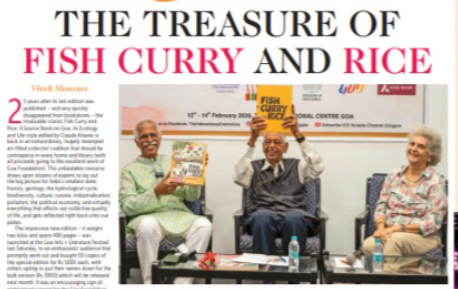
25 years after its last edition was published – and very quickly disappeared from bookstores – the invaluable classic Fish Curry and Rice: A Source Book on Goa, its Ecology and Lifestyle, edited by Claude Alvares, is back in an extraordinary, hugely revamped, art-filled collector’s edition that should be the centrepiece in every home and library (with all proceeds going to the excellent work of the Goa Foundation). This unbeatable resource draws upon dozens of experts to lay out the big picture for India’s smallest state: history, geology, the hydrological cycle, biodiversity, culture, cuisine, industrialisation, pollution, the political economy, and virtually everything that affects our collective quality of life and gets reflected right back onto our plates.

The impressive new edition – weighing two kilos and spanning 400 pages – was launched at the Goa Arts + Literature Festival last Saturday to an enthusiastic audience that promptly went out and bought 50 copies of the special edition for Rs 5000 each, while others opted to put their names down for the bulk version (Rs 3000), which will be released next month. It was an encouraging sign of widespread support for the Goa Foundation and also for this wonderful new book, which the distinguished ex-chief Town Planner of India, the nonagenarian Edgar Ribeiro, aptly called “a masterpiece” while launching it. The audience was informed that if this print run sells out in full, the Goa Foundation has enough funds for the next two years. Let us hope that happens right away.
Alvares’s introduction lays out the scope of his book: “Goa is nothing less than a great work of art, created over centuries by an amazing community of ordinary individuals who not only understood their environment but worked within the limits it imposed to generate an economy with in-built intergenerational equity concerns. Throughout the centuries of Goa’s existence, its inhabitants have in fact interacted intricately and wisely with the demands of their ecosystems. For instance, through the engineering marvel of the khazans, they effectively managed the issue of saline water intrusion, a natural occurrence in tidal rivers, into low-lying lands by creating an intricate system of embankments or bunds using local materials, including chikol or mud. Those bunds enabled the crabs to populate.”
Up and down Goa’s oceanfront, writes Alvares, “they strategically located their residential buildings behind the lines of sand dunes. On the entire South Goa coast, for example, no Goan erected any house within 500 metres of the high tide line. No Goan constructed their homes on hill slopes or on top of hills or plateaus. The sand dunes were left untouched. So were the rivers. No one even thought of interfering with the Western Ghats. Goans rarely experienced the water shortages that we face today because they intelligently created and maintained water harvesting systems based on topography. Every home had a well. Many still do. In short, they knew the art of survival while being environmentally conscious. This approach benefited both nature and human industry, as it enabled each to flourish. Consequently, when Goa became a part of India in 1961, it was the country’s greenest state, impressing all those fortunate enough to witness its natural beauty and the society it harboured, composed everywhere of hospitable folk, the sine qua non of any successful tourism industry.”
But here is the kicker: “It is all these principal elements of Goan life that have come under gross attack from one quarter or another ever since ‘development’ was sought to be introduced in this small state.” Fish Curry and Rice is great in many different ways and one of a kind in how it can be read as a guidebook to this moment, and the gloriously inclusive progressive movement that the Goa Foundation and Claude and Norma Alvares have nurtured around them over the past 40 years. There is an entire legion of contributors – even I am one of them, writing about the cultural history of Goan mangoes – and the sum of their efforts is notably vibrant, joyous, polyphonous, yet irreducibly united. I especially love the careful use of excellent original artworks by the fabulously effective Amchem Mollem crew, providing emotional depth to the hard-hitting analysis and data on land use and laws.
This book is urgently meant to be used and reiterates that point on its last page, entitled simply “Enough is Enough!” It carries a photo of Justice Ferdino Rebello, who has been holding meetings about his ten-point Citizen’s Charter, saying he wanted to know how building permissions could be given in villages where the government today is unable to supply water for even a few hours. He asked how fields could be sacrificed for construction when there was a ban on their diversion. He wanted to know why the government was departing from the land use notified in the statutory Regional Plan 2021 and who had given it the authority to do so. The learned judge weighed heavily against the desecration of Goa’s precious hill slopes, again to achieve nothing better than the construction of buildings built for purposes of speculation and profit. It appears the citizens of Goa have decided that neither their politicians nor their present government will be the face of the state. A citizens’ movement (remember the Constitution’s “We the People”) will now stand as a bulwark against wholly destructive despotism.