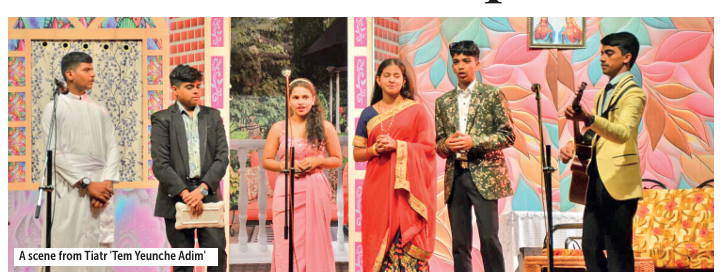
A total of eight troupes participated in the recently concluded 13th Children’s Tiatr Competition organised by the Tiatr Academy of Goa (TAG) and held at Ravindra Bhavan, including one institutional entry. Out of the eight performances, two children’s tiatrs, ‘Melody’ by William Fernandes and ‘Tem Yeunche Adim’ by Pio Esteves, were declared disqualified by TAG. Tiatr ‘Melody’ was disqualified due to participation of “overaged” children, while tiatr ‘Tem Yeunche Adim’ was disqualified because one song had earlier been presented at a singing competition organised by TAG. This action was taken despite the tiatr featuring 14 songs instead of the mandatory 12 kantars. Prior to the competition, TAG convened a meeting of all participating directors. It was unanimously decided that the age limit be raised from 16 to 17 due to the unavailability of children. Directors were also instructed to submit their scripts, lyrics of all songs, and birth certificates of participants a week before the competition. A scene from Tiatr ‘Tem Yeunche Adim’ However, the two tiatrs were disqualified only after being staged, resulting in injustice to children who sacrificed nearly a month of study time for rehearsals. In the case of Tiatr ‘Melody’, the director was informed about the disqualification when the troupe was leaving from Sanvordem to perform at Vasco. For Tiatr ‘Tem Yeunche Adim’, the entire troupe was disqualified because one song had earlier been performed at a TAG singing competition. As per point 7 of the scheme: “scripts of tiatr and lyrics of songs performed at TAG’s interschool/collegiate tiatr competition will not be permitted.” However, the song in question was not presented at any interschool/ collegiate tiatr competition, but at a TAG duo/ duet/trio/choral singing competition. Rule 7 does not specify that such a case warrants disqualification of the entire tiatr. Critics argue that TAG must clarify this ambiguity. Another issue raised was the participation of institutions such as schools in the general children’s tiatr competition. TAG already organises annual school and college-level tiatr competitions to promote tiatr among students. Observers question why institutions should again compete in a general children’s competition.
Expressing his resentment, William Fernandes, one of the directors whose tiatr was disqualified, said, “Although I had submitted my script and the birth certificates of all the participants on February 2, the TAG officials informed me about two overaged actors only on February 5 at 11 am, on the day of the performance, while our troupe was leaving to perform at Vasco. Is it right on the part of the administration to inform the participant at the last minute? Or was it a deliberate act?” “Nowhere in the rules and regulations is it mentioned that a troupe has to be disqualified. Where is it written that all the young children who worked hard to perform are barred from winning individual prizes?” Fernandes further asked. “It is disheartening for the young children who performed their best and received nothing in return.” Tiatr journalist from Vasco, Daniel F de Souza, stated that the general rules for the children’s tiatr competition should not be too stringent if the aim is to encourage youngsters. “Such an action will only deter scouting new talent and bringing them on stage. Rule 7 in particular needs to be toned down, at least regarding songs. What is the harm if participants present songs earlier performed at the inter school/inter-collegiate TAG singing competition? Both sections are separate,” he said. “And why should the entire tiatr be disqualified under this clause?” de Souza asked. “At most, that particular song and singer could be A scene from Tiatr ‘Melody’ made ineligible for awards. TAG cannot overlook the hard work of the writer, director and producer, along with the financial implications involved in staging the tiatr. Any anomaly should be detected at the scrutiny stage when scripts and lyrics are submitted.” Tomazinho Cardozo, founder President of TAG and instrumental in introducing the children’s tiatr competition during his tenure, also questioned the decision. “It was brought to my notice that because one kantar, sung earlier in a TAG competition, was later presented in the tiatr, the tiatr was outright disqualified. This is surprising,” he said. Cardozo explained that tiatrs are evaluated out of 300 marks. Of these, 200 marks are allotted to story, direction, acting, background music, light effects and stage sets. The remaining 100 marks are for songs. With 10 to 12 songs in a tiatr, each song carries roughly 8 to 10 marks. “If one kantar was repeated or not as per rule 7, disqualifying the entire tiatr is not correct and goes against evaluation norms. One kantar accounts for barely 8 to 10 marks out of 300. Does that justify discarding the remaining 290 marks awarded for performance and other aspects?” Cardozo asked.

He suggested that rule 7 be modified so that one or two songs cannot result in complete disqualification. “Such an attitude will destroy the creativity and imagination of directors and young artistes whom TAG seeks to promote,” he said. Veteran tiatrist Bonny Pereira from Colva, who served as a judge for the Popular Tiatr Festival organised by TAG some years ago, recalled, “Prince Jacob was then the president of TAG, but despite winning prizes earlier, he refrained from participating in that particular festival. I saluted him for that wise decision.” Fr Doel Dias, an executive member of TAG, acknowledged that several schemes introduced during the tenure of the first president, Tomazinho Cardozo, were never revised. “The process of revising and rectifying the rules of all the schemes is underway by TAG now and should come to an end shortly,” he said.