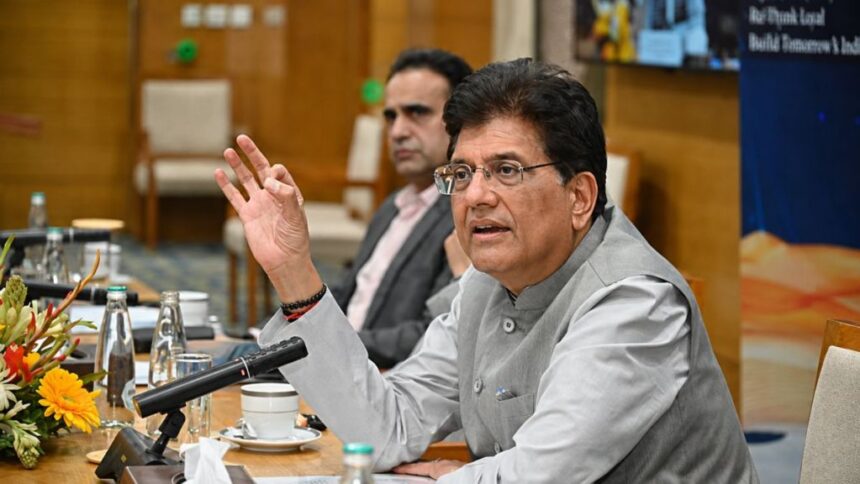
India has firmly ruled out supporting the creation of a common BRICS currency, reiterating its preference for settling international trade in national currencies instead of adopting a unified monetary system for the bloc.Commerce and Industry Minister Piyush Goyal made the government’s position clear after the conclusion of the two-day BRICS Trade and Industry Ministers’ Meeting in Jaipur on Friday. Addressing reporters, Goyal categorically stated that New Delhi does not support any proposal to introduce a common currency among BRICS nations.
“India is not in favour of a BRICS currency. We do not support the introduction of any such BRICS currency scheme; India opposes it,” Goyal said.Instead, India continues to advocate the internationalisation of the Indian Rupee (INR) and encourages bilateral trade settlements in local currencies. According to the government, this approach reduces dependence on third-country currencies while allowing individual nations to retain control over their monetary policies and financial systems.The issue has gained momentum as BRICS has expanded well beyond its original five members—Brazil, Russia, India, China and South Africa. The grouping now includes Egypt, Ethiopia, Indonesia, Iran, Saudi Arabia and the United Arab Emirates, making it one of the world’s most influential economic blocs with a significant share of global trade, population and energy resources.

The bloc’s expansion has also intensified discussions around de-dollarisation, with some member countries, particularly Russia and China, advocating a common BRICS currency to reduce reliance on the US dollar and minimise exposure to Western financial sanctions.India, however, has consistently maintained a cautious stance. While supporting greater use of national currencies in cross-border trade, New Delhi remains reluctant to back a shared currency, arguing that countries with diverse economic structures and monetary priorities are better served by retaining independent control over their financial systems.