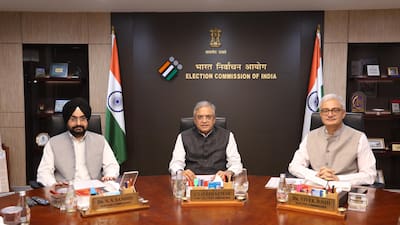
The Election Commission of India (ECI) moved decisively to quell weeks of speculation regarding internal friction, convening a full-member meeting at Nirvachan Sadan in New Delhi. Chief Election Commissioner Gyanesh Kumar, along with Election Commissioners Sukhbir Singh Sandhu and Vivek Joshi, sat together for a strategic review and subsequently issued a detailed press release addressing allegations about the commission’s operational integrity.
The high-profile meeting followed intense public scrutiny sparked by media reports that the two accompanying commissioners had previously registered objections on record regarding several key administrative decisions and the ongoing Special Intensive Revision (SIR) of electoral rolls. To counter narratives of an institutional breakdown, the commission firmly asserted that all critical directives—including the initial rollout and schedules of the SIR across various states and Union Territories—were adopted with unanimous consensus.

To address specific procedural concerns raised during the controversy, the ECI provided a point-by-point clarification:
- Form 6 Declarations: The poll body noted that parental mapping declarations attached to Form 6 during the SIR were legally backed by the Supreme Court, clarifying that standard Registration of Electors Rules apply outside of the intensive revision window.
- ECINET Portal: Acknowledging concerns over IT database access, the commission announced a formal review of the portal by a specialized committee headed by a Senior Deputy Election Commissioner, featuring independent technical experts from institutions like IIT or IIIT.
- Work Distribution and Correspondence: Addressing a reported letter sent to the Cabinet Secretary regarding administrative work redistribution, the ECI clarified that the matter concerned personnel management rather than core policy or IT division oversight, noting that contested changes had not been implemented.
- Goa Voter Discrepancies: The commission highlighted corrective actions taken in Goa, where Booth Level Officers conducted house visits to assist 97 left-out voters, resulting in 81 individuals successfully filing forms for re-inclusion.
Furthermore, the ECI introduced institutional reforms to bolster internal transparency, mandating that meeting agendas be circulated in advance and formal minutes be systematically recorded. Accommodating administrative demands amid the ongoing revisions, the poll panel also extended deadlines for filing claims and objections—pushing the deadline to October 30 for Delhi and October 12 for Maharashtra.
Despite the comprehensive clarifications, the controversy continues to draw sharp reactions from opposition parties demanding greater accountability, ensuring that the intersection of administrative procedure and electoral politics remains a central national talking point.