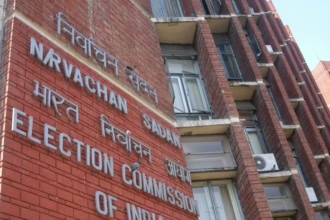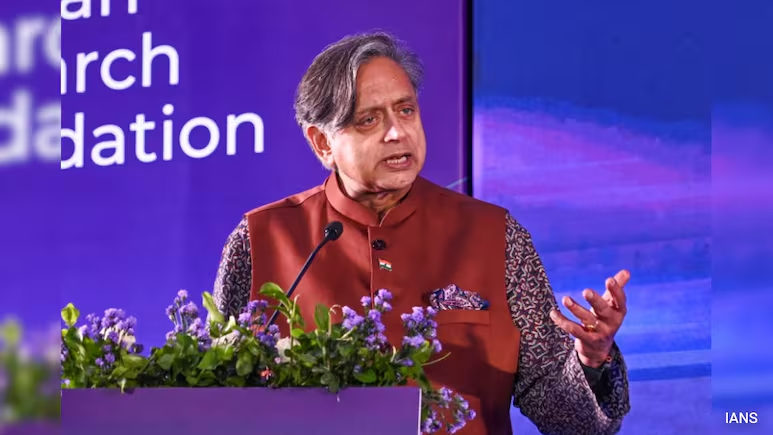
Congress MP Shashi Tharoor has criticised the Election Commission’s ECINet software following a report alleging that the system prevented Goa election officials from reversing certain voter deletions, even after the voters were found eligible through the prescribed process.
The controversy comes amid the Special Intensive Revision (SIR) of electoral rolls, during which voters submitted forms and supporting documents through ECINet. The platform was subsequently used by election officials to process applications and update electoral records.

The Election Commission launched the ECINet app in January this year, while a beta version had been tested during the Bihar Assembly elections in November last year. The platform is used to provide the public with real-time election-related updates and also serves as a tool for election officials.
A report cited by Tharoor alleged that concerns raised by Election Commissioners Sukhbir Singh Sandhu and Vivek Joshi over the centralisation of ECINet and the reduced role of state-level officials had materialised in Goa during the electoral roll revision process.
The report highlighted a case involving 97 voters in Goa. According to the report, the state’s Electoral Registration Officers had heard the cases, examined the relevant documents and determined that the voters were eligible under the process laid down by the Supreme Court.
However, the report said the EROs were unable to reverse earlier decisions to remove the voters from the electoral roll through ECINet because the necessary permission was controlled from Delhi.
The issue assumes added significance in Goa because electoral roll status is linked to eligibility for certain state welfare schemes. The report specifically cited the Goa Mediclaim Scheme, under which eligible voters can access financial assistance for specialised medical treatment not available at government hospitals. These treatments include dialysis, angioplasty, open-heart surgery, organ transplants, chemotherapy and cochlear implants.
The report further stated that Goa’s Chief Electoral Officer contacted the Election Commission in Delhi repeatedly in the days before the state was scheduled to publish its final electoral roll under the SIR process. One communication reportedly included the list of 97 voters whose cases had been reviewed by the state’s EROs.
Tharoor responded to the report on social media, describing the matter as extremely serious. He alleged that the issue could affect citizens’ constitutional rights as well as access to essential humanitarian benefits.
He also called on the Election Commission to apologise to affected citizens and demanded that ECINet be withdrawn and the alleged harm caused through the system be reversed.
The allegations have added to the wider debate surrounding the Election Commission’s handling of electoral roll revisions and the role of its centralised digital systems. The concerns described in the report focus specifically on the functioning of ECINet in Goa and the ability of state-level election officials to make changes after reviewing individual cases.
The uploaded report does not include a detailed response from the Election Commission to Tharoor’s specific allegations.