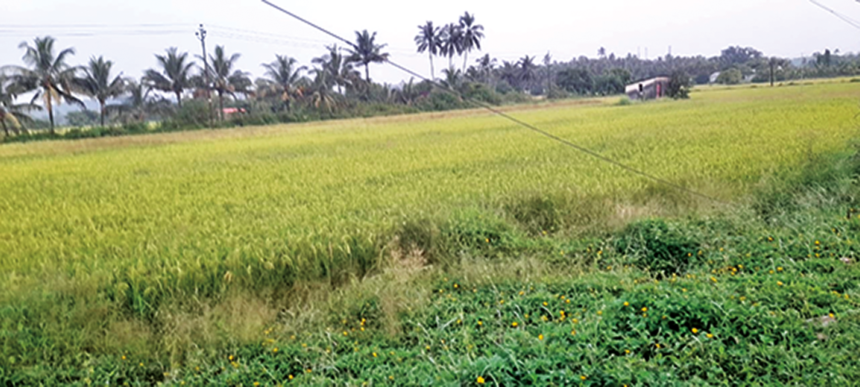
Margao: Farmers across Goa have been advised to closely monitor paddy fields for infestation of Gundi Bug, or Rice Earhead Bug, particularly during the flowering, milky and grain-filling stages, when the pest can cause considerable damage to developing rice grains.
The advisory comes amid reports of increasing incidence of the pest, scientifically known as Leptocorisa acuta, a sap-sucking insect that feeds on developing rice grains. If infestation is not detected in time, damage may become apparent only after harvest, when significant numbers of grains are found empty or poorly filled, locally referred to as “poll”.


Paddy is cultivated across about 24,441 hectares in Goa, with Salcete accounting for around 7,200 hectares during the kharif and rabi seasons. The taluka has large areas of low-lying rice fields and uplands.
Zonal Agriculture Officer, Margao, Shariff Furtado urged farmers to increase field inspections during the vulnerable stages and look for both adult insects and nymphs around the panicles. He advised adopting Integrated Pest Management (IPM) rather than immediately resorting to chemical pesticides.
He further advised farmers to maintain clean field bunds and manage weeds and grasses that provide shelter and alternate feeding sites for the pest. They should also conserve natural enemies such as spiders, dragonflies, predatory bugs and beetles, which help suppress pest populations.
The adult Gundi Bug is a slender greenish-yellow to brownish-green insect, about 15–20 mm long, with long legs and antennae, and emits an unpleasant odour when disturbed or crushed. Eggs are generally laid in clusters in two rows along the midrib of rice leaves, while nymphs resemble adults but lack fully developed wings.
Signs of infestation include brownish or discoloured patches on rice husks, black or brown spots around feeding punctures, shrivelled grains and poorly developed or chaffy grains. Severe infestation can leave a large proportion of grains unfilled.
The Agriculture Department has recommended IPM measures including regular monitoring, proper field and bund management, mechanical control in localised infestations and conservation of beneficial insects. Farmers may also consider neem-based biopesticides and other permitted bio-inputs as per recommended practices.
Chemical intervention should be undertaken only after assessing pest populations and obtaining appropriate technical guidance. Furtado stressed that early detection is crucial as grain damage cannot be reversed once the crop reaches harvest stage. Farmers noticing unusual levels of Gundi Bug have been advised to approach the nearest Agriculture Department office for guidance.