The Asian Games have entered a new digital chapter in Aichi-Nagoya, where keyboards, controllers and mobile screens are sharing the spotlight with athletics tracks, swimming pools and traditional sporting arenas. Esports has returned as an official medal discipline, with 11 medal events featuring 13 game titles being staged at the Aichi Sky Expo in Tokoname from September 23 to October 2.
- Yuki Kurihara, the 11-year-old who stole the spotlight
- ‘I felt a bit embarrassed’, says Kurihara
- From a childhood game to the Asian Games podium
- Esports expands its Asian Games footprint
- Other esports disciplines at Aichi-Nagoya
- India enters four esports events
- Paritosh gives India a run in Puyo Puyo
- Pokémon UNITE and League of Legends keep India in the competition
- Yuki’s gold and what it means for esports
But amid the growing international field, one of the most striking stories has come from an 11-year-old Japanese schoolboy.

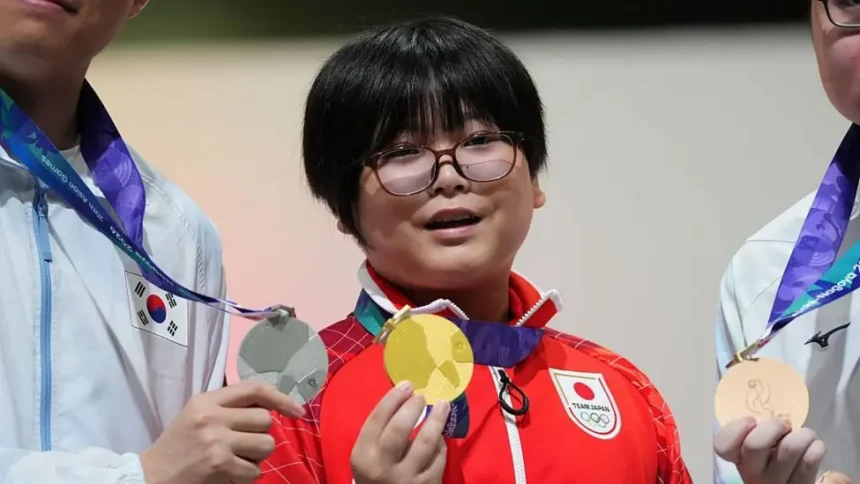
Yuki Kurihara arrived at the Games as Japan’s youngest-ever Asian Games athlete. On Saturday, September 26, he left the competition as an Asian Games gold medallist after producing a remarkable run in Puyo Puyo Champions.
Kurihara defeated South Korea’s Kang Dongshin 10-2 in the final to claim gold, having earlier beaten Singapore’s Justin Koh Mun June 5-0 in the quarterfinal and Thailand’s Tanarak Wongkitkun 10-1 in the semifinal. His victory came after an unbeaten group-stage campaign and completed a tournament in which he repeatedly defeated players more than twice his age.
The achievement also underlines how far esports has travelled within the Asian Games. The discipline was introduced as a demonstration sport at Jakarta-Palembang 2018 and became a full medal sport at Hangzhou 2023. Aichi-Nagoya has expanded the programme to 11 medal events covering titles across PC, console and mobile platforms.
Yuki Kurihara, the 11-year-old who stole the spotlight
Kurihara’s story began away from the bright lights of the Asian Games.
Born in Tokyo on June 18, 2015, he is a fifth-grade primary-school student who represents Tokyo Verdy Esports. He started playing Puyo Puyo during his first year of primary school and quickly became fascinated by the game’s chain mechanics.
What began as a childhood interest developed into competitive success. Kurihara obtained his professional licence in April this year and continued competing against established adult players before earning selection for Japan’s Asian Games team.
His age alone made him one of the most talked-about athletes in Aichi-Nagoya. His performance then transformed that curiosity into a sporting story.
Kurihara finished the group stage unbeaten, topping Group A with a 4-0 record. He then moved into the knockout rounds and continued his dominant run.
He defeated Singapore’s Justin Koh Mun June 5-0 in the quarterfinal before producing a 10-1 semifinal victory over Thailand’s 28-year-old Tanarak Wongkitkun.
That set up a gold-medal clash with South Korea’s 24-year-old Kang Dongshin.
The final briefly appeared to offer Kang an opening when he took the first game. Kurihara responded immediately, using a large chain to level the contest before gradually taking control.
The Japanese youngster eventually won 10-2, completing an unbeaten tournament and securing the gold medal on home soil.
‘I felt a bit embarrassed’, says Kurihara
Kurihara’s reaction after the final was almost as memorable as the victory itself.
While the arena celebrated his achievement, the 11-year-old remained remarkably composed. Asked why he did not display more emotion, he offered an explanation that sounded much more like a schoolboy than a newly crowned Asian Games champion.
“To be completely honest, I felt a bit embarrassed, so I couldn’t really show my expressions or change my face much,” Kurihara said.
Once the medal ceremony arrived, however, his excitement became clearer.
“I’m really happy. The gold medal is really beautiful, shiny and heavy,” he said.
Kurihara also had another favourite part of the prize.
“Also, the plush toy is super cute, and it’s cool that it is gold-coloured too,” he added.
The comments captured the unusual contrast surrounding his victory. Kurihara had just beaten adult competitors at one of Asia’s biggest sporting events, yet his attention was also on the mascot accompanying his medal.
From a childhood game to the Asian Games podium
Puyo Puyo Champions is a puzzle game built around matching coloured Puyos and creating chains. At the highest level, however, the seemingly simple mechanics require rapid pattern recognition, planning, precision and the ability to anticipate an opponent’s moves.
Players arrange groups of coloured pieces so that one clearing sequence triggers another. Longer chains can create increasingly difficult situations for the opponent.
Kurihara has developed that technical aspect of the game at an extraordinary pace.
His Asian Games campaign demonstrated both his accuracy and his ability to remain composed against experienced opponents. His semifinal against Wongkitkun ended 10-1, while the final against Kang finished 10-2 after Kurihara recovered from the opening game.
Kang himself acknowledged the Japanese player’s ability after the final, describing his technical ability and accuracy as exceptional.
Kurihara has also spoken about the difficulty of balancing competitive gaming with school and cram-school commitments.
“It’s hard having to balance it with school and cram school, but it’s really fun,” he said before the Games.
His preparation has reportedly included eel as a preferred training food, another detail that has added to the unusual character of his Asian Games story.
Esports expands its Asian Games footprint
Kurihara’s gold is only one part of a much larger esports programme in Aichi-Nagoya.
The Olympic Council of Asia has approved 11 esports medal events, including Puyo Puyo Champions, Pokémon UNITE, Honor of Kings, League of Legends, PUBG Mobile Asian Games Version, Mobile Legends Bang Bang, Identity V Asian Games Version, Naraka Bladepoint, Gran Turismo 7, eFootball and the Fighting Games team competition.
The Fighting Games event combines Street Fighter, Tekken and The King of Fighters into a single medal competition. The programme therefore covers a wide range of competitive formats rather than treating esports as one uniform discipline.
The competition is being staged at Aichi Sky Expo, with the esports programme running from September 23 through October 2.
Other esports disciplines at Aichi-Nagoya
| Discipline | Game titles | Format/platform | Status around September 26 | India |
|---|---|---|---|---|
| Puyo Puyo Champions | Puyo Puyo Champions | Individual, PC | Japan gold – Yuki Kurihara | Paritosh reached knockout stage but was eliminated |
| Fighting Games | Street Fighter, Tekken, King of Fighters | Team event, console | Competition underway/completed according to schedule | India not entered |
| Naraka Bladepoint | Naraka Bladepoint | PC | China claimed gold | India not entered |
| Gran Turismo 7 | Gran Turismo 7 | PlayStation 5 | Event completed | India not entered |
| eFootball | eFootball Series | PC/mobile | Event completed | India exited group stage |
| Pokémon UNITE | Pokémon UNITE | Nintendo Switch | Group/knockout stages | India competed |
| Honor of Kings | Honor of Kings | Mobile | Upcoming from September 27 | India not entered |
| PUBG Mobile | Asian Games Version | Mobile | Upcoming from September 28 | India not entered |
| Identity V | Asian Games Version | Mobile | Upcoming from September 28 | India not entered |
| Mobile Legends Bang Bang | Mobile Legends Bang Bang | Mobile | Upcoming from September 29 | India not entered |
| League of Legends | League of Legends | PC | Starts September 29 | India competing |
The OCA officially lists the 11 medal events and confirms that esports is being held at Aichi Sky Expo.
India enters four esports events
India has sent a 15-member esports contingent to Aichi-Nagoya, competing in four titles: eFootball, Pokémon UNITE, Puyo Puyo Champions and League of Legends.
The campaign began with eFootball, where Danial Patel and Chinmay Sahoo were involved in an unusual group-stage exit.
India was awarded a 0-0 forfeit win over Mongolia after Mongolia missed the required check-in deadline by three minutes. Because the win was recorded without goals, India finished level on points with Uzbekistan but was eliminated on goal difference.
The result became one of the more unusual stories of the early esports programme.
Paritosh gives India a run in Puyo Puyo
India’s strongest individual storyline in Puyo Puyo came through Paritosh from Rohtak, Haryana.
He finished third in Group B after winning two of his four matches. Paritosh opened his campaign with a 3-0 victory over Mongolia’s Munkhzorig Ganbold before beating Singapore’s Mun June Justin Koh 3-2.
He then lost 0-3 to Chinese Taipei’s Tzu-ang Kuo and 2-3 to Thailand’s Tanarak Wongkitikun, but the two victories were enough to send him into the knockout stage.
His run ultimately ended in the knockout rounds, but reaching the quarterfinal stage gave India a notable presence in an event that produced the Games’ biggest esports story.
Kurihara, meanwhile, went in the opposite direction. He did not drop a match and eventually collected Japan’s gold medal.
Pokémon UNITE and League of Legends keep India in the competition
India’s Pokémon UNITE campaign featured the Revenant XSpark roster, with the team entering the group stage alongside other leading Asian esports nations.
The competition has provided another opportunity for Indian players to test themselves against established regional teams. India’s League of Legends team will have its opportunity later in the Games.
The six-member League of Legends squad is captained by Akshaj Shenoy and includes players associated with S8UL. India is in Group B alongside South Korea, Chinese Taipei and Hong Kong. The group stage is scheduled for September 29 and 30, with the knockout rounds following on October 1 and 2.
That means India’s esports campaign is not yet complete, even after the early exits in eFootball and Puyo Puyo.
Yuki’s gold and what it means for esports
Kurihara’s victory provides a striking snapshot of how broad esports has become within the Asian Games.
His event is built around a puzzle game rather than a traditional sports simulation or action title. Elsewhere at Aichi Sky Expo, athletes are competing in driving simulations, multiplayer battle arenas, mobile games and fighting games.
The OCA says esports has developed from its demonstration appearance at Jakarta-Palembang in 2018 into a full medal discipline, with seven titles at Hangzhou and 11 medal events at Aichi-Nagoya.
Kurihara’s achievement adds another dimension to that evolution.
He is still a school student. He still has classes and a cram-school schedule. He started playing Puyo Puyo only a few years ago. Yet on Saturday, he stood on an Asian Games podium with a gold medal around his neck.
There is also a useful caution in his story. At 11, his career is only beginning, and the result itself is more significant than predictions about what he might achieve in the future.
For now, Kurihara’s Asian Games record is straightforward: four wins in the group stage, victories over adult competitors in the knockout rounds and a 10-2 win in the gold-medal match.
And when asked what he thought of the medal, his answer was characteristically simple.
It was shiny.
It was heavy.
And he was really happy.
That may be the simplest way to describe one of the most memorable esports moments of Aichi-Nagoya 2026.