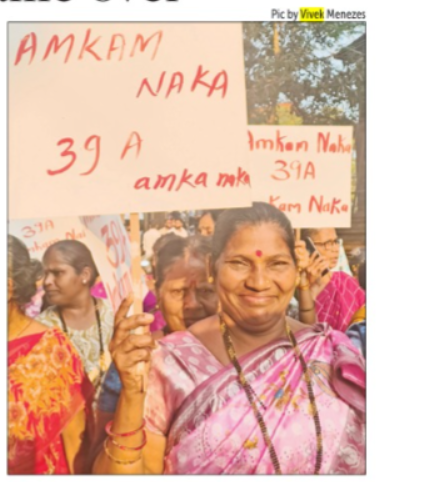
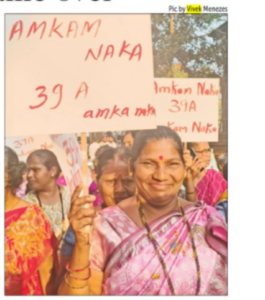
It became clear the tide was turning when the resplendent vendors of “gaunti” vegetables from the Panjim outdoor morning market showed up with their indomitable smiles at Azad Maidan this past Monday. This would turn out to be a dramatic moment of departure from the longstanding, bleak and familiar political theatre in Goa, where furniture moves around, but the characters remain the same. On that unforgettable evening of the 23rd of February, our historic old Praça just kept on filling up with an astonishing array determined Goans from across the state, many more individuals than organised groups, with everyone united by frustration and ire. Then, almost leaderless, but with unstoppable collective purpose nonetheless, this hugely impressive body politic brushed effortlessly past every attempted barricade all the way to Dona Paula to demonstrate that democracy is still alive in India’s smallest state.
Make no mistake, we turned a corner. Things may well deteriorate from this point – and it is certainly true recent trends have been relentlessly negative – but there will be no going back to the one-sided assault on Goa’s land, culture and people that has prevailed especially destructively since the Covid-19 pandemic. That awesome crowd milled into Azad Maidan to defend the young MLA on hunger strike next to Tristão de Bragança Cunha’s urn, but they were also seething to fight for justice. Things could easily have turned very bad, and it is hugely to the credit of the Goa Police and the demonstrators themselves that everything remained peaceful. But what will happen the next time? Can wisdom prevail, or is this mere setup for much more brutal crackdown?

“There are bigger battles ahead,” warns Dr. Joaquim Goes, proud son of Cortalim and distinguished research professor at Columbia University, who has been vocally supporting the burgeoning people power movements from New York. He says “Two back-to-back victories in Chimbel and St André remind us of something powerful: there is strength in unity. When people stand together, power is forced to listen. The attempts to bully, intimidate, the pressure, all of it collapsed in the face of united communities. But two victories do not end the fight. The larger struggle must continue, to free entire Goa from the 39A curse, to reclaim our rivers from casinos, but most importantly to rid our state of arrogance and corruption in public office.”
An outstanding science communicator, here is how Goes summarises what is at stake in his beloved home state: “Goa is not an empty canvas for speculative real estate. It is one of India’s most fragile ecological zones, a narrow coastal state of laterite hills, low-lying rice fields, orchard lands, mangroves, aquifers. It is a living civilisational landscape shaped for centuries by the Gaokari system, a community-based land stewardship model that balanced cultivation, commons, water, and social responsibility long before modern planning laws existed. Every hill cut, every field filled, every aquifer pierced has consequences. And yet, in less than three years, more than 200 mega housing projects have been cleared using a cunning amendment 39A to the Town and Country Planning (TCP) Act. This is not planning. It is rapid transformation without accountability.”
Goes explains “Goa’s environmental limits are real, and the threats from mega-projects are not small. Our green sloping hills regulate drainage. Our khazans protect against flooding, paddy fields recharge groundwater. Our orchard lands are part of a living agro-ecological system. When these are bulldozed for clusters of apartments, many complete with multiple swimming pools, the damage is not cosmetic, but permanent damage to a system that breathes through its aquifers, absorbs monsoon rains through its fields, and sustains livelihoods, humans and animals through its soil and waters. Those in power fail to recognise that Goan villages are living ecosystems, sustained by traditional cultivation, fishing, toddy tapping, faith practices, and intergenerational bonds. When large-scale projects intrude upon these spaces without meaningful consent or cumulative impact assessment, they do more than alter skylines. They fracture social fabric and erode trust. We are told these projects will bring revenue and employment. But we have seen that no amount of revenue can offset acute water scarcity, electricity shortages, collapsing garbage collection systems, and untreated sewage entering aquifers. Many villages struggle to receive water for even two hours a day. It is not uncommon to see garbage overflowing onto the streets. Yet the government is quick to approve projects with hundreds of units and multiple pools under lax local requirements.”
His conclusion: “These fires of protest spreading across Goa are not about hostility toward outsiders. Goa has always welcomed visitors and settlers. The issue is the scale and speed at which they are happening. When projects with luxury amenities rise in villages with erratic water supply and fragile waste systems, priorities are inverted. When sacred sites sit in the shadow of high-density towers, something fundamental shifts. When aquifers are treated as inexhaustible, when hills are carved as if they were decorative mounds, we gamble with irreversible loss. 39A has facilitated a form of development that does not benefit anyone in Goa, except those in power. Goans need to be united in this fight whatever your party loyalty. This is about the future. Dividing ourselves over trivial issues only weakens collective resolve. The larger question is whether we allow our fragile hills, rice fields, orchard lands, villages, our culture and way of life be permanently altered? If we remain silent now, no new government or amount of revenue will restore what is lost.”
(Vivek Menezes is a writer and co-founder of the Goa Arts and Literature Festival)