SHASHWAT GUPTA RAY
PANJIM: A week after the US-Israel joint strike “Operation Epic Fury” claimed the life of Iran’s Supreme Leader Ali Khamenei, West Asia has spiralled into an uncontrollable regional war. Far from the expected collapse, Tehran has launched a fierce wave of retaliatory strikes against Israel and US Gulf bases, turning the conflict into a bloody “zero-sum game” that has already claimed over 1,300 lives.

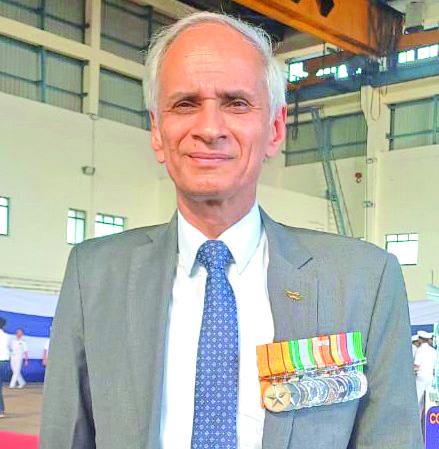
“No one can claim complete victory in this conflict as of now. Iran has taken a major beating in terms of their leadership and military assets; their navy is also bleeding hard. At this stage, even US can’t be exactly happy with the situation as their bases in the Gulf have been hit, which is testing resolve of the Gulf partners. Israel can feel little better as it wouldn’t have been able to inflict such a heavy damage on Iran and the Hamas without US support. But even they can’t claim victory,” former Chief of Naval Staff, Admiral Karambir Singh (Retd) said.
“The interesting part about modern warfare is that cheap drones using commercial technology like50CC scooter engines on the Shahed drones, using rocket assisted take off, can be produced in scale and cause large devastation. The fact that they have to be intercepted by expensive air defence missiles is something that makes even big powers like the US sit up and take notice,” Admiral Singh said.
“Looking at the current situation, it seems the US has advanced substantially on achieving military objectives, but if regime change was the political objective of this conflict, then it would be a much longer and arduous undertaking. Though it is easy to comment in hindsight, instead of killing Iran’s spiritual head, the US-Israel leadership could have focused on weakening Khamenei’s position. His death may have altered perceptions and increased the resolve of the Iranians to fight for national pride,” he said.
Major General Raj Mehta (Retd), a counter-terrorism veteran officer, said that America and Israel miscalculated the fallout of attacking Iran.

“They thought it would be a repeat of Venezuela. But this misadventure just turned out to be anything other than that so far. Iran has suffered major destruction, but its spirit, which was earlier divided, has been united by a common fear of being overtaken and completely destroyed as a nation,” Maj Gen Mehta said.
According to him, Iran has lot of internal strength and capacity to resist. They might lose their navy, they have already lost their airport, but their cheap but effective drones have inflicted lot of damage to the US bases in the Gulf.
When asked about any possibility of a land war, he said, “No. They can’t put ‘boots on the ground’ because it will complicate the situation further. With mid-term polls due in the US later this year, President Donald Trump can’t afford to have negative sentiments against his regime that would get triggered by mounting body bags of his soldiers,” he said.
The senior veteran added that the US has found itself in a deep quagmire and the only way to get out of this situation is diplomatic settlement, with the help of friendly countries like India.
Colonel Jesus Furtado (Retd), Kargil conflict hero and former Commanding Officer of 1 Goa Battalion NCC, said that there appears to be ambiguity in the US objective.

“Is it oil or regime change or stop Iran’s nuclear programme? Deep down below, it appears a mere regime change may not guarantee the US favourable oil exploration contracts. The Iranian objective seems to be to defend by attrition and cause delay to swing international opinion in their favour as victims,” Col Furtado said.
He also called for immediate UN intervention. “They need to step in immediately. Call all conflicting parties to the negotiating table. After all, the global economy is getting impacted too. Till then place UN observers from neutral countries in the trouble spots,” he said.
According to Lt Col Austin Collaco (Retd), Kargil conflict hero, US-Israel might claim success in degrading specific Iranian military assets, disrupting its nuclear ambitions, or deterring immediate large-scale attacks.

Iran’s objectives might include demonstrating its capacity to retaliate, preserving its core military and political infrastructure, and maintaining its regional influence despite attacks. They might claim success in surviving the onslaught, inflicting some level of cost on the aggressors (even if indirect), and showcasing national unity.
“The US-Israel strategy would likely be characterised by precision strikes, overwhelming air superiority, cyber warfare, and potentially special operations. The aim would be to achieve specific military objectives with minimal collateral damage (to avoid wider escalation) and to project decisive power,” he said.
Lt Col Collaco added that sending ground troops into Iran by US and Israel would be an extremely high-risk escalation that both the countries would want to avoid.
“The implications would be severe. Iran has a large population and a significant, albeit less technologically advanced, military. An invasion would lead to prolonged urban warfare, insurgency, and heavy casualties for all sides. Oil prices would skyrocket, and global trade routes would be severely disrupted,” he said.
On possible steps to end this war, he said that potential avenues, even if difficult, might include increased international pressure, discreet back-channel communications through neutral third parties (e.g., Oman, Qatar, Switzerland) might be ongoing to explore potential off-ramps or de-escalation steps.
“The US and Israel might offer specific, verifiable concessions (e.g., sanctions relief, security guarantees) in exchange for concrete, verifiable changes in Iranian behaviour (e.g., halting uranium enrichment, withdrawing support for certain proxies),” he added.