SHASHWAT GUPTA RAY
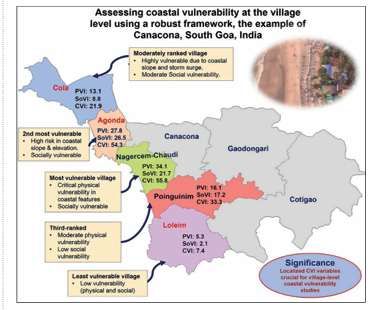
Even though the Canacona taluka has been relatively less damaged than other talukas of the State, a new study shows that even the pristine coastal villages of this remote sub-district are now highly vulnerable to the stress ors of climate change, namely erosion and sea-level rise, due to growing tourism-related ac tivities in the region.

This was found using a novel Coastal Vulnerability Index (CVI) framework, which calculates relative coastal vulner ability. It was conceptualised and developed by the first au thor, Dr Ritwik Nigam, during his PhD tenure at the School of Earth, Ocean and Atmospheric Sciences (SEAOS), Goa University, under the supervision of Dr Mahender Kotha, who is also the corresponding author of the study along with other co-authors. Using this model, the researchers analysed five villag es of Canacona — Agonda, Palolem, Cola, Loliem, and Nagercem-Chaudi. Agonda and Nagercem-Chaudi were predicted to be the most vulnerable due to their low-lying sandy beaches and high tourism activity. Palolem and Cola showed moderate-to-high predicted risks from eroding shores and population pressures. Loli em emerged as the least vulnerable, benefiting from stable rocky coasts and stronger socio-economic buffers. High CVI scores indicate greater vulnerability to human lives and infrastructure, providing a clearer picture of risks at each beach. The study titled ‘Assessing coastal vulnerability at the village level using a robust framework: The example of Canacona in South Goa, India’ has been published in the iScience journal. “We conducted a village-level assessment of coastal vul nerability in Canacona, South Goa. This is the most detailed index-based CVI methodology published to date in India, integrating 21 variables across physical, social, and hydro logical factors to reveal clear-cut vulnerability scenarios at the studied beaches. We combined geospatial data with field observations to evaluate 42 km of coastline across five key villages,” said Dr Ritwik Nigam. The model assesses how tourism-heavy beaches like Agonda and Palolem could face amplified risks from cli mate stressors such as erosion and sea-level rise. “Our multi-author team prioritised linking vulnerabil ity scores to potential adaptation needs for policymak ers. Our primary objective was to develop and validate a novel CVI methodology capable of village-level analysis in data-scarce regions like Goa’s coast. This is the most de tailed index-based approach published, bridging gaps in high-resolution mapping beyond taluka or district scales,” Dr Nigam said. The researchers quantified predicted interactions be tween physical features such as beach morphology and so cial stressors like population density. “Ultimately, we sought to provide evidence for sustaina ble coastal management, aligning with broader Sustainable Development Goals. We employed a novel multi-paramet ric CVI framework — the most detailed index-based CVI methodology at the time of publication — scoring 10 Phys ical Vulnerability Index (PVI) variables such as elevation, slope, shoreline change, and wave exposure, along with 11 Social Vulnerability Index (SoVI) variables including literacy, tourism density, and infrastructure. Data sources included multi-beam bathymetry, Sentinel-2 imagery, and Census 2011 demographics, enabling precision at the vil lage scale,” he informed. Dr Mahender Kotha, who supervised the study, ex plained: “We used weighted overlays to aggregate PVI and SoVI into a composite CVI, validated against ero sion hotspots. This ensured sub-village precision, out performing coarser national models and revealing clear predicted vulnerability patterns. PVI dominated in tour ist hubs, while SoVI amplified risks in densely populated areas. Overall, 60 per cent of the coastline scored medi um-to-high vulnerability, suggesting the need for targeted interventions.” Summarising the study, Dr Kotha said it predicts that Canacona’s tourism-dependent economy could face es calating threats from sea-level rise, erosion, and storms. High-vulnerability villages like Agonda may see significant land loss, potentially disrupting fisheries and livelihoods with clear beach-level implications. “This study highlights the predicted role of climate change in worsening physical-social synergies, such as sandy beaches eroding under intensified waves. Policy makers should consider mangrove restoration and decon gestion of coastal belts. These predictions could extend to other Goan coasts under similar pressures,” he added