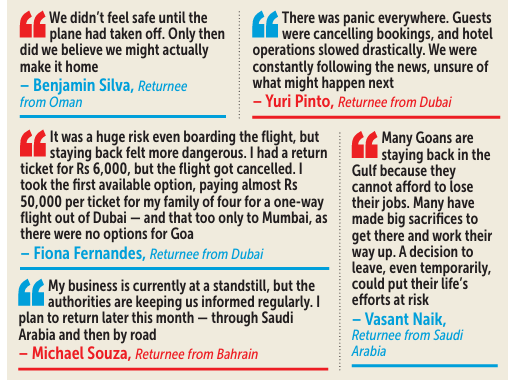
For decades, the Gulf Coop eration Council countries — the UAE, Saudi Arabia, Bahrain, Qatar, Kuwait, and Oman — were Goa’s most reliable export destina tions — not fish or iron ore, but people. Young men and women packed their bags and flew east toward a fu ture they could not afford to build at home. They went for the money, the oppor tunity, the gleaming prom ise of a tax-free salary in a region that seemed to exist outside the chaos of their immediate circumstances. Now, those same people are packing their bags again — this time in fear. As the United States and Israel’s military campaign against Iran plunges the re gion into its deepest crisis in living memory, the Gulf’s 35 million foreign workers — including approximately 9.1 million Indians, the sin gle largest expatriate group in the GCC — find them selves trapped in the epi centre of a war they never chose and had no power to prevent. For the thousands of Goans who made the Gulf their home, the reckoning has arrived with terrifying speed. “We didn’t feel safe un til the plane had taken off. Only then did we believe we might actually make it home,” said Benjamin Silva (name changed) from Sal cete, a returnee from Oman. The transformation, say those who witnessed it, was sudden and total. Luxury hotels that once hummed with global tourism fell ee rily quiet as international guests cancelled en masse. Shopping malls emptied overnight. Construction sites went still. For a hos pitality worker from Be naulim who had spent years serving guests in one of Dubai’s five-star prop erties, the psychological whiplash was jarring. “There was panic every where. Guests were can celling bookings, and hotel operations slowed drasti cally. We were constantly following the news, un sure of what might happen next,” recounted Yuri Pinto, a hospitality worker from Benaulim working in Dubai.
The calculus of staying shifted overnight from eco nomic logic to something more primal — survival. A young man from Nuvem described the moment his workplace simply stopped. “We were told to stop work immediately. There was confusion, and many of us were left without clear instructions. Safety became a major concern, especially with rumours spreading every day,” said a youth from Nuvem (name with held). Getting out proved near ly as harrowing as staying put. Airlines slashed capac ity as demand surged. Tick et prices rose to multiples of their normal fares. Some returnees spent days re freshing booking platforms; others camped at airports, chasing last-minute seats that might or might not ma terialise. The ordeal of sim ply reaching the departure gate became its own test of endurance. “It was a huge risk even boarding the flight, but staying back felt more dan gerous,” said Fiona Fer nandes from Verna, a re turnee from Dubai. “I had a return ticket for Rs 6,000, but the flight got cancelled. I took the first available option, paying almost Rs 50,000 per ticket for my family of four for a one-way flight out of Dubai — and that too only to Mumbai, as there were no options for Goa,” he added. In Bahrain, the situation deteriorated further.

Unlike Dubai — where life, while dis rupted, has retained a degree of surface normality — the island kingdom has been in the direct flight path of the conflict. Mis sile and drone interceptions have become a daily occurrence. The airport shut entirely, forcing travellers to reroute through Saudi Arabia in journeys that doubled in cost and tripled in stress. Basil Fernandes, a Goan businessman currently back in India, has watched it unfold from a distance — and is preparing to return anyway. “The Bahrain Interior Ministry has been very proactive in providing updates about the attacks. But business activity has al most come to a standstill.Roads are emp ty. In the digital space, there is hardly any movement,” said Fernandes. Michael Souza, who has lived in Bahrain for over 25 years and runs a small adver tising agency in the capital, speaks with the measured calm of a man who has invested too much in a country to walk away easily — even as that country shudders around him. “My business is currently at a standstill, but the authorities are keeping us informed regularly. I plan to return later this month — through Saudi Arabia and then by road,” said Souza from Porvorim. This is the cruel arithmetic of the Gulf dream laid bare. After 25 years, a man’s livelihood can be rendered worthless in a fortnight of geopolitical catastrophe he has no hand in and no clean exit from — not without cost.
The sunk cost of a life built abroad becomes its own trap. This reality is more applicable to the working class. “Many Goans are staying back in the Gulf because they cannot afford to lose their jobs. Many have made big sac rifices to get there and work their way up. A decision to leave, even temporarily, could put their life’s efforts at risk,” said Vasant Naik from Ponda, a professional in the oil and gas sector in Saudi Arabia. Back in Goa, the families of those still in the Gulf are living through their own ordeal — glued to phones, monitoring news chan nels, triangulating rumours against official statements, praying that the next call from Dubai or Kuwait is not the one that breaks them. For those who have made it home, the reunion is real — but so is the wreckage: jobs abandoned or lost, savings depleted by emergency flights, and careers interrupted with no guarantee of resumption. The Gulf was never supposed to be forev er. It was meant to be a few years — enough to build a house in Goa, educate children, and set something aside. For many Goan families, that compact sustained entire generations. What remains unclear, as mis siles continue to fly, is whether that com pact will survive this war.