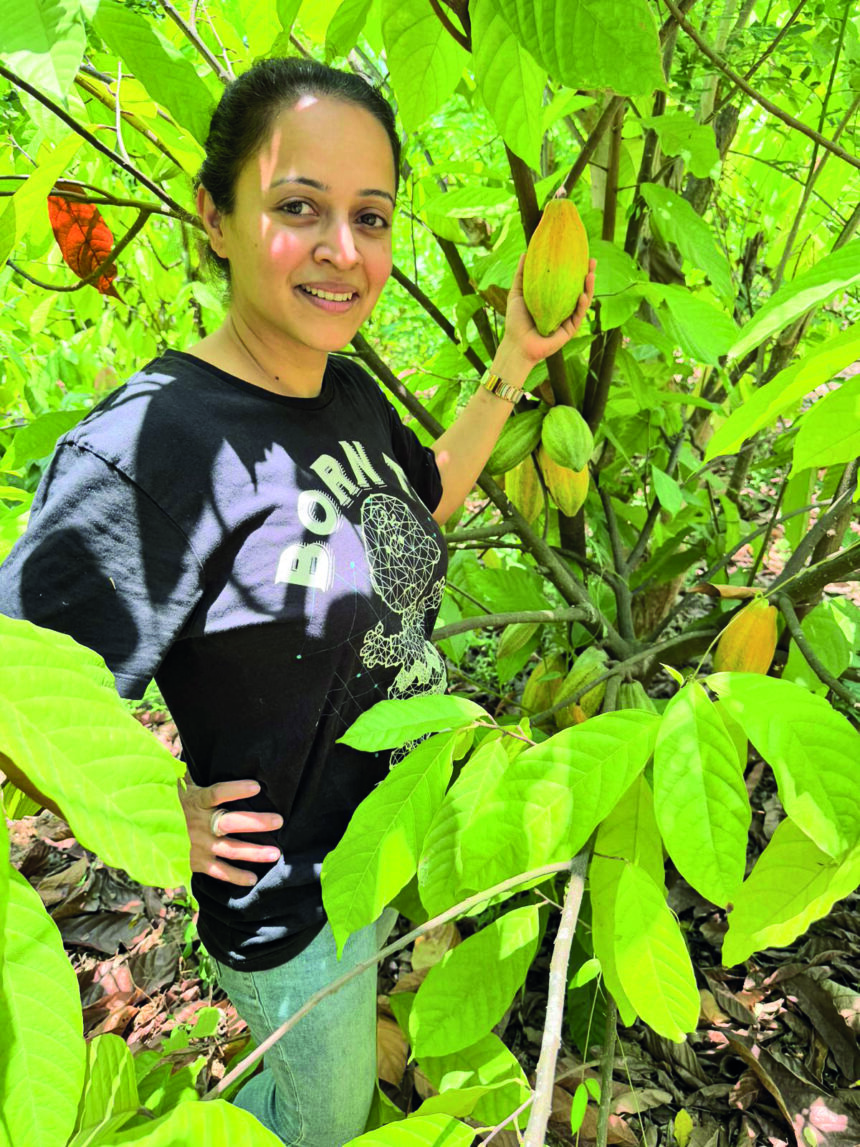
KARSTEN MIRANDA

MARGAO: When Alvinia De Souza walked into a small artisanal chocolate shop in Europe and found a bar made from Indian cacao, she stopped. Until that moment, she had always associated fine chocolate with Latin America, Africa — anywhere but home. “That stopped me in my tracks,” she recalls. That bar — made from Kerala cacao — stayed with her. If Indian cacao could produce something worth noticing in Europe, what could Goan cacao do? Alvinia decided she would be the one to find out.
She already had the training. A Goan by birth, she had left home in 2013 to study chocolate and pastry arts in Switzerland, followed by an internship and five years working as a chocolatier across Europe. But the path there had not been straightforward. She had studied pharmaceutical engineering, joined the family business done what was expected. It felt stable, she says, but not hers. The pull toward the kitchen had been there since childhood — standing beside her grandmother in Goa, watching her make sweets with no measurements and no recipes. “That’s really where I started understanding flavour without even realising it.” Switzerland gave that instinct a foundation. The Kerala bar gave it a direction. “It felt very clear,” she says of the decision to return. “Like I was finally choosing something for myself, not just continuing a path that was already laid out.”
She returned to Goa in early 2020. Together with her father, she had already identified a 10-acre property in Bedshi village, Dodamarg, just across the Goa-Maharashtra border. For a first-generation farmer without inherited land or an existing agricultural background, the choice of Dodamarg over Goa itself was also a practical one — land prices on the Goa side made entry difficult, whereas Dodamarg, closely linked to Goa in terms of movement and livelihood, offered a more workable start. She reflects that if agricultural land meant for farming could remain realistically accessible to those who genuinely want to cultivate it, it may encourage more such ventures in the future. The land she found was dry, depleted, and scarred from repeated fires. Restoring it meant rebuilding the soil from scratch — water management, organic matter, shade trees, compost, mulching. “It was slow, physical work, and nothing really gives you instant results,” she says. There were moments of doubt — when things didn’t grow as they should, when the land felt resistant.
“You question if you’ve taken on something too big.” But small changes kept coming. The soil softened. Things began to grow.
Cacao cannot handle direct sun when young, so an entire canopy of support trees had to be established first. The climate — Goa’s heat and humidity, its long dry spells and heavy monsoons — demanded careful management of drainage, irrigation and shade at every turn. The first trees went in the ground in May 2021. The first significant harvest came four years later, in April 2025 — around 100 kilograms. Alvinia describes the moment as quiet. “There wasn’t a big moment — just standing there, holding the first real harvest after years of waiting, failing, adjusting. It felt real. Like the land had finally responded.”
That harvest led to the launch of DoDā, a small-batch craft chocolate brand — the name drawn from the farm’s location and as an acronym for divinity, origin, distinctiveness and ananta. Every step, from harvesting the pod to the finished bar, is done by hand. Fermentation is where flavour truly begins — managing time, temperature and airflow, turning the beans, watching closely. Drying follows, then roasting, then the long work of grinding, conching and tempering until the chocolate finds its shape.
“At every stage, it’s less about control and more about attention,” she says. “The beans tell you what they need — you just have to listen.” What comes out the other end is lighter and more layered than people expect — fruity, nutty, with a soft rounded finish. “It still feels like the beginning. Like we’re just starting to understand what this land can produce.”
From the farm, nothing goes to waste — and that extends well beyond the bar. Pulp goes into drinks and ferments, husks into tea, nibs into trail mixes. A cacao husk ice cream — light, aromatic, nothing like what people associate with chocolate — has become one of her more unexpected creations. “It became less of a philosophy and more just instinct,” she says, “to use the whole fruit and see what it can become.” Growing up in Goa, she adds, nothing went to waste. This is simply an extension of that.
That same groundedness carries into how she talks about where things stand. A local Goan audience is slowly emerging alongside visitors, with people beginning to value origin and flavour over sweetness. She is candid about the commercial reality — still building more than extracting. But she is also reaching out to farmers across Goa, encouraging cacao cultivation, particularly for those already working with mixed cropping. The vision is collaborative — working together so that quality holds and Goa builds a name for homegrown chocolate.
The biggest misconception about all of this, she says, is that it looks romantic. “People see bean-to-bar and think it’s this beautiful, artisanal, almost effortless process. I too did, once upon a time.” The reality is slow, unpredictable, and brutally hands-on. And there is one more thing worth saying — that darker or more bitter does not automatically mean better. “Good chocolate isn’t about intensity. It’s about balance and clarity of flavour.”
For people in Goa, her message is a simple one. “We often look outward for quality — whether it’s chocolate or anything else — but there’s so much potential here, in our soil, our climate, our way of working with ingredients. It hasn’t been easy, and it’s definitely not quick. But it’s real.”