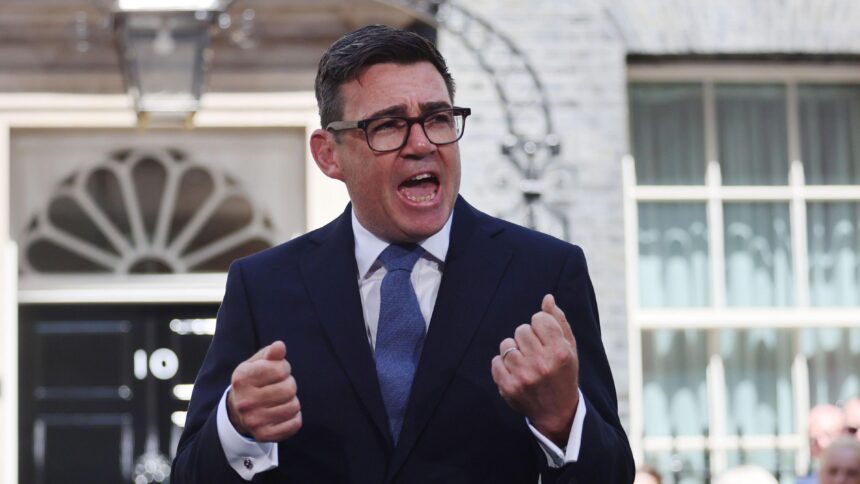
Andy Burnham was officially sworn in as the United Kingdom’s new Prime Minister on Monday after meeting King Charles III at Buckingham Palace, succeeding Keir Starmer and becoming Britain’s seventh prime minister in just over a decade. The Labour Party leader assumed office without a general election after winning the party leadership unopposed following Starmer’s resignation.
The 56-year-old, often referred to as the “King of the North” due to his popularity as Mayor of Greater Manchester, formally took charge after Starmer stepped down amid mounting political setbacks, electoral defeats and internal party challenges. Under the UK’s parliamentary system, a governing party can replace its leader—and therefore the prime minister—without holding a nationwide election, provided it retains a majority in Parliament.

Following the traditional audience with King Charles III, Burnham travelled to 10 Downing Street, where he delivered his first address as prime minister. Promising a “circuit breaker for Britain,” he vowed to introduce the country’s most significant reforms in four decades.
Burnham said his government would unveil a comprehensive 10-year national plan later this year while also taking immediate measures to ease the cost-of-living crisis. Among his first priorities, he announced a commitment to end rough sleeping across Britain and provide financial relief to struggling households.
Acknowledging growing public frustration with politics, Burnham admitted that political leaders had failed to meet expectations and pledged to rebuild public trust by devolving more power to local communities and focusing on long-neglected issues.
The new prime minister inherits several pressing challenges, including Britain’s economic slowdown, pressure on the National Health Service (NHS), immigration policy, and relations with Europe. He also faces political competition from Nigel Farage’s Reform UK, which has gained momentum in recent opinion polls.
Burnham’s Cabinet is expected to see significant changes after several senior ministers from Keir Starmer’s administration, including Deputy Prime Minister and Foreign Secretary David Lammy and Chancellor Rachel Reeves, opted not to continue in the new government.
On foreign policy, Burnham reaffirmed Britain’s unwavering support for Ukraine and said one of his first international conversations would be with Ukrainian President Volodymyr Zelenskyy. He also plans to engage with US President Donald Trump despite previous disagreements between the two leaders.
While Burnham has previously expressed support for Britain rejoining the European Union during his lifetime, he clarified that reopening the Brexit debate is not an immediate priority. Instead, his government will focus on tackling domestic issues, reviving economic growth and restoring confidence in public institutions.
Starmer, who resigned after two years in office, described serving as prime minister as “the privilege of my life” and offered his full support to Burnham during the leadership transition.