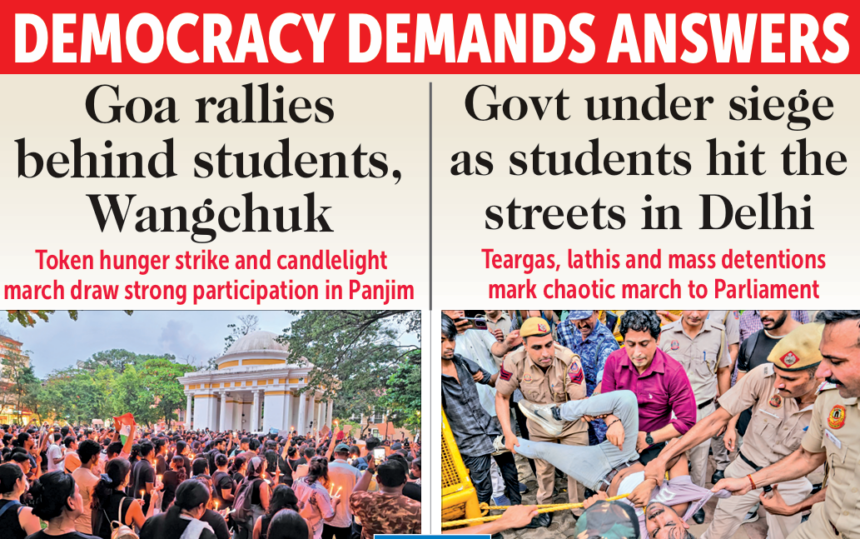
A massive turnout of social activists, students and concerned citizens transformed Panjim’s Azad Maidan into a platform of dissent on Monday, as pro testers linked environmental justice, students’ rights and democratic accountability in a day-long demonstration backing environmentalist and education reform advo cate Dr Sonam Wangchuk. Beginning with a token hunger strike and culminat ing in a candlelight march that drew large numbers of young people dressed in black, the protest accused the Union government of fail ing both the country’s youth and its democratic institu tions. Alongside expressing solidarity with Wangchuk’s ongoing hunger strike, dem onstrators renewed their demand for the resignation of Union Education Minister Dharmendra Pradhan over the alleged NEET examina tion paper leak. Social activists Anthony D’Silva and Rajdeep Naik observed a peaceful token fast at Azad Maidan from 9.30 am to 6 pm, appeal ing to Wangchuk to end his fast while assuring him that citizens across the country would continue raising the issues he has highlighted. Addressing reporters, Naik said the protest re flected growing public an ger against the Narendra Modi-led government. “If the country is to be protected, we must safe guard the future of our youth.
Lakhs of people are protesting across the country, which shows the growing dissatisfaction with the government,” Naik said while demanding Pradhan’s resignation. D’Silva questioned what he described as the erosion of political accountability. “There was a time when even railway ministers resigned after train accidents. Today, examination papers are leaked, yet people question why the Education Minister should resign. It is shameful,” he said. As dusk fell, the protest gathered momentum with a candlelight solidarity march organ ised by NGO Uzwaad – The Rays of Hope. Hundreds of participants walked from Miramar Circle to Azad Maidan carrying candles and placards demanding transparency, justice and reforms in the education system, while raising slogans calling for accountability and the protection of democratic values.

Organisers described the event as a non-partisan citizens’ vigil to express solidarity with Wangchuk and draw attention to concerns over student welfare, environmental pro tection and constitutional rights. Addressing the gathering at Azad Maidan, Naik sharpened his criticism of the Centre, urging Prime Minister Narendra Modi to resign and arguing that the growing participa tion of students and youth reflected increasing public disillusionment. Historian and social activist Prajal Sakhardande said Wangchuk’s movement represent ed a broader struggle for constitutional safeguards and environmental protection. “Our demand is that Union Education Minister Dharmendra Pradhan should resign. Dr Wangchuk’s demands are not anti-national. He is seeking constitutional safeguards and protection of the rights of the tribal communities in Ladakh. We, too, have always demand ed protection for Goa’s environment, rivers, forests and hills,” Sakhardande said. Social activist Francis Coelho alleged that the Centre’s response to Wangchuk’s agita tion reflected a disregard for public accountability. “The treatment meted out to Dr Wangchuk was unacceptable. Governments must re main accountable to the people. We will continue our protests until the Education Minis ter resigns,” he said. Highlighting the large presence of students and young citizens, social activist Rama Kankonkar said the participation underscored a growing willingness among the youth to question those in power. “The government should realise that the youth are alert and aware.
Today’s turnout has shown that young people are prepared to speak up,” he said. The demonstrations concluded peacefully, but not before protesters delivered a pointed political message that concerns over the alleged NEET paper leak, environmental protec tion and democratic rights had converged into a broader demand for greater accountabil ity from the Union government.
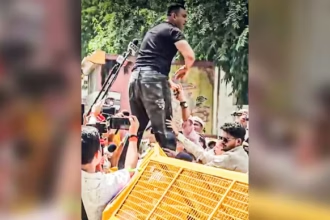
White clouds of teargas hung over Parliament House, slogans echoed through the high-security corridors of central Delhi, and police wielding batons clashed with thousands of young protesters on Monday as the first day of the Mon soon Session descended into one of the biggest youth-led demonstrations in recent years. Answering the call of “Chalo Sansad”, students, job aspirants, parents and citizens converged near Parliament demanding the resignation of Union Education Minister Dhar mendra Pradhan over the alleged NEET paper leak, while expressing solidarity with environmentalist and education reform advocate Dr Sonam Wangchuk.
What began as a march soon spiralled into confronta tions as police used teargas shells and lathis to prevent protesters from reaching Parliament. Carrying the Tricolour and placards, demon strators raised slogans of “Bharat Mata Ki Jai”, “Jai Bhim”, “Vande Mataram” and “Dharmendra Pradhan Istifa Do”. As police sealed roads with barricades, groups of protesters staged sit-ins wherever they were stopped, turning multiple intersections across central Delhi into makeshift pro test sites. The crowd reflected the breadth of the movement, with school and college students, parents, senior citizens and youth from several states participat ing. Some arrived in school uniforms, while others wore cockroach costumes, symbolising the Cockroach Janta Party (CJP). The clashes left more than 50 police personnel and protesters injured, according to police sources. Around 100 people were detained, while 65 medico-legal cases were reg istered at Ram Manohar Lohia Hospital. Police mounted a massive security operation around Parliament, Jantar Mantar and Connaught Place as tensions escalated through the day. The CJP, which has been staging a sit-in at Jantar Mantar since June 20, gained mo mentum after Dr Sonam Wangchuk began his hunger strike and several young activists joined him. Exactly a month later, authorities dismantled the main protest stage at Jantar Mantar, while three youth activists ended their fast unto death. Despite the removal of the protest site, hundreds remained on the streets, gathering in lanes around Jantar Mantar, Connaught Place’s Central Park and outside Metro stations.
There were also reports of vandalism, with videos circulating online showing stones strewn across roads in Connaught Place and damage to parked vehicles. While distancing itself from the violence, the CJP maintained that its agitation would continue peacefully. CJP founder Abhijeet Dipke, who took over the hunger strike after Wangchuk was re moved from Jantar Mantar following a 21-day fast, was detained by police along with several others, including Wangchuk’s wife, Gitanjali Angmo. The group later resumed its sit-in at Kerala House nearby. Meanwhile, Wangchuk, undergoing treatment at Safdarjung Hospital, declared he would continue fasting until youth representatives were allowed to meet Members of Parliament or MPs visited him at the hospital. The protests also reverberated inside Parliament, with repeated disruptions in both Houses as Opposition members raised the NEET controversy and demanded accountabil ity from the government. Outside Parliament, the voices of young protesters captured the frustration driving the movement. Seventeen-year-old Anshika said she had told her family she was going to school before joining the march. “We did not lie to our families and come here to be picked up and detained like crim inals.
When it is time for elections, they come to our homes and ask for votes. But they did not even come to engage in a dialogue over the NEET paper leak,” she said, showing bruises sustained during the clashes. Similar demonstrations were reported from Mumbai, Ahmedabad and several other cities, signalling that what began as anger over an alleged examination paper leak has evolved into a wider youth movement demanding transparency, accountability and polit ical responsibility.