SHASHWAT GUPTA RAY
[email protected]
VASCO: Exactly 27 years ago, the Indian armed forces regained control over their posts after evicting the Pa-kistani intruders following an intense and bloody battle for nearly three months on the icy peaks of Kargil, in Kashmir.
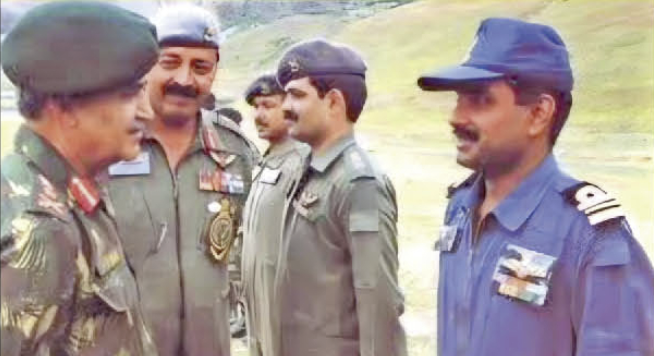
One of the brave hearts fighting for his motherland was Vasco-based Indian Navy veteran, Captain Utpal Datta (retd), the only Navy helicopter pilot to fly Army choppers, the Cheetah, in the Kargil and Drass sectors during the 1999 Indo-Pak Kargil conflict while undertaking search and rescue missions.

For his courage in the face of intense enemy fire and harsh operational condi-tions, Captain Datta was awarded the Nau Sena Medal (Gallantry). During the Kargil War in 1999, Captain Datta held the rank of Lieutenant Commander.
Reminiscing about his role in Op Vijay, operating in the epicenter of the conflict zone 27 years ago, Captain Datta said: “I had completed exactly 10 years of commissioned service until 1999. Following my transfer to Army Aviation unit at the end of December 1998, I joined the 23(1) R&O flight under the 6 Mountain Division in Bareilly in January 1999.”
“The core events began on June 4, 1999, during a routine reconnaissance flight. We received an urgent directive from Air Traffic Control to return to base. Upon landing, we were instructed to deploy immediately to the Kashmir valley,” he said.
As a reserve division, the helicopter pilots and ground forces of the 6 Mountain Division in Bareilly are fully cleared for immediate operations in mountainous terrain, which prompted their swift deployment to the Valley.
The intense training enables us to push both personnel and equipment to their absolute limits. For instance, during operations where we served as the aerial observation for Bofors artillery units, we frequently op-erated well beyond standard limitations – Captain Utpal Datta, NM (Gallantry) retd, former navy helicopter pilot
The primary responsibilities of the pilots involved search and rescue operations. Due to the constant risk of enemy shelling, the choppers remained fully loaded with water and ammunition. “We adhered to a strict protocol where ground time during landings was limited to 30-40 seconds to minimise exposure. I also had the privilege to fly the then Chief of Army Staff, General V P Malik, and provide an aerial overview of the area of operations during such a critical period,” he said.
Attributing the success of the Indian armed forces in the harshest of conditions to an intense training regimen, the Navy veteran said: “It enables us to push both personnel and equipment to their absolute limits. For instance, during operations where we served as the aerial observation for Bofors artillery units, we frequently operated well beyond standard limitations,” he said.
Captain Datta said in many missions he pushed the helicopter to 26,400 feet, beyond the designed ceiling of 13,000 feet.”Operating at such altitudes introduces extreme physiological challenges, including a severely limited time of useful consciousness and the immediate risk of hypoxia. To mitigate this, our two-pilot crew developed a coordinated system of alternating the control every minute, hyperventilating with 100% oxygen to maintain consciousness and complete the mission,” he informed.
While technology continues to evolve and integrate into the forces, the core driver of Indian armed forces’ success remains the foundational ethos, and the high motivation-or “Josh”-inculcated from the Academy onward, he said.