Govind S Poteker
Festival filled with fun always bring lots of amusement, and Gopal Kalo or popularly known as Chikhal Kalo festival has all the elements that signify Lord Krishna’s younger days when he played traditional games in the forest along with his friends, Gopalas. The celebrated monsoon festival of Chikhal Kalo is all set to herald at the courtyard ground opposite Shree Devi Devki-Krishna temple at Marcel today, July 26. It is held during the lunar calendar month of Ashadh on Dwadashi day. This temple is considered as the only temple where mother and son are revered together and the festival is believed to be held at for the last 400 years. Many of the temples in Marcel were earlier located at Chodan (Chorao) before the Portuguese rule in Goa.


Although many festivals are held in this temple village of Marcel or Mashel, which is home to some 33 temples, Chikhal Kalo is the signature festival which has gained prominence over the years. Recently, state government has elevated it as the state festival. Large numbers of locals as well as tourists attend the festival enjoying a great cultural tradition of Goa that is kept alive by devotees of Lord Krishna.

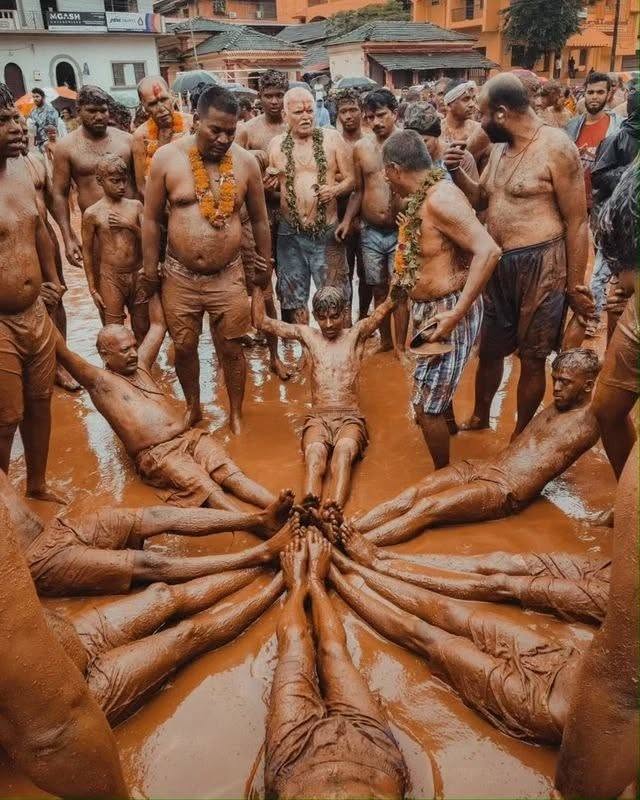
Toddlers, young and the elderly from Deulwada turn into Gopalas, the friends of Krishna and participate in the mud festival. Now it is a three day festival comprise of variety cultural programmes. Fun-filled excitement of dancing and playing games in the mud has remained a biq draw to revelers.
Prominent resident of the village and educationist, Premanand Shirodkar, has seen the changing scene of Chikhal Kalo from his heydays when it was a small festival centered with participants residing only in the Deulwada region. In recent time it has gained international publicity, agrees Premanand.
Festivity before the D-Day begins 24 hours on Ekadashi day with lighting of sacred lamp (Divli) in the afternoon in the precinct of Shree Devki-Krishna temple, and when the non-stop devotional Bhajan Saptah presentation by various groups begins that include bhajan by Mahashala Kala Mahila Sangh, says Premanand. Most important is that the Taal beats (playing of cymbals) continue without a break. That tradition (Parampara) is religiously followed even now.
Rajendra Phadte who belongs to Pandurang Brahmeshwar Mandap from Akhada who regularly take part in the bhajan recital states, “We feel extremely delighted to perform in this festival as our honour and service to the deities for more than ten years. Our group comprises about 12-14 members that include both male and female artistes. During Chikhal Kalo celebration, it is pleasant to observe that young parents bring their toddler, barely few months old and apply mud over their body. There is a strong belief that minerals in clay are supposed to protect one from skin ailments, feels Rajendra.
Premanand informs that the next day in the afternoon at 12 prm. after invocation and blessing from deity for the success of festival, the temple priest (Pujari) sprinkles sacred Tirth on Gopalas who smear their bodies with oil from the sacred Divli. There is age old tradition that the oil is supplied by the local shopkeepers free of cost for the festival. To the playing of musical beats of drums and cymbals and chants ‘Vithal Vithal Jai Hari Vithal’ on their lips, Gopalas circumambulate the temple and lead to the ground where a gathered crowd keenly wait to experience the games Gopalas play, some keeping safe distance lest, they get smeared in sacred clay. But for others enjoy it, for whom it is akin to colours of Holi.

That marks the beginning to great festivit with games after game unfold on the slushy ground. Various games are played, says Premanand, such as Chakra (human wheel), cat and mouse chase game, Beduk Udi (Frog jumping), Chendu-Fali (bat and ball game), Tug of war, kabaddi and wrestling (Khusti), etc. Youngsters on the other hand keep themselves busy enjoying the moment throwing mud or one another. The Gopalas then divide into two groups and play a game of words, which is hilarious with puns and swear words, but the is immunity as everything is taken sportingly by everyone with smile and laughter. And, or can’t miss the mock wedding too of two young boys acting as bride and groom.
Finally, what attracts the gathered devotes of Lord Krishna is the breaking of Dahi-Handi with Gopalas building a human pyramid to reach the pot filled with curd hanging from Pipal tree (ficus religiousa) marking the grand finale to a day where dancing in mud is thought to be the only rule. Revelers are offered Prasad in the form of variety sweet, laddoo, kappa, jilebi, puran poli, sweet poori, but the most prized one are the ‘Boll’ made from wheat flour, coconut and jaggery. Getting Prasad is like winning a lottery as everyone try to catch as it is tossed in air.
Later, Gopalas take a bath in the nearby Talli (pool) located close to Shree Mallikarjun temple, and Aarthi at the Shree Devki-Krishna temple brings to a close to a fascinating festi engrossed with nature. Though science has progressed, the traditional festival like Chikhal Kalo still retain its ethnic flavour and big draw as people’s faith in age old festivals and practices help to keep society together thereby forgetting all ills and rejoice in the divine blessings.