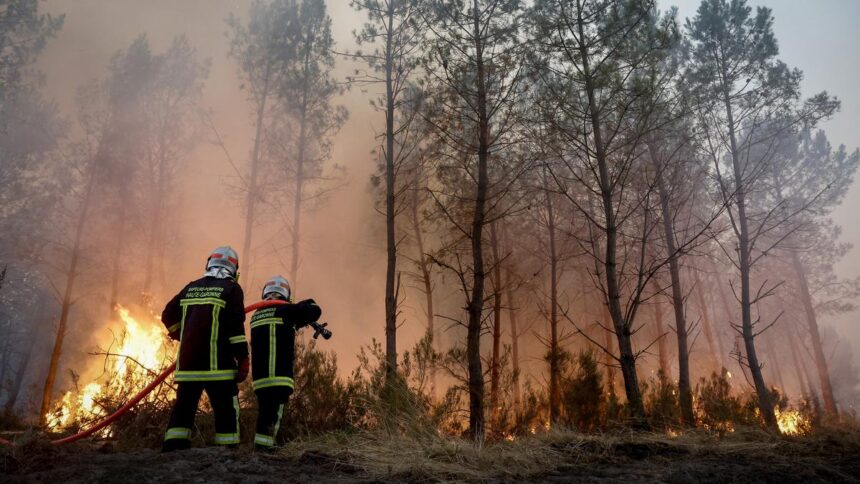
More than 325,000 people have been forced to flee their homes as devastating wildfires sweep across France and Spain, triggering one of Europe’s worst fire emergencies in decades. Fuelled by record-breaking heatwaves, prolonged drought and powerful winds, the blazes have scorched vast forests, threatened major cities and stretched emergency services to their limits. With fresh fires also reported in Italy and other Mediterranean countries, scientists say the crisis reflects a worrying new reality in which climate change is making wildfires more frequent, more intense and increasingly difficult to contain.
Contents
What triggered the current wildfire emergency?
- Record-breaking heatwaves and prolonged drought have left forests and vegetation dangerously dry, creating ideal conditions for wildfires.
- Strong winds are spreading flames rapidly and making firefighting efforts highly unpredictable.
- Dense forests and low humidity have allowed several fires to merge into massive wildfire complexes.
Where are the fires spreading?
- France’s Gironde department, including Bordeaux, Arcachon Bay and Cap Ferret, has become the centre of the country’s biggest wildfire emergency.
- In Spain, major fires have spread across Ávila, Madrid, Toledo, Andalusia and Castellón, forcing large-scale evacuations.
- The crisis has also spread to Italy and other Mediterranean countries as extreme heat grips southern Europe.
Why are these fires proving so difficult to contain?
- Extreme heat, drought and strong winds are creating fast-moving fires that frequently change direction.
- Multiple large blazes are burning simultaneously, stretching firefighters and emergency resources.
- Authorities are prioritising evacuations and protecting communities over extinguishing every fire.
Pyrocumulonimbus clouds explained
- Pyrocumulonimbus (PyroCb) clouds are thunderstorm-like clouds formed by the intense heat generated from wildfires.
- They can produce lightning, strong winds and flying embers that ignite fresh fires kilometres away.
- Their formation shows a wildfire has become powerful enough to create its own weather system.
How are authorities responding?
- France and Spain have deployed thousands of firefighters, helicopters and water-bombing aircraft.
- Fire crews are using controlled backfires to remove vegetation and slow the advance of the flames.
- Several European countries have joined the response by sending aircraft, equipment and specialist teams.
What has been the impact so far?
- More than 325,000 people have been evacuated, making it one of Europe’s largest wildfire displacement events in recent years.
- Thousands of hectares of forests, farmland and wildlife habitats have been destroyed.
- Road closures, transport disruptions and losses to tourism and agriculture have added to the economic toll.
Is climate change worsening Europe’s wildfire crisis?
- Scientists say rising temperatures and prolonged drought are extending Europe’s wildfire season.
- More frequent heatwaves are making forests drier and fires larger, faster and more destructive.
- Experts warn better climate adaptation and forest management will be essential to reduce future risks.
What happens next?
- Weather conditions over the coming days will determine whether firefighters can contain the blazes.
- Authorities remain on alert as strong winds could trigger fresh flare-ups and further evacuations.
- Experts warn Europe must prepare for more frequent and intense wildfire seasons in the years ahead.