Dolcy D’Cruz
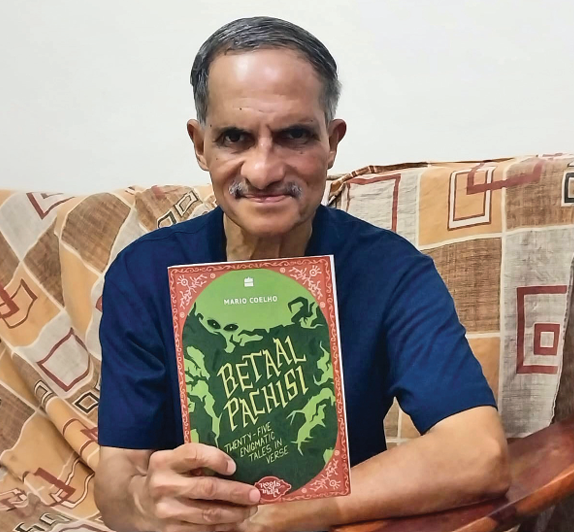
‘Betaal Pachisi’ are spellbinding stories told to the wise King Vikramaditya by the wily ghost Betaal. On a moonless night, King Vikramaditya ventures into a frightening burial ground to carry a corpse inhabited by the spirit Betaal to a mendicant waiting at the other end. Each time the king answers one of Betaal’s riddles, the spirit slips away and returns to the tree from which he was taken, forcing Vikram to begin the perilous journey all over again. This familiar premise forms the basis of Mario Coelho’s new book, ‘Betaal Pachisi’ which gives the 25 celebrated Vikram-Betaal tales a distinctive poetic treatment.

Chimbel-based Mario, a Goan writer, has retold all 25 stories in verse. The book remains faithful to the spirit of the traditional tales while making the stories accessible to today’s young readers. The idea had been offered to him by HarperCollins several years ago, but Mario initially declined because he was working on his own children’s stories. When the opportunity returned, he decided to take up the challenge. He selected the stories that appealed to him most and began rewriting them in verse. ‘Roots of India: Betaal Pachisi – Twenty-five Enigmatic Tales in Verse,’ written by Mario Coelho and published by HarperCollins Publishers India.
The stories are set in an earlier era, with kings, queens, princes and other characters from a world that children today may find difficult to relate to. Writing in verse was one part of the process, but making the stories engaging enough to prevent them from seeming like distant tales of royalty was equally important. “I had to do the story in such a way that it will hold the attention of today’s generation. That was a challenge for me. I kept the spirit of each story without interfering. At the same time, the knowledge and wisdom is not solely Vikram’s, it’s also mine. So it gave me a chance to put my own value system there,” he adds.
Vikramaditya is the legendary and perhaps bravest king in the universe. At one point in the story, however, even this great king reaches the point of collapse. In Mario’s retelling, the moon then calls upon the other planets and stars, and the entire universe seems to gather around Vikram, shining its strength upon him and healing his battered body. “This is my own version. You will not find it anywhere,” Mario says. In a flash of light, Vikram is revived, renewed and strengthened, and rises to continue his journey. One of Mario’s most striking additions is a solitary star shining above Vikram throughout his ordeal.
When the king becomes exhausted and wonders why he continues, the star becomes a symbol of hope and strength. “For me, the star is essentially a symbol of the strength we receive from above when we feel we cannot go on, when everything seems lost or we begin to question why we are here. I believe, divinity is always with you. Always keep your eyes upward, do what you have to do and fulfil your assignment. I have a very strong belief in God, and I believe we must dream bigger and trust that there is always a higher presence guiding and strengthening us,” he explains. The relationship between Vikram and Betaal is also given a fresh dimension. In the original tales, Vikram is bound by the rules of the challenge and Betaal continually tests him with riddles. Mario introduces an extended conversational exchange between the two, “The dialogue between Vikram and Betaal is entirely my own creation. In the original, Vikram is not supposed to respond, but I wanted to introduce a livelier back-and-forth between the two characters.
At one point, Vikram loses patience and tells Betaal, in effect, that he talks too much and challenges him to go ahead and smash his head if he dares. This gives their relationship a touch of humour and creates a more engaging exchange between the two.” The riddles remain faithful to the traditional stories, but Mario takes creative liberties with the answers and their interpretation. “I took liberties. I went out on a limb, and I’m happy to say that the book has been accepted,” says Mario, who describes the process as an opportunity to combine the wisdom of the original tales with his own value system. Visual storytelling is another important element of Mario’s writing. He wants readers to be able to see his characters and settings in their minds, whether the scene involves a terrifying graveyard or an ordinary person caught in extraordinary circumstances. His fascination with thrillers, detective stories and supernatural fiction has also shaped his writing. His first book, ‘Moonlight and Shadow – Unsettling Tales’, was a collection of stories centred on murder and intrigue, followed by ‘The Twisted Child – Tales of the Unexpected’, brought together twelve short stories set in Goa. His interest in storytelling, however, began much earlier and was closely connected to his daughter Rebecca.
When she was young, Mario would invent stories to put her to sleep. She rejected familiar fairy tales and demanded stories about new characters, prompting him to create tales about Khalil, Sara and Rebecca herself. “On the spot, I had to make up a story, the adventures of Khalil, the little prince, Rebecca and the Magic Ring. When she went to school the next day, I started writing all these stories.
I got a combination of children’s stories,” he recalls. Those improvised bedtime adventures eventually became written stories and laid the foundation for his work in children’s literature. For Mario, however, writing remains a long term pursuit requiring patience. His Vikram Betaal project has given him confidence that he can take well-known Indian mythology and folklore and transform it into something entirely new. He is already looking towards the Panchatantra and Akbar-Birbal tales, while continuing to dream of seeing his own original characters and stories reach readers.