Dolcy D’Cruz
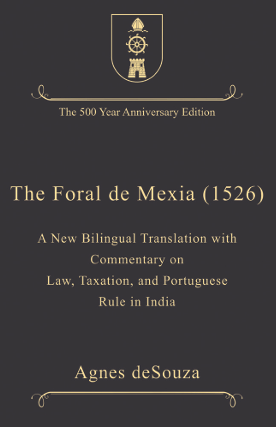
‘Foral de Mexia,’ issued on September 16, 1526, was the charter set out the rights, obligations, dues, jurisdictions and administrative arrangements governing the villages under early Portuguese control. It recognised and regulated the customary rights of Goa’s hereditary village landholders, or gaunkars, bringing an existing local system into the legal framework of the Portuguese Crown. Exactly five centuries to the day after the ‘Foral de Mexia’ was issued, the Goa Book Club and Broadway Book Centre will co-host a discussion on the landmark charter. Historian and author Dr Sharmila Pais will introduce the ‘Foral’, which will also be at the centre of the launch of a new bilingual edition ‘The Foral de Mexia (1526): A New Bilingual Translation with Commentary on Law, Taxation, and Portuguese Rule in India’ by historian and author Agnes deSouza. The discussion will be held at Broadway Book Centre, Panjim today, September 16, at 5pm.

The event is open to the public, with attendees required to confirm their participation. The 500 Year Anniversary edition is a 180-page book, which contains the original Portuguese text alongside a new English translation, detailed article-by-article commentary and five chapters. Agnes deSouza is American and her father Glenn’s family has roots in Goa. Her works includes a translation from classical Chinese of the religious writings of Xu Guangqi, the Ming imperial official who became a key patron and protector of the Jesuits in China. Her great grandfather, Dr F X deSouza, was the first Indian Christian to enter the Indian Civil Service and represented Indian Christians in Parliament. His sister, Seraphina married a D’Souza and had five children, four of whom became priests, including Fr Jerome D’Souza, who played a role in shaping Article 25 of the Indian Constitution. “This family tradition has inspired me to seek a career in law and to learn more about the role of religion in society and how we can preserve and enhance our religious heritage. Going back to my roots has given me a much deeper sense of identity and pride in being not only Indian, but Luso-Indian. I think we have combined the best of both rich traditions,” says Agnes, who is currently based in Switzerland. “The project began with a simple personal question: why did my family have the Portuguese name deSouza? I grew up in Shanghai and knew that my father’s family was Catholic and Indian, but I did not fully understand our earlier connection to Goa or the meaning of being Luso-Indian. The ‘Foral’ offered a way to explore that history through an original document rather than through family memory alone. I began by researching a name. I ended by discovering a history,” she explains about what inspired her research. Portugal could conquer Goa with its navy, but it could not govern Goa by force alone.
Why is the ‘Foral de Mexia’ important in understanding how Portuguese rule in Goa was sustained for more than four centuries? “The Foral gave Goa’s hereditary village elites a financial and political stake in Portuguese rule. Portugal was a tiny country, with a population of roughly 1.4 million, but it had become a maritime superpower. In Goa, the Portuguese encountered a complex society whose language and institutions they did not understand. It therefore made strategic sense to enlist the support of local elites, the gaunkars, who at that time were dominated by Gaud Saraswat Brahmins, and preserve the existing system of collecting revenue and paying taxes to the ruler. The Portuguese conquered Goa in 1510 with the assistance of Timoja, a Hindu naval commander. Sixteen years later, the gaunkars participated in the preparation of the ‘Foral de Mexia’, as King João III acknowledges in its Preamble,” she says, In Goa, the charter covered the Island of Tiswadi, where the city of Goa was located, along with 31 other villages. Among those named were Neura, Calapor, Gancim, Morombim, Ella, Carambolim, Azossim and Batim, as well as a number of smaller villages. The ‘Foral’ kept the existing gaunkari system intact. Gaunkars collected rents from cultivators in their villages, paid an agreed amount to the Portuguese Crown and retained the difference. Their rights were hereditary and could be passed on to their sons. The major change was that the revenue once paid to the Bijapur Sultanate was now paid to the Portuguese. The ‘Foral’ itself was brief, containing only 49 articles, but its provisions were remarkably wide-ranging.
They dealt with taxation, inheritance, dispute resolution, landholding, village administration and community rights. According to Agnes, the gaunkari system existed by at least the eleventh century. It survived the Kadambas, the Vijayanagara Empire, the Bahmani Sultanate and the Bijapur Sultanate. “When the Portuguese conquered Goa in 1510, they preserved the system and made it part of Portuguese law through the ‘Foral de Mexia’ of 1526. The gaunkari was not simply a collection of individual landowners. It was a village corporation. Membership was inherited through particular families and lineages known as vangods. The gaunkars met in village assemblies, allocated land for cultivation, organised irrigation and other common works, collected revenue and paid the amount owed to the ruler. After meeting the village’s expenses, they divided the remaining income among themselves through an annual payment known as the ‘zonn’. The Portuguese did not create the gaunkari system. They codified it. The Portuguese ruled Goa, but much of village life remained in the hands of its hereditary local elite. The ‘Foral’ therefore became an important institutional bridge between the old and the new. It preserved the existing village order while bringing it under Portuguese sovereignty. In doing so, it helped create a partnership that would prove remarkably durable,” she says. After translating and studying the ‘Foral de Mexia in depth’, what is the one misconception about Portuguese Goa that Agnes would most like readers to reconsider? “The greatest misconception is that Portuguese rule in Goa was sustained by force alone. It also depended on cooperation with local elites starting with Timoja who helped in the conquest of Goa, Catholic conversion and the creation of a distinctive Luso-Indian culture.
The relationship between Portugal and Goa was exceptionally deep and complex. Portuguese India was not simply another version of British India. In Goa, the Portuguese treated the territory as part of Portugal, encouraged intermarriage and promoted Portuguese names, language and customs,” she explains. Agnes is in awe of the Goan historians who have dedicated so much of their lives to educating about Goa’s history, including Sharmilla Pais, Rochelle Pinto, Rowena Robinson and Celsa Pinto. “The work of the Xavier Centre of Historical Research under Fr Rinald D’Souza, particularly in bringing international scholars to Goa, has also been inspiring. And, of course, to Frederick Noronha whose Goa 1556 has helped bring much new light on this part of history. It has helped Goans write our own history rather than leave that task to others. What is still often missing from popular accounts is the economic reason local elites cooperated with an imperial power. Empire was sustained not only by the power of the ruler, but also by the interests of those who agreed to work with the ruler. My contribution is to use the Foral de Mexia to bring that partnership into clearer view and to compare it with the responses of local elites to empire in Brazil and British India,” concludes Agnes.