LUIS DIAS
In this month’s column, I would like to cast the spotlight on the former Directorate of Accounts building, previously the Fa zenda Pública e Contadoria Geral (Public Treasury and Accounting department) during the Portuguese era. Those around my age and older will remember it was one of the stops for the Panjim city bus, and pas sengers and bus conductors alike referred to the stop as ‘Fazenda.’ It is believed that the orig inal building on this site was the harem of Yusuf Adil Shah, with much speculation (not supported by any evidence to my knowledge) of an under ground tunnel connecting it to the Adil Shah Palace (also known to us as ‘old Secretari at’).

Highly improbable as the tunnel would have had to be quite deep underground, and water-resistant, there was a water-filled moat between the two, which was filled in the 1700s to create the road we use today. The building which until recently housed the Directo rate of Accounts and still has the Secretariat branch of the State Bank of India toward the end facing the old Sec retariat began as a smaller structure that was expanded between 1851 and 1855. José Nicolau da Fonseca in his 1878 book ‘Historical and Archaeological Sketch of the City of Goa’ already describes the building as the Contado ria Geral, or the Accountant General’s office, and gives its dimensions as 249 feet long and 128 feet broad, cover ing an area of almost 32,000 square feet.
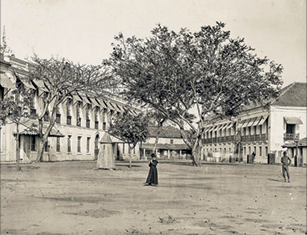
Major modifica tions were carried out from 1881-1885. The accompanying picture seems to have been taken in the 1890s, and shows the Fa zenda building to the left. Looked at from above via Google Earth, it is rectangu lar in shape enclosing a cen tral courtyard (as many other private and public heritage buildings in Panjim seem to do). At the corner of the build ing that faces the old Secre tariat lies a stone plaque in a terrible state of disfiguration, which reads: “No reinado de Sua Majestade D. João VI, governando a Índia o ilus tre e excelente D. Manoel da Câmara, pela portaria de 25 de Novembro de 1824 esta beleceu o Monte-pio para o Exército de Goa, tendo er igido este ad perpétuo me moriam.” (In the reign of His Majesty D. João VI, governing India the illustrious and ex cellent D. Manoel da Camara, by the Ordinance of Novem ber 25, 1824 established the Monte-pio for the Army of Goa, having erected this in perpetual memory).
The term monte-pio is de rived from the Italian ‘Monte de Pietà’, mount or ‘fund’ of piety, a charitable initiative to control usury. According to Padre Gabriel de Saldanha (História de Goa Vol. 1, 1925), the next viceroy D. Manoel de Portugal e Castro (1827-35) added the military monte-pio to the Public Treasury, and the monte-pio was abolished in 1874. Also worth mentioning is the majestic centennial (actually much older, as it was already quite large in a 1910 photograph) peepal tree across the road from the building, near the petrol station. One hopes our city fathers will leave it unmo lested. It poses no danger to anyone, but offers instead all the blessings of oxygen, clearance of carbon dioxide, and much-needed shade, lowering of ambient temper ature and more.
Sadly, there is free public access to the portion of the building housing the State Bank Secretariat branch, but across the partition, the part formerly occupied by the Directorate of Accounts is inaccessible to the public, dormant like Sleeping Beau ty in the fairy tale except for about a week in December, when it magically opens its doors, all scrubbed and cleaned lickety-split, given the “kiss of life” for another edition of the Serendipity Arts Festival (SAF). Since the many times last December when I visited the building to feast my eyes on the Caravaggio painting ‘Mary Magdalene in Ecstasy / Maddalena in Estasi’ (1606), it is currently ‘off-limits’. The SAF serves to high light the yawning gap be tween what is possible, and what we the public citizenry are offered instead. Across from the Fazenda building, in the Adil Shah Palace lie the priceless artefacts of the Goa State Museum in a de plorable condition. These artefacts, and the building they are in, are our collec tive public heritage.
It is the bounden duty of our elected officials and bureaucrats, on salaries paid with taxpayers’ money, to showcase them favourably to the public and ensure their maintenance. I recently wrote in another section of the press about the artwork of Raghuveer Govid Chimulkar (1904/5 -1948), son of our soil. He, along with the pantheon of great Goan artists ought to be better known, and this can only happen if their work is displayed to the public daily. We are grateful to SAF for the once-in-a-blue-moon sight ing of a Caravaggio in Goa, rare as Haley’s comet. But it underscores even more the unconscionable non-visibili ty of a Laxman Pai, Gaitonde, Navelcar, FN Souza, Fonseca or Chimulkar in Goa’s capital city! So much for Goenkar ponn! SAF also shows how in tra-city shuttle services can efficiently prevent traffic congestion for the festival duration. The Smart City buses are a positive step, but unless one already knows the routes and timings, it is diffi cult to figure out where a bus halts or is headed, and when. The online information is even more confusing. Keeping the Fazenda build ing shut and neglected year round (with the exception of one week in December for SAF) is a shameful waste of a beautiful irreplaceable heritage space.
It is also my opic to think only in terms of monetization and revenue, while ignoring the idea of the greater public good. SAF is already advertising its 2026 edition at the Fazen da building, highlighting “its secret tunnels” (which has no factual basis but hints darkly and erroneously at scandal). Our precious heritage is misrepresented into tawdry, factually incorrect innuendo for the consumption of visi tors and tourists. To reclaim the dignity and the history of our capital city and State, we must first take pride in it ourselves. That starts with loving and looking after it. (Dr. Luis Dias is a phy sician, musician, writer and founder of Child’s Play India Foundation. He blogs at luisdias.wordpress.com)