MARCOS GONSALVES & SHASHWAT GUPTA RAY
Goa recorded 30 cases of crime against senior citizens in 2024, down from 60 in 2017, according to Nation al Crime Records Bureau (NCRB) data. But the fall in registered cases may say less about the safety of the State’s elderly than about the extent of abuse that re mains outside the criminal justice system. The State registered 424 cases involving senior cit izens between 2015 and 2024 — 59 in 2015, 43 in 2016, 60 in 2017, 36 in 2018, 40 in 2019, 31 in 2020, 50 in 2021, 35 in 2022, 40 in 2023 and 30 in 2024. The figures become more troubling when placed alongside survey findings. A HelpAge India survey conducted in Goa with the All-Goa Senior Citizens Fed eration found that nearly seven in 10 respondents re ported emotional abuse, 65 per cent financial exploita tion and around 55 per cent physical mistreatment. The findings highlight a key limitation of police records: much elder abuse never becomes an FIR.

Financial exploitation re portedly included misuse of pensions, unauthorised con trol of bank accounts and pressure over property — forms of abuse that can re main hidden when victims depend on family members for care or financial support. An earlier Goa survey re leased in 2023 found that 53 per cent of elderly re spondents felt disrespect ed, while 30 per cent per ceived verbal abuse and 20 per cent reported physical abuse. Yet 45 per cent said they had done nothing in response, citing concerns over reporting and the availability of support.
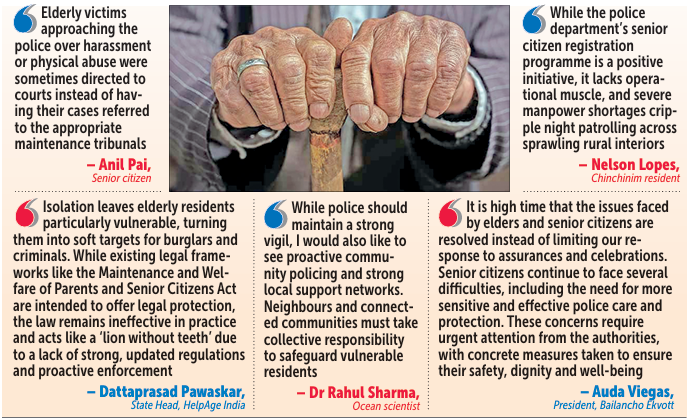
The criminal justice data reveal another gap. At the end of 2024, 25 cases were pending investigation, while the charge-sheeting rate stood at 72.7 per cent and investiga tion-stage pendency at 43.1 per cent. As many as 223 cases were pending trial, with only one conviction recorded dur ing the year. For elderly victims already reluctant to report abuse, a prolonged legal process can become another barrier to seeking justice. Anil Pai, a senior citizen and former active member of a senior citizens’ association, had in 2023 raised concerns over the implementation of the Maintenance and Welfare of Parents and Senior Citizens Act, 2007. Speaking to OHeraldo, he alleged that “elderly victims approaching the police over harassment or physical abuse were sometimes directed to courts instead of having their cases referred to the appropriate maintenance tribunals.” The vulnerability also extends beyond family abuse. “In July 2025, a senior citizen in Chandor was reportedly attacked and robbed of cash and gold worth around Rs 12 lakh, prompting calls for increased police patrolling and protection of elderly residents,” said Peter Viegas, another senior citizen and retired government servant.
In another case, two men allegedly posing as policemen targeted senior citizens in Vasco and Fatorda, prompting Goa Police to issue an advisory asking elderly residents to remain cautious. For many elderly Goans, the security problem begins much before a crime is committed. Chinchinim resident Nelson Lopes said the migration of young people abroad in search of better prospects had left many parents living alone. While practical constraints of ten prevent children from taking their parents with them, many seniors also prefer to remain independent and age in their ancestral homes rather than move into institutional care. “Yet, Goa severely lacks standardised senior living in frastructure that balances autonomy with safety.
This iso lation has exposed critical security vulnerabilities. In the absence of mandatory, structured verification, relying on private maids and caretakers often backfires — driven by mistrust and insider-facilitated crimes,” Lopes said. He also questioned whether existing policing mecha nisms were sufficient to protect isolated elderly residents, particularly in rural areas. “While the police department’s senior citizen registra tion programme is a positive initiative, it lacks operational muscle, and severe manpower shortages cripple night pa trolling across sprawling rural interiors,” Lopes said. He said technology could not substitute for preventive policing. “Even modern tech solutions like CCTVs offer false com fort, acting merely as post-incident record keepers rather than active deterrents against violent dacoities and home invasions,” the octogenarian said.
According to HelpAge India State Head Dattaprasad Pawaskar, isolation has become a major vulnerability for elderly residents whose children have migrated to cities or overseas. “This isolation leaves elderly residents particularly vul nerable, turning them into soft targets for burglars and criminals. While existing legal frameworks like the Main tenance and Welfare of Parents and Senior Citizens Act are intended to offer legal protection, the law remains ineffec tive in practice and acts like a ‘lion without teeth’ due to a lack of strong, updated regulations and proactive enforce ment,” Pawaskar said. He also pointed to neglect within families, arguing that financial prosperity does not necessarily translate into ad equate care. “Modern generations often lack the patience required to support bedridden or ailing parents, especially when deal ing with complex care needs such as incontinence. Surpris ingly, economic stability does not guarantee proper elder care.
More than half the distress cases reaching support or ganisations involve well-to-do children — many employed in government positions — who neglect their elderly par ents despite having ample financial means,” Pawaskar said. He said provisions allowing senior citizens living alone to register with local police stations for regular wellness checks were rarely implemented on the ground. “To address familial neglect, Goa could adopt legislative models like the one in Uttar Pradesh, where a portion of a government employee’s salary is directly deducted to sup port neglected parents. Ultimately, restoring safety requires rebuilding trust, as many elderly victims currently refrain from reporting crimes or filing complaints simply because they lack confidence in the police, the legal system, and state machinery to deliver timely justice,” Pawaskar added.
The vulnerability is also increasingly digital. Veteran ocean scientist Dr Rahul Sharma said a lack of awareness about modern digital threats, combined with the trust older people place in others, makes them vulner “Unlike younger, digitally-native generations who are naturally more cautious, seniors often open suspicious messages out of curiosity or answer unfamiliar calls out of habit,” Sharma said. He said protection could not rest entirely on police in tervention. “While police should maintain a strong vigil, I would also like to see proactive community policing and strong local support networks. Neighbours and connected communi ties must take collective responsibility to safeguard vulner able residents,” Sharma said. The State has introduced formal support mechanisms. The Directorate of Social Welfare signed an MoU in October 2024 to introduce Elderline 14567, a toll-free helpline of fering information, guidance, emotional support and field intervention in cases of abuse. But a helpline cannot by itself address the wider prob lem if victims remain unwilling or unable to report abuse.
As Goa observes World Elders’ Day on October 1, the challenge therefore extends beyond counting FIRs. “It is high time that the issues faced by elders and senior citizens are resolved instead of limiting our response to as surances and celebrations. Senior citizens continue to face several difficulties, including the need for more sensitive and effective police care and protection. These concerns re quire urgent attention from the authorities, with concrete measures taken to ensure their safety, dignity and well-be ing,” said Auda Viegas, President, Bailancho Ekvott.