Freddy Fernandes
On this 58th Anniversary of the Opinion Poll, we need to be aware of the Damocles sword that was hanging over Goa, that of merger of Goa with Maharashtra. Although the Opinion Poll battle for identity was won, today the political class and people individually and collectively have to do some soul searching on whether and how long, Goa as we knew/know it, with all its beauty, its unique culture and identity, will survive for us and for our future generations, especially in terms of intergenerational equity.

Can the Union government, the State Government and the people of Goa redeem the pledge of the great Statesman and Visionary Jawaharlal Nehru who said “Goa has a distinct personality and we have recognised it. It will be a pity to destroy that individuality and we have decided to maintain it…”? The answer lies in each one of our hearts and in the hands of the government and the present Cabinet. What if we have swanky highways, and signature bridges? What if we have crores in our bank accounts and finally forfeit Goa and sell our motherland? The Pramod Sawant cabinet must act to make policies and legislation to save our lands and identity. The people must resolve not to sell lands to outsiders. Otherwise, we will have only ourselves to blame and the landmark Opinion Poll will be just another date in history.
The Opinion Poll was a Red Letter day in Goa’s fledgling post colonial history. 16th January 1967, was the first such referendum ever held in India.
Nehru’s Promise to protect
the identity of Goa
The Congress party under the towering and charismatic leadership of Prime Minister Jawaharlal Nehru assured to retain the language (Konkani) and identity of Goa. On 22nd May 1963, Nehru declared “Goa has a distinct personality and we have recognised it. It will be a pity to destroy that individuality and we have decided to maintain it… No agitation against it will be of any purpose.
The MGP STance
While the Congress put a 10 year moratorium on the political future of Goa, the Maharashtrawadi Gomantak Party (MGP), appeared to thrive on primarily the contentious issues that the Congress wanted to steer clear of. The party which was a conglomeration of organisations, decided to espouse the cause of Marathi as the official language of Goa, as a corollary toward the larger goal of merger of Goa with Maharashtra, in the context of linguistic formation of states in India.
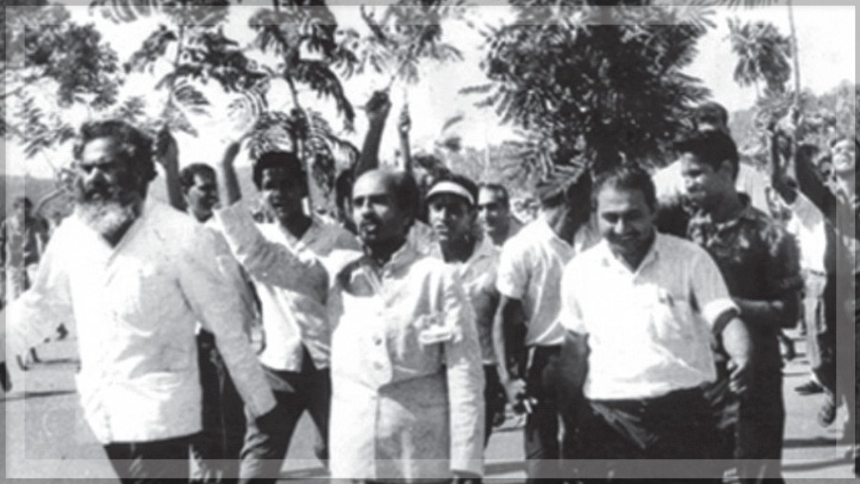
However, it is very interesting to note after Bandodkar’s transform¬ing encounter with India’s iconic Prime Minister Jawaharlal Nehru in Bombay, in December 1963, Bandodkar, decided to go slow on Merger and gradually veered away from the Merger Agenda, as he would be the master of the political destiny of his own Union Territory –Goa.
The United Goans Party
A virtual antithesis to the pro-merger MGP was the United Goans Party (UGP). The UGP was born in 1963 from the merger of like minded parties committed to preserving the Goan identity, more specifically by working for separate Statehood , within the Indian Union. Stalwarts and men with tremendous foresight, such as João Hugo Eduardo de Sequeira popularly known as Dr. Jack de Sequeira, leader of the Goencho Paksh, Dr. Alvaro de Loyola Furtado, leader of the Partido Indiano, J.M. D’Souza, leader of Goan National Union, merged their parties with other parties such as the United Front of Goans and Democratic Party to form the United Goans Party.
Thanks to Jack de Sequeira and others who fought for the Opinion Poll and won it, Goa is today a separate state whose fruits the politicians and the people of Goa are enjoying.
It has also to be acknowledged that the Karnataka factor especially Chief Minister S. Nijalingappa and Karnataka M.P., Hanumanthayah, played a strong role in neutralising the Maharashtra Factor.
The Opinion Poll of 1967
Due to the continuous unrest and agitations in Goa right from 1963 to 1967, even as the Central Government had agreed on a 10 year moratorium, on the political future of Goa, the Centre finally decided to hold the first ever referendum in India, in Goa called the Opinion Poll, to settle the Merger issue. Four years of uncertainty prompted by the MGP agenda for Merger ended on 16th January 1967 when the Opinion Poll was conducted.
voters who saved goa
from merger
Which are the constituencies majority of whose voters sought to save Goa, its unique identity and culture and which are the constituencies majority of whose voters sought to wipe out Goa and its identity and culture are seen from the Table 2 and Table 3
Majority of the people from nine constituencies of North Goa New Conquests, three constituencies, North Goa Old Conquests and just one constituency of South Goa New Conquest voted for Merger and to effectively wipe out Goa from the map of India. However, the extreme right column shows that many people from these constituencies also voted to Save Goa and in some constituencies the margin was very narrow in favour of merger.
However, we owe a very big and deep debt of gratitude to majority of the people of one constituency of North Goa new Conquest, six constituencies of North Goa Old Conquests and five constituencies of South Goa Old Conquests and two constituencies of South Goa New Conquests majority of who voted to Save Goa, its land, identity and culture built over centuries of human evolution in this ancient land, on that sultry 16th January 1967 day.
Generations to come will salute these now unknown voters and leaders who worked tirelessly for three years to save Goa and gave their sweat blood and toil. Goa continues to exist due to the vision, toil and tears of these brave men and women who came out and braved the January heat, stood in long queue and voted in large numbers recording perhaps the highest ever voting percentage in the history of Goa which is 81.70%.
It is to be noted that a substantial number of voters from Curchorem, Mapusa, Siolim, Aldona, Panjim, St Andre, Margao, Navelim and Mormugao and Quepem also voted for merger. However the majority voted to save the Union Territory Status of Goa. But at the end of the day it was Salcete, Mormugao and Cuncolim which tilted the scales in favour of retaining Goa as a separate political entity. The region-wise voting has been analysed for academic understanding of the voting patterns. In actual fact, it was the majority of all of Goa and Goans irrespective of religion, caste and colour and irrespective of regions whose majority vote counted for the overall verdict against Merger of Goa with Maharashtra.
Besides, Jack de Sequeira, the UGP leaders, Rashtramat Editor Chandrakant Keni, many Konkani writers, tiatrists (Konkani drama artistes) and singers and most importantly the voters from all the regions of Goa whether North or South, whether Old or New Conquests, who voted for a separate Union Territory that saved Goa from the disastrous foray of Merger of Goa from Maharashtra.
The suicidal Merger move was orchestrated not only by the MGP alone but the entire mergerist forces comprising MGP, PSP, Jana Sangh (forerunner of the BJP), RSS, Maharashtra Vilinikaran Aghadi (ex-MGP dissidents), CPI, political parties from Maharashtra, a small pro-Merger group of Goa Territorial Congress Committee, Goa Vilinikaran Sahayak Samiti (Bombay), the Government of Maharashtra which opened a Maharashtra Parichaya Kendra at Margao, and the Marathi Press including Gomantak (published from Goa), the Goa Press, the Maharashtra Press and Information Department of Maharashtra Govern¬ment.
Similarly the victory of anti-Mergerists forces comprised the UGP (Sequeira), UGP (Furtado), the other section of Goa Territorial Congress, the action council of the Anti-Merger Convention, the UG party (Bombay) and a significant group centered around the Marathi daily Rashtramat and its editor Chandrakant Keni and effective propaganda enunciating the social, political and economic benefits of not merging with Maharashtra carried out by Rashtramat, the Konkani, Portuguese and Kannada press contributed to their success.
Has the Opinion Poll verdict been neutralised today?
Today on the 58th Anniversary of the historic Opinion Poll and in the years to come, Goans have to collectively do an exercise in contemplation and introspection. We have to contemplate whether we have been worthy of the sacrifices put in by great leaders such as Jack de Sequeira, Chandrakant Keni and other great and visionary men and women and the voters of Goa have gone in vain. If not for the victory in the Opinion Poll, there would be no State of Goa, no Chief Minister and council of Ministers. Goa succeeded in retaining its separate political, territorial, cultural and linguistic identity, through the Opinion Poll but was it a victory for all time? The answer is obviously no.
Today, the short sighted marketing of Goa as a beautiful, peaceful and Golden Goa and the blitz on social media of Goa as Maldives of India and a real estate haunt with grandiose villas, has led to thronging of the rich and famous and also the labour class from other parts of the country into Goa. Today the ill thought out and reckless sale of land of Goa by comunidades and Goans themselves assisted by mega brokers from outside the state has destroyed the very things that we sought to preserve — Goan land, language and identity. As per unofficial statistics the non Goan population of Goa is more than the ethnic population of Goa. People from all part of the country are flocking to Goa and settling down in this so called Paradise and Rome of the East. The real estate boom has in fact been the real life doom of Goa. The flood of mega housing projects and the rage of high end villas and their sale has spelt doom for Goa.
Can we still Save Goa?
At the time of Liberation, unlike in the case of Hyderabad and in Jammu and Kashmir there was no Treaty signed to ask for any Special Status for Goa or any concessions to protect Goa. Unlike Hyderabad and Jammu and Kashmir, Goa more than any other State in India needed a Special Status right from 1961, due to its tiny size. Goa joining the India Federation and due to secular and multicultural ethos of India right from times immemorial, has the right to preserve it land, culture, and identity. Government after government in Goa have stood as mute spectators and have done nothing to save Goa from the onslaught of inmigration. Instead of protecting Goa and its lands, politicians today have become land brokers in league with the big real estate brokers, as exposed by the Opposition itself. People themselves are selling their lands. So the question is how Goa can be saved and whether individually and collective, as a government and as people we will work to save Goa.
(Excerpts from the forthcoming book ‘Post Colonial Politics of Goa, from Liberation
to Statehood’)