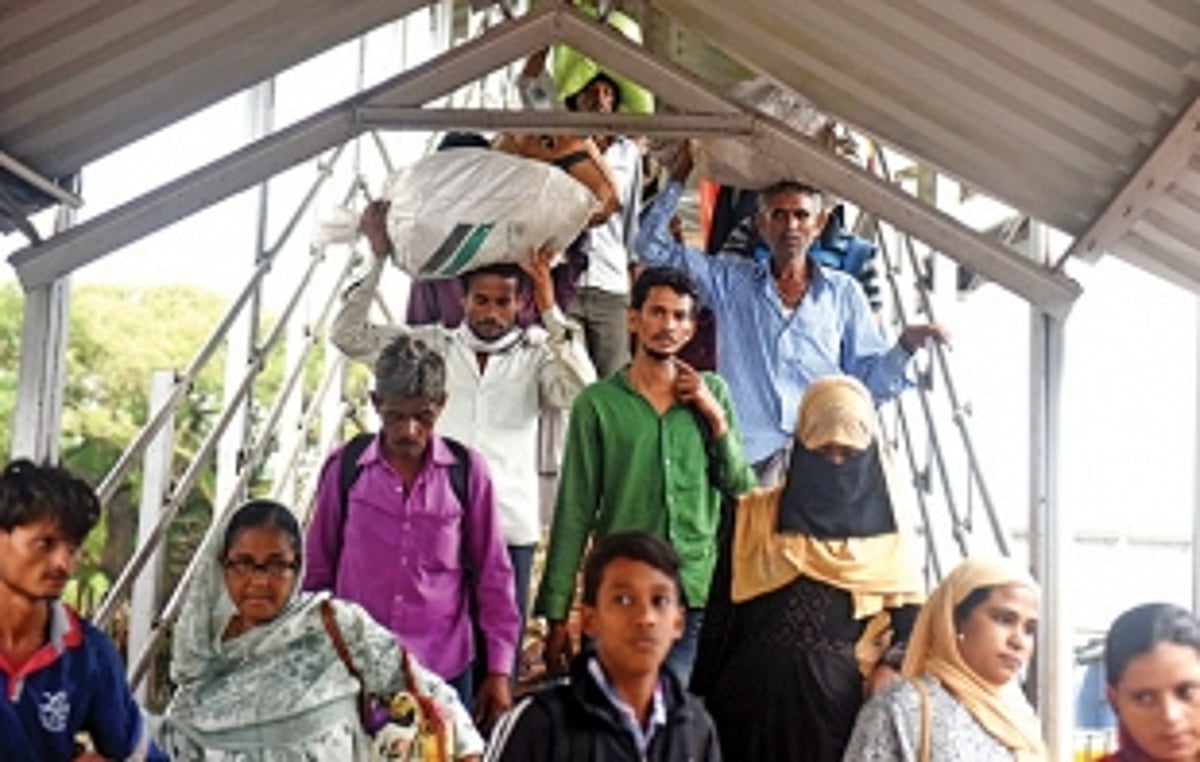
Commuters in Mumbai predominantly depend on the public transport system to meet their daily travel demand. The problem with Mumbai’s various public conveyance systems is that most of them are becoming obsolete and need an upgrade, while some need to spread their connectivity base. Bombay became the foremost to establish a suburban railway system in Asia. Today this railway network is one of the most frantic and frenzied systems, carrying over 75 lakh commuters a day. In order to take Mumbai out from the abyss of congestion, and to meet with growing transport demands, the Government of India along with the Japanese International Cooperation Agency, established the Mumbai Metro Project, a behemoth project that will consist of a network of over 235 km and 200 stations, at its conclusion. The most ambitious project yet, the Line 3 (Aqua Line), will be an entirely underground system, connecting important residential, business, educational, health and recreational centres along with major transport hubs including domestic and international airports, catering to 17 lakh commuters daily, once fully commissioned. According to the United Nations Climate Change Observer Report, this corridor will not only reduce CO2 emission to the tune of 12,500 Metric tonnes per year but will also help Mumbaikars cope with the deteriorating travel conditions on public transport and traffic congestion on roads.
What is Aarey, and what is this controversy about? Aarey is a neighbourhood situated in Eastern Goregaon. It was established in the late 1940s to organise the dairy and cattle sector of the City. The Aarey Land, being a Government owned property, continued to remain a largely untapped green zone in Mumbai. The controversy finds its roots in 2015, when the State government announced plans to construct a metro depot in the Aarey Zone, by acquiring 33 hectares of land and felling around 3000 trees. Now what is the importance and necessity of this depot and why only Aarey? The metro depot is an indispensible requirement for the smooth operation of any Metro system; it is the only area of the line for the parking, maintenance and repair activities. It is the starting point for train operations every day. A car depot serves Metro trains akin to a “home” for humans. But why Aarey? First of all, Cost efficiency. The Aarey land belongs to the Government, and no additional cost for procurement of land is required. The budget of Rs 22,000 crores for Line 3 was time and again exceeded and another escalation would be unfeasible. The bigger issue was the fact that there were no other viable areas for construction, out of the other two options; one was the Back Bay Reclamation Area, which would involve land reclamation for the purpose of construction and would escalate the price into a few lakh crores. Another option was Kanjurmarg, which too was unfeasible due to its status as a marshland and for the fact that it is a private owned property and would further escalate the budge by about Rs 7000 crores.
This announcement was resented by several activists and organisations, going to the extent of terming this move as a, ‘genocide of trees’, several protests were staged and petitions were put forth. The first of which, were appealing to the Bombay High Court for all 1280 hectares of Aarey to be declared as a Reserved Forest or Protected Forest under the Indian Forests Act, 1927. The Bombay High Court, after a series of long deliberations and hearings, declared the Aarey Development Zone, as a Non-Forested Area, and that the competent body may grant permission for the felling of trees. Due to the various environmental and legal complications involved, Larsen and Toubro and Shanghai Tunnelling Pvt Ltd, withdrew their contract, causing a loss of Rs 9.75 crores to the Government. The Supreme Court was approached by the activists, demanding the issue of the writ of mandamus, directing an immediate termination of project and ordering the project to be shifted to a new locale, which was rejected by the court. The judgement stipulated that, “The options to look for an alternative site had been exhausted by the Mumbai Metro Rail Corporation Ltd (MMRCL)”. The sites being unviable, no termination was issued. The activists once again approached the Bombay High Court, seeking a Judicial Review. In the Court’s Final Judgement, passed a few weeks, the permission issued by the Tree Authority of BMC, to fell the 2,185 trees was upheld. In spite of a whirlwind of protests by eminent citizens, activists and socialites, followed by social media propaganda, and debates in environmental forums, the felling of 2141 of the 2185 trees was overseen on October 4 and 5. As many as 29 activists were arrested for obturation and assaulting police personnel during the felling of trees, and later released on bail. The Supreme Court on October 7 issued a proroguement, ceasing the Forest Authorities from felling any more trees. Having felled the trees essential for the metro depot, the MMRC said it will abide by the Supreme Court and will abstain from felling any more trees. The next hearing in this matter is fixed on the October 21. Even on understanding, the dire need of this project, this unduly felling of trees does seem absurd at first. But on analysing the fact of this case which I will present to you, it seems totally judicious and well compensated. Primarily, the Aarey Forest Area subsists of a citizenry of trees in opulent proportions. It consists of around 4, 82, 300 trees. The 2702 trees proposed to be cut don’t even serve as 0.2% of the total trees prevailing. Out of which 2200 or so are to be felled and 500 have to be transplanted in divergent portions of the Aarey Zone in Mumbai. Therefore, the uncorroborated narrative that the Aarey forest will be utterly blemished is false. Secondly, the positive and beneficial effects of a metro project are of a much greater magnitude than 2185 trees. Environmentally, the mantle of trees, in the constraint of Carbon Emissions can be easily compensated by the reduction in emission caused due to the introduction of Metros. Thirdly, over 45% of the trees that are cut are non-indigenous and alien trees in the Aarey Zone, with tap root formations, that are not possible to be transplanted. Lastly, the MMRC has planted around 24,000 trees across Mumbai, nearly 12 times those felled, in Aarey Zone and the degraded areas of the Sanjay Gandhi National Park. That will reach optimum efficiency level in 2 years’ time.
Paramountly, the timing and political disagreement could be an example of malignant political vendetta due to the upcoming Vidhan Sabha Elections. This issue is a complicated case of good intentions but unpragmatic actions, and anti-developmental approaches by the activists, who have to realise the relevance of sustainable development along with changes in the hostile attitude displayed by the government. In the end, it is an inherent requirement that both parties focus on constructive deliberations rather than senseless oppositions, for the greater good of our nation.