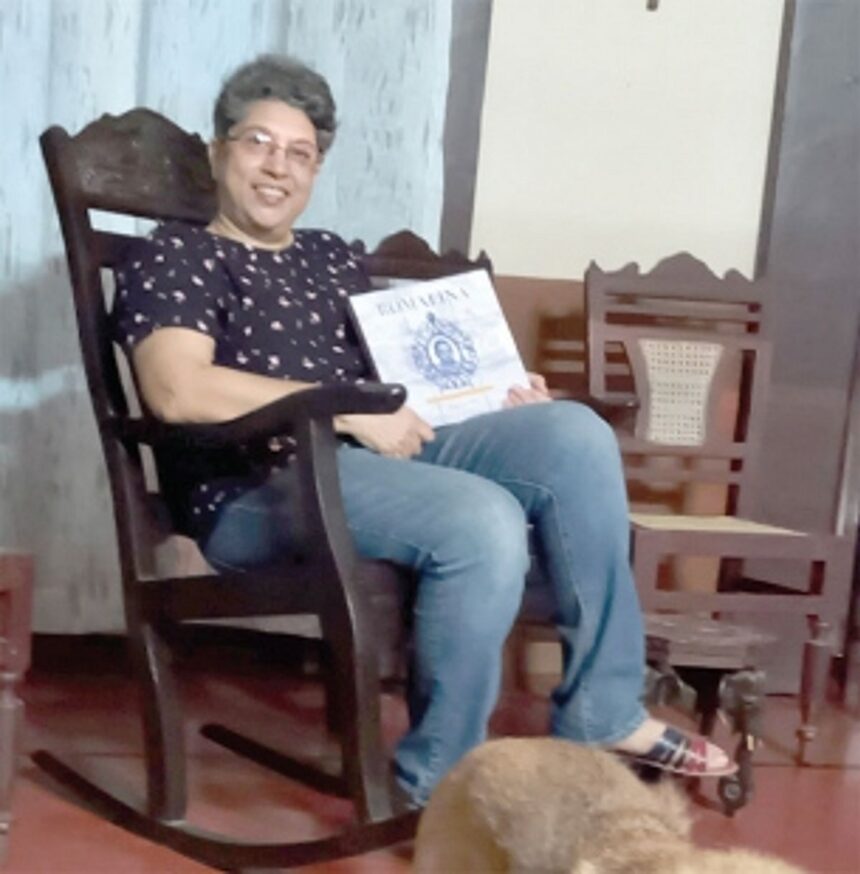
On a cold monsoon evening, Clarice Vaz along with her younger
sister, Lynette D’Souza, the last descendant of the Dias family, by her side,
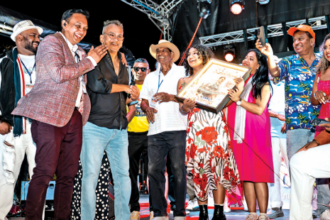
launched her book, ‘Romalina – Goodbye Africa, Adeus Portugal, Namaste Goa!’ at
her ancestral house in Moira. The very walls where history has been written
were witness to this moment as the pages of the book brought back to life sepia
rich photos and azulejos- inspired stunning visuals created by Bina Nayak. The
215-page book is dedicated to the Goan way of life that has seen families move
from Africa and adapt in Goa.
Self-taught artist, Vaz is known for her
syringe painting technique and is also an author of her first book, ‘A Song for
Saligao’ which sold around 400 copies and is going in for the second edition.
“I realized that Goans wanted something to hold on to. My Facebook stories on
village life were popular and I decided to write on how I came to be a Goan.
Goa’s history fascinated me. I began to join the dots of how my Hindu Goan
ancestors with Indian traditions transformed to Christian Goans with European
traditions. I was a Goan with many layers of cultures. And importantly, my
family and I were experiencing a confused life,” says Vaz.

Born in Uganda, Africa, she was brought up in Goa, post 1969,
when Goa just got liberated and now having to assimilate in the Indian Union.
To give a broader understanding, Vaz traces her family tree back to generations
when they might have been converted. While many Goans aspire to do the same to
find their genealogy, she helps guide the way, “I was privileged to connect
Richard de Souza from Moira, based in UK. He is the webmaster of our family
tree. He started by detailing his own parental genealogy predominantly from
villages of Moira, Colvale, Assonora, Socorro, Aldona, Guirim and a lot more
villages in Bardez, and a few in Ilhas. My ancestors are originally from Sao
Mathias (Divar), settled in Moira. Richard has a ‘Moira genealogy team’
assisting him worldwide and this secure site at TribalPages aims to provide a
more detailed and personal genealogy. It is filled with anecdotes, stories and
memories through photographs. It is a historical/heritage documentation and
thirty-six thousand entries are linked to their Moira clan (Vangodd).
Meticulously kept colonial records have helped him trace individuals to a rural
network of five clans in the Moira Communidade and this site displays an added
dimension highlighting the connection between ancient tribal clans of the Gaud
Saraswat Brahmins. I felt lucky to have had access to his site and I too began
to help him in collecting data,” says Vaz.
Vaz was fortunate to meet her aunt, Eulalia Menezes in
Bangalore, who will be celebrating her 96th birthday in a few days, who gave
her an old album and said ‘share this story’. “I obtained permissions from my
sisters who supported me when I decided to write on my family’s ancestors and
this book turned out to be a memoir of sorts. I can’t wait to gift my aunt a
physical copy of the book. She is absolutely alert and has praised and thanked
me. The book was meant to send a message to future generations to know what
life passed through our family and ancestors as we lived in Goa. Now post
Liberation, Goa is fast changing and it’s alarming to note that our history and
heritage is being distorted in the process. We need to accept change but we
also need to preserve our past. I wrote my witness account through my ancestry,
in the form of real life stories experienced with my grandmother and I guess
‘Romalina’ represents Goa’s granny,” says Vaz.
Towards, the end of the book, Vaz has meticulously created a
chart in chronological order on what was happening around the world, in Goa and
also in her own family. In this chart, one will get an idea as to how a Goan
family had evolved from a Hindu to Catholic to be influenced, eventually being
empowered to move out of Goa themselves and assimilate easily in their new
land. These families also brought back influences themselves to build Goan
houses and create unique Mandos and other markers, not seen in any part of the
world. Now, these Goan families are spread all over the world in the diaspora.
A first of its kind, this book is written as documentation and
it’s available as a free download. It can be converted into a coffee table
book, but Vaz feels it is beyond her budget with the GST on printed products
now at 18 percent. “Braz Menezes from the Matata book series financially
supported my project in part and I have been working on getting this book in
print. It will take another few weeks as being a book filled with visuals, test
printing is being done. I have to apply for an ISBN. Once done, it will be
available online,” Vaz explains the process.
To
conclude, Vaz says that she prefers being in front of her canvas rather than
her computer. “Being an artist, I have a painting project coming up with a
heritage theme. This has been postponed twice because of my book. I have also
joined a few social related projects in my village,” says Vaz.