MAPUSA: In the idyllic village of Sangolda, a family of
farmers fights a battle against an unexpected enemy: flocks of pigeons,
parrots, and peacocks. Nilu Tandel and his sons, Manoj and Gaurav, have become known
as the ‘Pigeon Warriors’ for their gritty dedication to safeguarding their
crops, as well as their neighbours’. Every year, from sowing till harvest, they
engage in the exhausting task of keeping watch over their fields from 5.30 am
to 6.30 pm, chasing away the feathered pests that threaten to devour their
hard-earned produce.
The Tandel family’s farming heritage runs deep. Their
forefathers tilled the land, passing down a love for nature and agriculture.
“When I was a student, going to the fields after school was not an option but a
means of sustenance. With little money to spare, all the farmers in the village
relied on a barter system. Money rarely exchanged hands, it was always
produce,” reminisces Nilu.

Back then, their fields were adorned with Khontri, a local
rice variety known for its delectable taste but meagre yields. The villagers
relied on one another to sow and harvest the rice. “All the fields were
cultivated by locals, and we’d have farmers from Sattari and Poriem coming down
during harvest season, requesting help with the task. There were no migrant farmhands
for hire then, we would all have to pitch in, or the rains would ruin the
crop,” he adds. However, as time went on, the introduction of high-yield
varieties of rice, such as Jyoti and Jaya, coupled with the allure of office
jobs, has led many of the younger generation to shy away from farming, says
Nilu.
As modernisation seeped into their lives, the farmers of
Guirim and Sangolda found themselves confronted by an unexpected pest problem.
Flocks of pigeons, having lost their natural habitats, descended upon the
fields just as the sowing season began. With an uncanny sense of timing, the
pigeons swooped down in the thousands, threatening to devour the seeds and
sprouts. If the Tandels let their guard down, their crops could be reduced to
ruins in a matter of minutes.
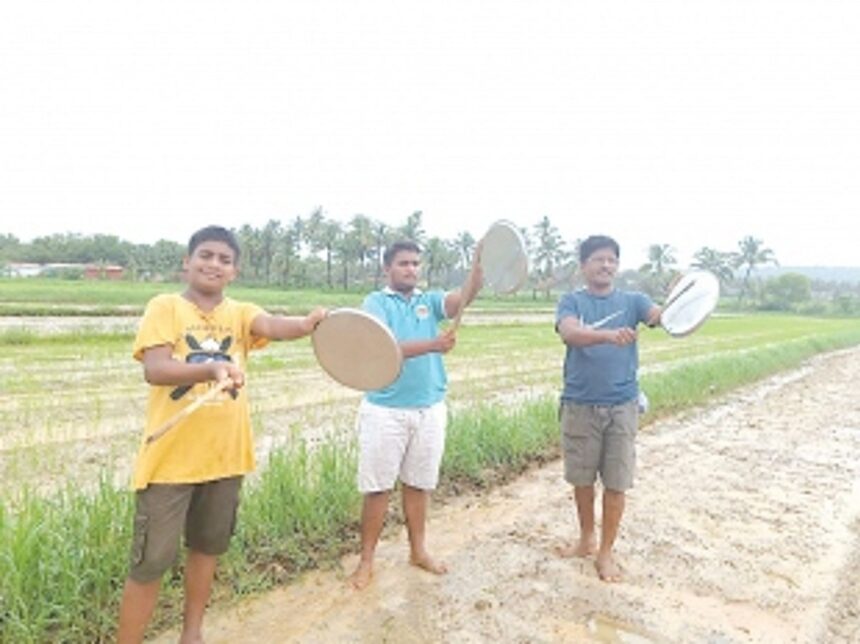
Undeterred by stormy weather, Nilu, Manoj, and Gaurav create
a cacophony of noise with pots and pans to discourage the intruders. However,
the pests soon grow immune to the commotion, prompting the Tandels to use
firecrackers, which are difficult to ignite during the rains.
“I’m here during the first half of the day, and once my sons
finish school, they come to help me,” says Nilu. “This is an important part of their
education as well. They need to learn to grow their own food, and eat from the
stomach of Mother nature, only then will they respect and protect her gifts,”
he says.
However, the challenges faced by the Tandels are not limited
to the pest problem. “The compensation received by farmers for their loss is
meagre, and the cost of fertilisers and essential supplies continues to rise. I
cannot afford to pay a labourer Rs 1,200 per day, for ten days, to watch my
crops,” he adds.
The Tandels and other farmers like them plead with the
agricultural department to introduce new schemes and raise the procurement
rates. “I also appeal to the Agriculture and Forest departments to join hands
and together find a sustainable solution to the menace of pests, such as
pigeons, rodents, and peacocks,” he says.