The monsoons bring along a
number of happy and beautiful
festivals in different parts of the
country. The rains are a big part
of our lives and worshipping and
celebrating the season in various
was is a very common sight.
However, what can be called the
most unique and carefree festival
that celebrates nature in the
rawest manner is the Chikal Kalo
in Marcel. Celebrated every year
on the day of Ashadh Dwadashi
that usually falls in the month
of July or August, this festival is
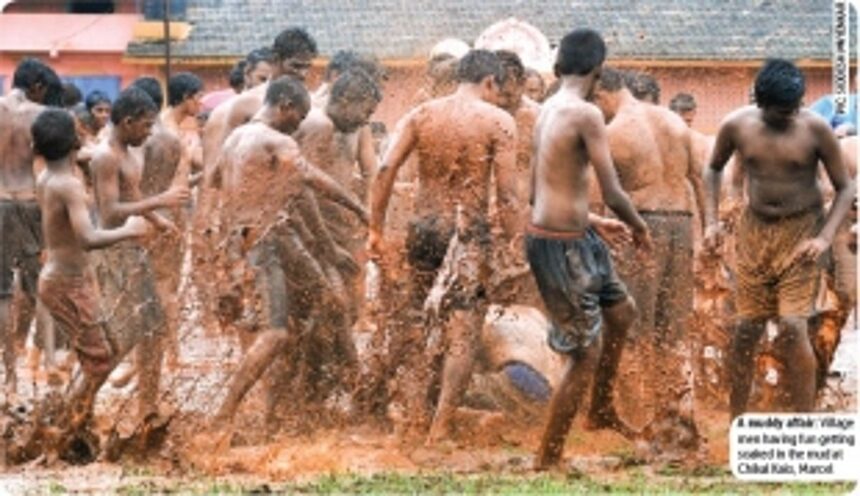
celebrated by the village men
and children by playing in the
mud outside the one-of-itskind
temple of Devki Krishna in
Marcel.
Vaibhav Bhagat, a resident of
Marcel who as been a part of this
festival since is childhood, says,
“We celebrate Chikal Kalo to
worship Lord Krishna. The actual
program starts on the previous
night with bhajan at Shri Devki
Krishna Saunsthaan. Traditionally,
every household in the village
was allotted a particular time
slot to sing bhajan/abhang (holy
songs) in the temple premises.
Now the temple committee
organises bhajan/abhang singing
competitions at the all Goa level,
on this day.” So, after the whole
night of singing bhajans begins
the actual programme of playing
in the mud. “In the morning, all
villagers gather in front of the
temple, singing ‘Jai Hari Vitthal’,
in praise of Lord Vitthal. All the
participants roam in the market
area asking for oil to apply on
their bodies. Then they gather in
the temple premises and dance
and play in the mud,” he explains.
There are different stories
as to what might be the
significance behind the origin of
Chikal Kalo. Renowned historian
Rohit Phalgaonkar opines, “As
far as the age-old festivals are
concerned, it’s really difficult to
tell when and how they might
have commenced. Chikal Kalo
seems to be an outcome of
the natural and cultural setting
of the place. It signifies the
importance of nature in our
culture.”
According to Bhagat,
“Though most people relate this
festival to Lord Krishna/Vitthal, I
have also heard a different story.
During Portuguese rule, the
colonial rulers destroyed Hindu
temples, so most of the people,
in an attempt to protect their
deities, shifted their temples in
Ponda region as Ponda was then
ruled by a Hindu ruler. Some
temples were brought to Marcel
as well. So it’s possible that this
festival was started to unite
people who had come from
different regions. It helped them
bond.”
Chikal Kalo indeed brings a
happy day full of fun and playing
to the people of Marcel
and around. “Chikal
Kalo is the only day
of the year when
our parents didn’t
scold us for playing
in the mud. In fact,
some people even
dip their newborn
babies in mud.
Once in the mud,
we play a variety of
traditional games,
like tug-of-war,
mendhi ani kolha
(lamb and wolf),
human chakra,
frog jumps, kho
kho to name a few.
The games are
accompanied by
folk songs that have
been passed on
from generation to
generation. Also, a
special sweet dish,
‘ball’, is prepared
for this festival. It’s
a kind of stuffed
paratha filled with
panchakhadhya
(mixture of coconut
and jaggery),”
describes Bhagat.
One of the best
things about Chikal
Kalo, for Bhagat,
is that it includes
people of all kinds,
irrespective of what
caste or class they
belong to. “People,
no matter what
their caste or race,
participate in this
festival and play in
the mud together.
It is said that once
you are covered in
mud, all are of the
same colour, so all
are equal. This is
the thing I admire
the most about
Chikal Kalo,” Bhagat
concludes.