Business owners, especially successful ones, are always on the lookout for ideas to provide the spark for the creation of a new business. Another ‘baby’ which can be nurtured into a successful adolescent and adult. This quest for building a new business is often driven byyearning for the thrill of another start-up. Sometimes, it is yet another step in the dream of having a renowned conglomerate. Or a foray into segments which are more ‘modern’ and ‘fancy’ and hence might attract the next generation into the business. New businesses can be started in an adjacent field to the current business or in a completely different field. For instance, a silk sari retail business might enter the cotton sari business- an adjacent field with sari being the common theme. Or it could enter the jewellery retail business where retail is the common theme. Or it could enter the real estate business which is a completely different field.
So, you just go ahead and start the new business, right? Unfortunately, it’s not that simple. A healthy proportion of business owners I meet want to start another business. Yet, most of them get stuck at the first hurdle- what new business should I start? And that’s a difficult question. Often, the existing business choice was by chance.Or was the first business opportunity that the entrepreneur came across. This article gives you 4 essential steps to figure out the answer to the ‘which new business’ question.
Step 1: Identify your critical capabilities.
Ask yourself the questions ‘what are my capabilities?’, ‘what are my core strengths?’. These can be capabilities you have developed through running your existing business. For instance, sales and marketing expertise or managing the regulatory environment or industry-specific skills. While this might seem an academic exercise, it’s an important one. While running a business, you would have incrementally improved at several things. Over the course of time, these incremental improvements have made you an expert. The small improvements have made you highly capable in a variety of things. So, spend some time thinking over these questions and you may be surprised at the things you are an expert at. Like an internal assessment of your capabilities, look externally at resources you have access to. For example, you may have access to a resource in short supply such as scarce industrial land
Don’t forget to include capabilities developed through things you are passionate about. Regardless of you not having started a business around them. For instance, you may have a packaging business but are passionate about food. And you understand the trends in food processing. Is there any opportunity for your next business to be centred around food?
For family businesses, it’s important to go beyond your personal capabilities and consider the passions and capabilities of the next generation. The next generation may be more clued-in to new trends and opportunities. Often, they may have very different capabilities to the previous generation. And since its likely that they will be managing the business at some point of time, this is a useful and important consideration.
The best way to do Step 1 is a workshop with the top management of your existing business(es). And another one with the family members involved in the business. It’s important to put a name to each of your capabilities. The more specific the capability name the better.
For eg ‘Marketing construction products to B2B customers’ is better than ‘Sales & Marketing expertise’. Step 1 is critical to defining the differentiation of your product or service which is needed in subsequent steps. That makes it a critical step. Involve trusted third parties in the workshop to ensure an objective evaluation of capabilities. All of us tend to get carried away with assessing our own capabilities!
Step 2: Identify your critical constraints
Ask yourself ‘What are my current constraints?’. Constraints set the boundary conditions while evaluating a new business. And setting boundaries saves time. Constraints can include elements like capital investment, break-even point, risk tolerance, geographic coverage and availability of management bandwidth. It’s useful to put a number, or at least a range, to each element.
While identifying constraints is good, founders often go overboard in this step. For the first business they started, the founders often didn’t have much to lose. For a new business, there’s a lot more to lose. Yet, risk is a necessary element of any business. So, while drawing boundaries that define your constraints push yourself to go a little further. Remember, there’s no guaranteed business!
Step 3: Identify the universe of opportunities
Have another workshop with your top management! And one more with your family. Include an objective third party for good measure. Brainstorm ideas for new businesses, regardless of how outlandish they seem. For each idea, the group checks for alignment with your capabilities (Step 1) and staying within your constraints (Step 2). This step will need work pre and post-workshop.
Try to be specific with naming the opportunities in the universe- for e.g. ‘Do-it-yourself furniture’ is better than ‘home decor’. That said, don’t try to force specificity beyond a point. If the opportunity drivers and the source of your competitive positioning areconsistent, the specifics can wait.At the end of Step 3, you should have a set of opportunities which seem worthy of a closer look. There should be no more than 10 and no less than 3 opportunities at the end of this step.
Step 4: Compare the opportunities
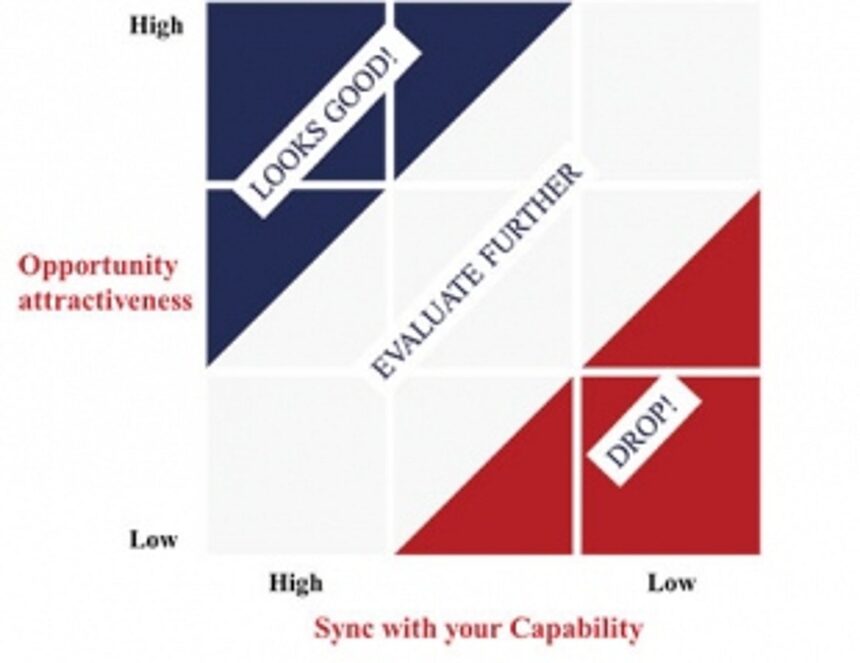
Compare the opportunities generated from the previous step. Do some homework and put them into something like a GE-McKinsey 9-box matrix. Opportunity attractiveness considers elements like size of the opportunity, competitive intensity, scalability and growth. The sync with your capability is the level to which the industry matches your abilities.
What next?
Do further analysis of the opportunities that ‘look good’ and those that you need to ‘evaluate further’. Stop once you are confident that a robust analysis is complete. And then trust your gut and take that final decision!
A Caveat and a word of Caution
This post is an oversimplified look at choosing your new business. Deciding on a new business takes significant effort and time. And can be nerve-wracking. Yet, it’s also a lot of fun and a worthy investment for the future. And having a diversified businesscan not only be a revenue generator, but it can also unleash your hidden potential.
It’s become fashionable to start a new business. Don’t start a new business just to try to join the latest fad. For instance, starting an ‘Artificial Intelligence’ company since it sounds fancy, isn’t very intelligent. The other thing to be careful about is resisting the allure of the ‘serial entrepreneur’ tag. Sure, some people do start multiple successful businesses. Yet, be sure you are starting a new business for the right reasons. Saying ‘No’ to some opportunities is an essential part of being a good businessperson.