On Goa
Liberation Day 2018, the Serendipity Arts Festival celebrated emerging visual artists, unique theatre
and dance utilising non-traditional performance spaces, creating public
interventions and offering audiences alternative perspectives into the
performance space. These took place alongside culinary workshops, music
performances and an exploration of emergent media experiences and platforms.
And speaking of Goa, there was the fascinating ‘Digital Heritage
Lab’ – an exploration of Goan heritage using digital media and interactive
experiences.

This project presented ‘digital heritage’ experiences inspired
by Goa. The Digital Heritage Play Lab encouraged people to explore Goan
heritage through emergent media experiences and platforms. “We are surrounded
by objects, places and practices that have been a part of the quintessential
Goan household and community for centuries,” said the organisers.
“The exhibit is a
medley of heritage projects in immersive media and interactive storytelling
showcasing works by three research and design collectives—Quicksand, Tandem and
Greenhouse— that work at the intersection of art, design and technology.
Through a gallery of ‘Heritage Playthings’ featuring augmented reality, virtual
reality, 360 lm, gami cation, app design and transmedia storytelling, the
project aims to bridge the gap between Goan heritage and modern audiences. A
highlight of the project is an interactive storytelling smartphone app for
discovering Panjim, arising from a collaboration with prominent historian,
Vivek Menezes, as we discover the charming city through an entertaining
narrative of nine of his favourite locations,” added the organisers.
Another project that
paid ode to the land, in this case the country was ‘Dhamaal’. Dhamaal is a
celebration of drumming traditions from India. It represents India’s cultural
diversity through her music, particularly through percussion traditions. For
several centuries, these traditions have run parallel, have intersected or have
worked in isolation. Significantly, they have not threatened each other and
have in fact lived in harmony. Drummers in ‘Dhamaal’ come from various parts of
the country to weave a tapestry of rhythm with other musicians. While the focus
of ‘Dhamaal’ was on percussion traditions, the performance was equally grounded
in melody and song-text.
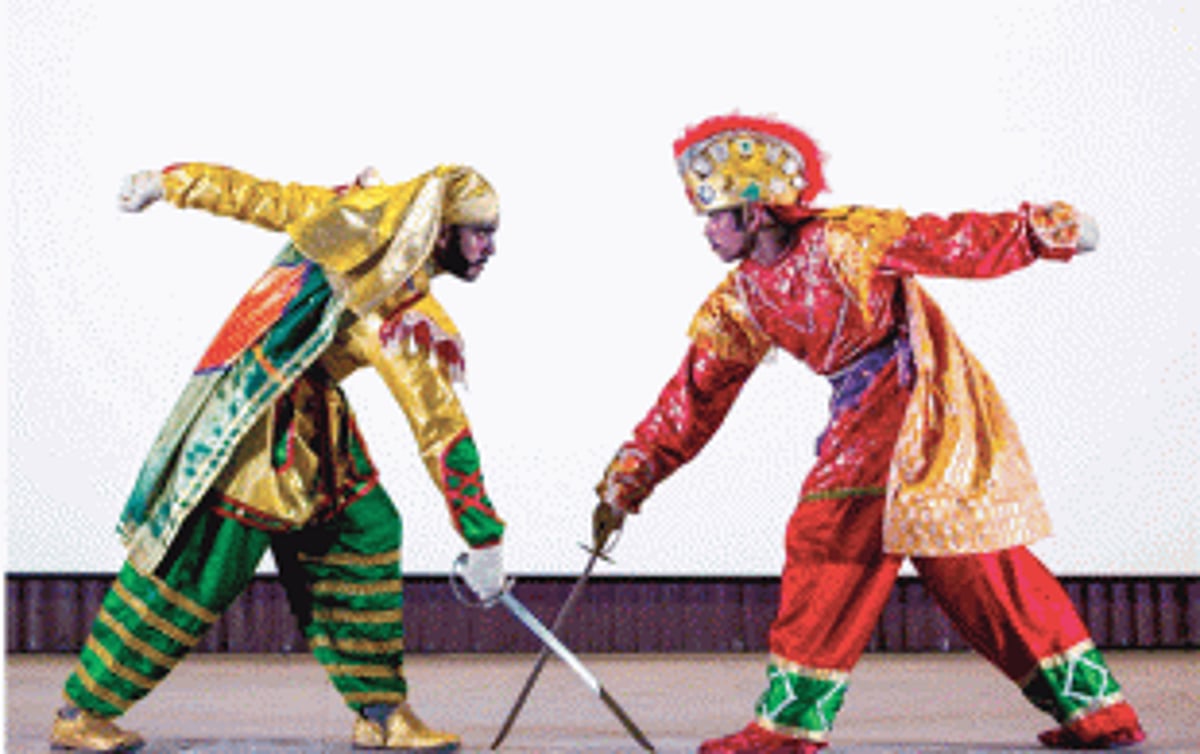
A Kerala folk
performance that resembles the Greek Opera – ‘Karalsman’ – impressed one and
all. “ The story of this play is based on the heroic deeds of the French
emperor Karalsman (Charlemagne), who defeated Albrath, the emperor of
Jerusalem, regaining the land he had once lost. Chavittu Natakam originated in
the coastal belt of western Kerala during the 16th and 17th century, together
with the advent of the Christian Missionaries. Closely connected to Koothu and
Koodiyattam of Kerala, the dance form also bears striking resemblance to the
Greek Opera. While in the olden days, the performance of a single story of
Chavittu Natakam extended between ten to fifteen days, it has now been confined
to a short span of two hours,” said the organisers.
Elsewhere, at the
Immaculate Conception Church (Junction), one got to see the dance performance
titled ‘Look Left, Turn Right’. ‘Look Left, Turn Right’ is a site-specific
intervention that questions the fine line between functionality and
performativity in movement. Set up as a series of structured improvisations,
Look Left, Turn Right is performed at busy traffic intersections, taking dance
out of a formal setting into an everyday public space that is accessed by all.
The performers engaged with the site in real time as a first encounter, thus
setting up relationships between a dynamic passing audience, and the space they
temporarily inhabit.
Visitors attending
the festival also got a chance to check out the ‘Dharti Arts Residency
exhibition’. “This interdisciplinary exhibition showcased the works of four
artists and a critic who were selected to be a part of Serendipity Arts
Foundation’s annual three-month residency. Dharti, now in its second cycle, is
a programme based equally in theory and practice, allowing the artists to
create work and collaborate with a group of their peers, and to connect with
the city and artist community at large,” the organisers added.
Moving to theatre,
‘Notes on Chai’ – was an exploration of the inner and outer landscape of urban
life through everyday conversations. “ Notes on Chai is a collection of
snippets of everyday conversations interwoven with abstract sound explorations
that attempt to relocate our relationship with the quotidian. The humour
created through these details carries within it desires, fears and insecurities
of the mundane that remain unsaid and yet palpable. The attempt is to create,
through a series of portrayals, a collective sense of the everyday, which
resonates with a universal sense of the ordinary across cultures and hopefully
across different socio-economic strata. The abstract sound explorations in the
piece are inspired from Tibetan throat singing, western overtones and extended
vocal techniques,” said the organisers.
‘Queen
Size’ – a choreographic exploration of intimacy between two men, was also
staged. Queen-size is a choreographic exploration that takes the form of a
detailed study of the intimacy between two men. The duet was initially
triggered by Nishit Saran’s article titled Why My Bedroom Habits Are Your
Business, first published in the Indian Express in January 2000. The
performance ran in a 45-minute loop played out continuously over two and a half
hours. The audience could enter the performance at specific intervals through
this period and stay for as long as they like.