The labyrinth of lanes, in Fontainhas, Panjim, each a mesmerizing nugget of a ‘Latin; way of life has many delights. Soft music emanating from many homes, the gentle strumming of the guitar or a man with delightful wrinkles and a tuft of willowy hair, playing the mouth organ, transfixed and fixed to a past which remains his present.
At the junction of St. Sebastian Road and Rua de Natal, the 1888 built St Sebastian Chapel has been restored to a degree of its early magnificence with the promise of it returning to its past grandeur and quaintness. This has further added to the charm of the Latin quarter. With the rains letting off, art students from Panjim are back, some on their cycles, others perched on footpaths and outside homes or right on the streets sketching away, each swish of the brush or a pencil stroke, keeping alive the Fontainhas memory project, a Quarter, which itself is a work of art which has inspired the work of so many artists.

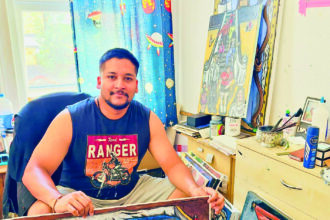
Drawn to this magnet and into its amorous recesses were this Assamese couple Saurav and Mona. He, an erstwhile member of the urban corporate tribe, working for the telecom and radio sector. She, a creative graphic designer. After getting married, work took them to Bombay and then briefly back home to Guwahati. Somewhere, as it happens to the best of us, the Goa bug struck and the inevitable move happened. They arrived here bringing with them memories of Assam, Mona’s moms recipes and their taste buds. And completely out of the blue a restaurant happened in the congested area of what we call a tourism stampede, Candolim. Here they did a bit of everything offering North Eastern Fare with North Indian. But somewhere down the line Mona and Saurav paused, spoke to each other and realised that the food you miss and want to cook and serve, is only from home.
Post this epiphany, they started looking for a small pace, which felt like home, where they would cook and create food, they grew up with at home with, getting spices and ingredients from Assam, flown in to maintain the purity of their creation. And they finally found a little place, where else, in the Fontainhas, Mala area in a little lane adjacent to the Old Quarter hostel, next to the People’s High school. The Assamese couple, all soul, set up their home kitchen Soul Chef right here, bringing a tiny bit of Assam and the Northeast, complimenting the charm of Goa’s Latin/ Portuguese quarter.
Two very dear friends Kabir and Anisha, discovered Saurav, Mona and their one and half-year-old doll Jia, who will one day launch more than a thousand ships in her direction, beating Helen of Troy, and of course their restaurant Soul Chef, way before I did and insisted that my wanderings, which take me all over Goa should also take me to places closest to home.
It’s a tiny place, with three tables and a long one, beautifully decorated and neatly furnished. The omnipresent Jaapi or Khomfri, the conical Assamese hat made from woven bamboo or cane tells you that this is an Assamese home. The flavours from the kitchen confirmed this.
Mona’s menu (with Saurav’s inputs) is perhaps the finest spread of Assamese and other North eastern food found here, each a salutation to the cuisine of a land many know little of. Of course, for those who love Pork one meal isn’t enough. The Pork Chops in bhut jolakia (chilies so spicy that you see ghosts, hence the word ‘bhut’ or bhoot) is for the adventurous. This is served with aloo pitika (mashed potatoes) or egg pitika (mashed potatoes with eggs). Others include Pork in dry bamboo shoots, Pork ribs in black sesame and roast chilli pork.
This is just from the non-curried variety. In the curried section there’s naga pork curry, pork curry with fermented bamboo shoots.
But there’s more. The journey from Assam to Meghalaya is short and you are greeted with Shillong street styled noodles and Ja-doh which is (twisted) khasi meat and rice. This folks, is just a small sample.
What goes into the making of this is a serious back story. The fermented and dry bamboo shoots come from Assam. So do all the chillies like the bhoot jolakia and other spices. And then there are recipes from Arunachal and other seven sisters which haven’t found their way to the menu and may soon might.
It was an afternoon of chatter and imbibing. Stories were not just about food but about journeys and how the world can and does become one through its people and most certainly through food. A little Assam in the middle of vignettes of old Portuguese charm is what makes us one
And there was another lesson learned. Even as you wander and discover, there are surprises at your doorstep which tell you, all journeys, whether long or very short, are worth it
(*Ahoms are an ethnic group found in Assam and Arunachal Pradesh. The writer played on this and used Ahom instead of Ahem! in the headline)