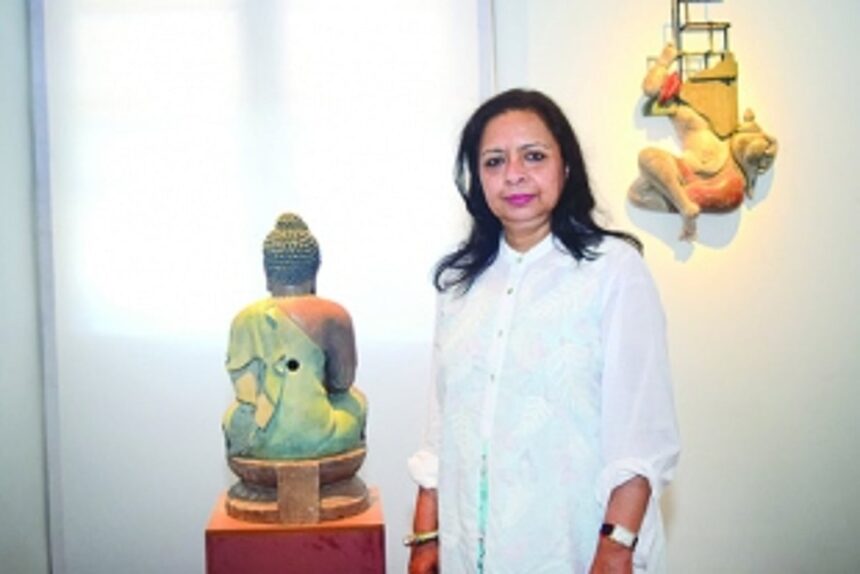
“‘A Tale of Two Cities’ is not
just an art exhibition, it’s about artists coming together and starting a
conversation in response to their own country, and each other’s. There are a lot
of similar and often interconnected cultural, religious and political issues between
India and Sri Lanka. Each of the artists involved in this project has a
distinct voice and aesthetics. They are each established in their own practice
and known internationally,” says Renu Modi about the exhibition on display at
the Adil Shah Palace in Panjim.
Participating artists from India
include Riyas Komu, Manisha Parekh, Ram Rahman, Paula Sengupta, Chintan
Upadhyay and Manjunath Kamath while the artists from Sri Lanka are Jagath
Weerasinghe, Anoli Perera, Pala Pothupitiye, Pradeep Chandrasiri and Bandu
Manamperi. Ruhanie Perera is the Curatorial Advisor for the exhibition.

The idea of ‘A Tale of Two Cities’
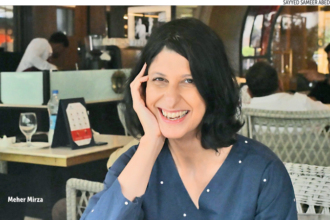
was conceived by Renu Modi, Founder of Gallery Espace. The gallery was
established in New Delhi in 1989 with an exhibition of autobiographical works
of MF Husain. Modern India’s most celebrated artist. “Speaking of inspiration,
I have been relooking the work that I’ve done over the last 25 years. I have
been in this business for 26 years and I had done something like this on a much
smaller scale in 2001 at Haridwar, where we have our own house along the
Ganges. I always wanted to have another interaction in Varanasi, where art is
discussed, particularly in present contemporary style. After 25 years, I felt
we should now go beyond the boundaries of India. It had to be South East Asia
because it plays a very important part in various aspects like political social
economic and artistic,” says Renu, as she walks through the works on display.
She further adds, “I had worked with
the Sri Lankan artists before and I was familiar with them. Theertha is an
artistic collective in Colombo, Sri Lanka. I explained to Anoli Perera and
Jagath Weerasinghe, the two founding members of Theertha, what the whole idea was
and they found it absolutely enchanting and said they were interested.”
‘Tale of Two Cities’ is not an
ordinary exhibition as it has a lot to tell, share and even experience. “It is
not just an exhibition organised to sell artworks. It actually shows how
artists are responding to two cities, two cultures that are very similar yet
different. They have the same issues about religion, politics, violence, gender
but how they respond. Through Varanasi and Anuradhapura, we took as two cities
as both are very volatile with archaeology, history, politics and religion. It
is important because both are ancient cities of ancient civilisations and
that’s why I picked these two cities,” explains Renu.
Smriti Rajgarhia-Bhatt, the director
of the Serendipity Trust, gave Renu the much need opportunity. “I gave her this
lofty idea which was not practical without a partner and she said, ‘I would
love to partner with you’ and I just jumped at the opportunity because I found
a partner with whom I could realise my idea.”
The exhibition will be launched in
Goa as part of the Serendipity Art Festival and will then move to Delhi in
March and Colombo in July. “Along with this exhibition, we are coming out with
a well documented book. As there were a lot of serious discussions taking
place, it has been visually documented into a film that will be shown at the
India Art Fair, which includes artist interviews, artists doing work in both
Varanasi and Anuradhapura,” says Renu.
Renu has been working on this
exhibition for the last two years. “In September 2014, we had gone to
Anuradhapura, and in December, we visited Varanasi. But this whole idea took us
nearly two years to get into form. The artists interacting with each other and
visiting the places, knowing their culture and responding to cities was my
whole idea. There was no brief given to the artists about what they have to
produce. They were just told to do what they can.” The exhibition will be open
throughout the festival and the Visual Art Festival will continue till January
2017.