Vivek Menezes
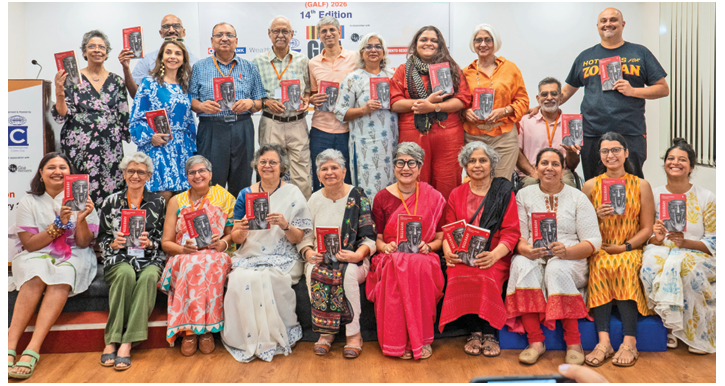
Exactly two decades after the Goa Writers group (GW) was founded in 2006, this wonderfully diverse and constantly evolving community of writers and literary aspirants from India’s smallest state has achieved another landmark with Appetite: New Writing from Goa, an eclectic new anthology edited by Tino de Sa and Shivranjana Rathore, and published by Penguin Random House India via its Ebury Press imprint for “the best of popular fiction and non-fiction”. This wide ranging selection of original essays, short stories and poetry was launched with great joy last month at the 14th edition of the Goa Arts + Literature Festival – itself another singular GW venture in partnership with International Centre Goa – but there is also an interactive discussion with the editors today at Literati Bookshop in Calangute at 5.30pm. ADD HEART HEALTHY HABITS TO YOUR DAY A CELEBRATION OF COLLECTIVE CREATIVITY AND VOICE SWIPE RIGHT Smriti Mandhana honoured with a Barbie doll Needless to say, no other writers’ group in India possesses anything close to this kind of national footprint or marketable imprint, and it also not surprise anyone that Appetite is already selling widely wherever it has become available.

The stellar Delhi-based writer and poet Sumana Roy has blurbed it rather charmingly as “a delicious history of habit and habitat”, while the formidable Mumbai-based poet and multidimensional cultural force Ranjit Hoskote summed it up as “polyphony wrought persuasively [and] an invaluable seismograph, attentive to the pulse of Goa’s cultural and political present. Its pages are electric with the energies of a region in transition, its traditional courtesies threatened by brash tourism and runaway development, its cosmopolitanism reshaping itself in step with the urgencies and exhilarations of a new historical moment.” In their editorial note, Rathore and de Sa say Appetite “brings together voices rooted in, reaching towards and weaving through Goa, in a chorus of poems, tantalizing stories and reflective essays that explore what it means to long for, to savour and to belong…As editors who took on the responsibility to enable the nurturing of these ideas and stories, our role was to listen deeply, to hold space for writers – emerging and established, young and seasoned – as they shaped their pieces, helping each one develop their contributions and reach closer to the heart of that they truly wanted to say. This was not always easy. Appetite is a hungry thing, and in the editorial process, we had to make space for differing palates and perspectives. We had to learn when to push and when to step back. The goal was never to impose, but always to illuminate and enable.” They write that “we hope readers find in these pages not just a taste of Goa, but something that lingers, that satiates and
nourishes, that invites them to return. We offer this book as an invitation: to read, to remember and perhaps to rediscover our own hungers, wherever they may lead you.” Appetite is an appealing banquet, with some big names – a short story from the great Jnanpith Award winner Damodar Mauzo (translated from the original Konkani by Xavier Cota) and an essay by the unstoppable centenarian Victor Rangel-Ribeiro about his unrivalled eight decades-long writing career – but also many other relatively unknown authors. That mix is an apt reflection of the GW ethos, as described in my own contribution to the book as “an almost radical inclusivity in both membership and methodologies. Insiders, outsiders, every possible medium from podcasts to publishing to playwriting, Goa Writers has flourished far beyond the stereotypes to redefine what an unstintingly democratic group of peers can do in supporting each other to accomplish.” Earlier this week, in response to some emailed questions, Rathore told me that “appetite is never only about food — it is about longing, ambition, lust, migration, belonging, memory, land, inheritance.
We were interested in how writers might stretch that word, complicate it, even resist it. What emerged surprised us. The fiction travels into intimate, sometimes uncomfortable territories — desire that cannot be named easily, families negotiating change, characters wrestling with what they owe to place and to themselves. The poetry is formally adventurous and emotionally precise. The essays bring reflection, history and lived experience into conversation. Together, the pieces move between the sensory and the political, the deeply personal and the expansively social. As editors, our role was not to flatten those voices into uniformity, but to listen carefully and help each piece become more fully itself. I am proud of the unevenness, the tonal shifts, the refusal of homogeneity. That plurality feels honest.” She said “thirty-three writers cannot stand in for a place. Instead, the book offers a series of situated perspectives — voices that are in Goa, from Goa, or in dialogue with it — thinking through what appetite might mean in a moment of visible transformation and flux. For readers in Goa, I hope the book offers recognition and perhaps even friction — a sense of the many ways people are negotiating identity, memory and desire here and now. If it sparks conversation, disagreement or self reflection, it has done its work.” When I asked de Sa to describe the anthology for potential readers, he said “it may be easier to first say what Appetite is not. It neither purports nor pretends to present a comprehensive and cohesive view of Goa. The thirty-six stories, poems and essays – including a graphic one – are an eclectic collection of creative responses to the layered meanings that ‘appetite’ could have in the context of a Goa in flux.
Most anthologies rely on previously published material. As editors we are particularly proud that we have been able to deliver on the promise of the sub-title: ‘New Writing from Goa’; not a single piece has been published in the past – all the writing is new and fresh. Why should people pick up the book? Quite simply, because it’s a darn good read!”