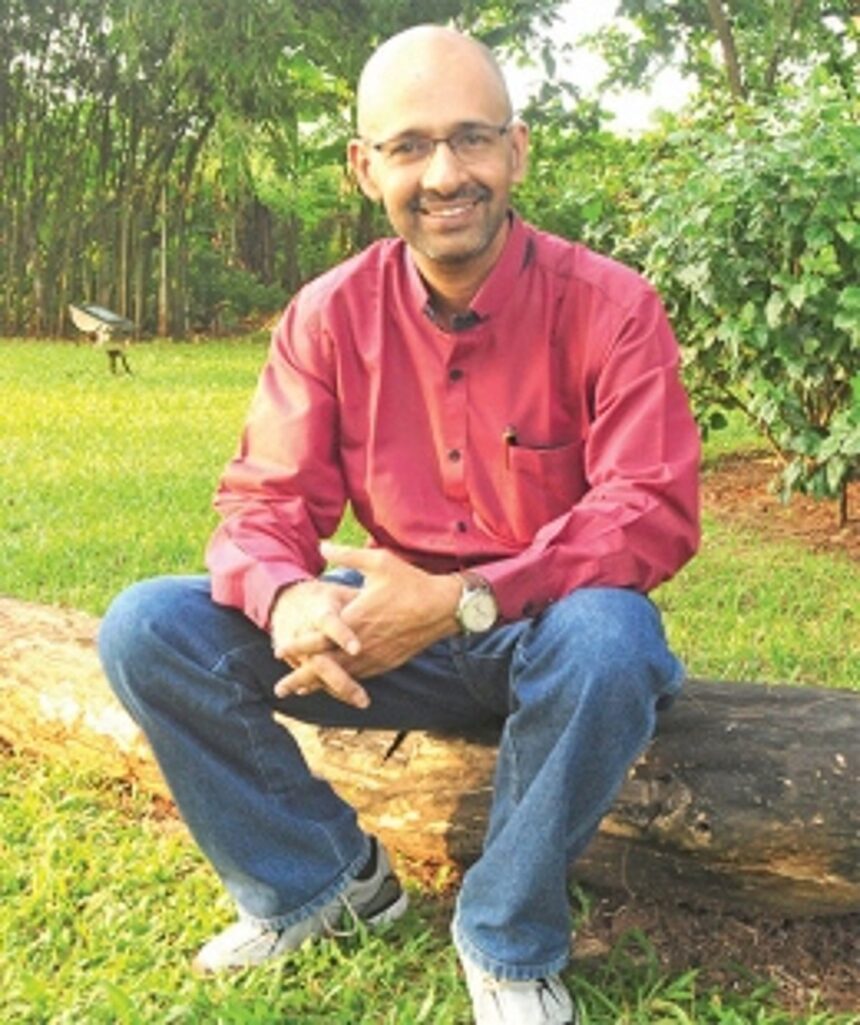
He recently made a mark in Nice, France where he curated ‘8 Bengal Masters: Miracles of Existence’ at the Musee des Arts Asiatiques, but Soumik Nandy Majumdar’s focus on art inevitably returns to art education and the right perception and appreciation of art. “Even as an art student, my interest was invariably drawn to visual perception and appreciation of art. When I was teaching art history later, I was disappointed to see that people who are closely associated with art are those who know about art, but the common man seems excluded. I was keen and resolved that to make art non-insular, we needed to sensitise more people to art. I firstly began by writing about art in my own vernacular language. I was keen to bring home the fact that art exists in our everyday life and not just art galleries,” avers this post graduate alumnus of MSU, Baroda College of Arts who joined the revered Santiniketan way back in 1996.
To get this wave of appreciation going, he decided to start at the school levels. “Art education is no doubt present at schools, but not in terms of perception and appreciation,” he points out. “We need to sensitise children to various forms and types of art and imbibe a respect for art in them, especially our heritage monuments. All this is a part of our aesthetic education and art helps us to become aware of art in our daily lives.”

Having said this, Majumdar is aware of the fine line between facilitating and goading. “I would like to emphasise that art appreciation cannot be taught. It is a practice. How to talk about art appreciation especially to children, where there is fear of pre-conditioning, is a challenge. There are no hard and fast rules to be followed. I discover something new in every session,” reveals Majumdar whose experiments of presenting Tagore’s prints to a cross section of children from urban and rural schools has elicited eager responses.
“Initially, I would not tell them they were Tagore’s paintings, but just tried to engage them in a meaning-generating process. I provoked them to react by putting myself in the position of a co-learner. In the process, we jointly explored, shared and interpreted,” reveals Majumdar who emphasises the need for the art educator to keep an open mind and be respectful of the varied visual patterns of response. “As art teachers/facilitators, we need to expand our vision. We stand to gain in the process,” he maintains. “It’s basically about breaking the ice and making art appreciation enjoyable for everyone. One’s reference point should also be contemporary for them to relate to it. I can talk about Tagore to a class today, but how I go about it is important.”
In his endeavour to make art less intimidating and reach the common man, Majumdar has helped to bridge the gap with an unusual process of ‘facilitating’ as he terms it – looking at art through the eyes of the viewer!
(Through the eyes of children – Experiments in art appreciation’ will be held at the Lecture Hall, Sanskruti Bhavan, Patto, Panjim on October 16, 2015 at 4:30pm, followed by a Q&A session)