To mark the 150th birth anniversary of Mahatma Gandhi this year, various programmes are being
organised in every nook and corner of India as well as around the world.
Mohandas Karamchand Gandhi, lovingly known as the Mahatma, was born on October
2, 1869 in Porbandar, Gujarat. The United Nations General Assembly on June 15,
2007 declared October 2 as International Day of Non-Violence. While Gandhi in
his lifetime never set foot in Goa, his teachings, especially about non
violence, have certainly had an influence on Goans.
Mahatma Gandhi has been a major influence in the life of Dr
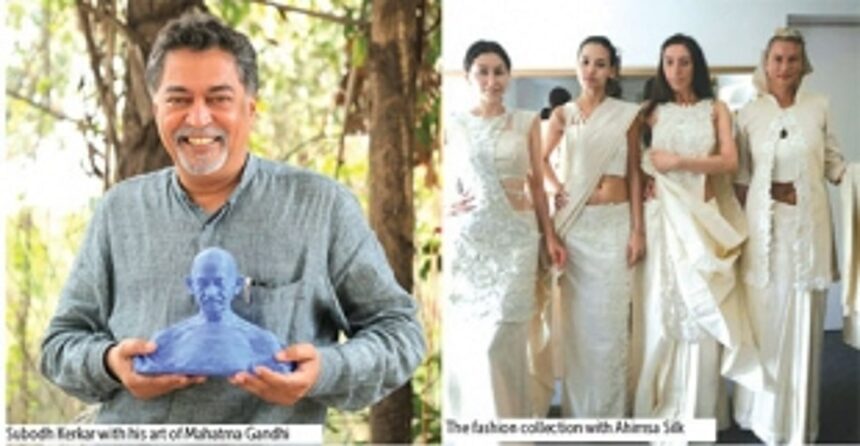
Subodh Kerkar, founder of Museum of Goa in Pilerne. His connection with Gandhi
only grew stronger over the years and he culminated all his years of research
into a unique and evolving exhibition titled ‘Reclaiming Gandhi’. The exhibition
was inaugurated on October 2, 2017 at Museum of Goa. This year, Subodh has been
invited to speak at Sevagram, Maharashtra, on the occasion of Gandhi Jayanti.
Sevagram was the place of Gandhi’s residence from 1936 till his untimely death
in 1948. “For me, going to Sevagram or Sabarmati is a place of pilgrimage. To
speak on Gandhi’s 150th birth anniversary at Sevagram, near the house where he
stayed, is something I consider a great fortune because it is almost like going
to heaven and speaking about God.
“I will speak about Gandhi and health. When Gandhi spoke about
health, he did not talk about physical health; he spoke about mental, spiritual
and social health. If your mind is full of hate, anger and greed, you are not
healthy. The same way, if the society is full of communal violence and hatred
towards different communities, somebody living in that society cannot be
healthy. We are living in a society where Gandhi is forgotten and is just being
used for the convenience of politics,” says Subodh. The talk will be held
entirely in Marathi. He has also been invited to the London School of Economics
for a panel discussion on Gandhi on October 15, 2019.
‘Gandhi Meets Kunbi’, a collection by Goan designer Verma
D’Mello, hit the runway at the Paris Haute Couture Week 2015. The collection,
as described by the internationally acclaimed designer, was a great
collaboration between Khadi and Kunbi tribal weaves of Goa’s pre-Portuguese
colonial era. The show was based on the theme ‘Gandhi’s tryst with Goan Kunbi’.
“The Father of the Nation, Mahatma Gandhi, is an epitome of non-violence and
self-reliance. All his practices have been taught to us since childhood and
maybe that is why I took his message of non-violence, which is Ahimsa, as an
inspiration. He has always been my inspiration on the thought of freedom. You
have freedom when you do not depend on anyone. Gandhi’s practice of Charkha to
roll on Khadi is the best example, which led to the giving up of foreign goods
in the country all those years ago,” says Verma.
Her collection was well received in Paris and she was asked to
repeat the show with ‘Luxurious Cacoon’ the following year at the same show.
“During my research on new trends in fabric developments, Ahimsa Silk was a big
help for me to make my collection. When I was invited to present my designs in
France, I was the only Indian designer. Exchange of knowledge and exploring new
methods of recreating new sources in our surrounding is the new way. The
collection talked about the same. The silhouettes and gowns are more of whites,
which flagged the non-violence and peace on a global fashion platform,” she
adds.
In 2001, The Mustard Seed Art Company performed the English play
‘Spectacles of Peace’ on Mahatma Gandhi, which was later translated into
Marathi and won the drama competition in Goa. The original play was written by
Isabel Santa Rita Vas. “It was a contemporary play on the life of somebody who
is commissioned to make a documentary on Mahatma Gandhi to demonise him. His
father had lived in Gandhi’s Ashram and this filmmaker feels that he had
neglected his family to live with Gandhi. This documentary becomes his means of
revenge towards Gandhi. His wife is an artist and works with puppets and she
does a show on Gandhi’s peace, which makes him realise that he should not make
an attempt to demonise Gandhi. Through his research, he understands that Gandhi
was someone who has to be admired. The play was well received and as we like to
explore new spaces, it was staged at the All India Radio, Altinho,” says Isabel.
Isabel also conducts a course on theatre at Goa University,
called ‘Faces of Theatre’. “When we wound up the course, we had a theatre
performance by the students of the course, titled, ‘The Fourth Monkey’, which
was a Mustard Seed Company production. This was also based on Mahatma Gandhi,”
adds Isabel.
Even 71 years after his death, Mahatma Gandhi still lives on
through his teachings, despite his words, “I have nothing new to teach the
world. Truth and non-violence are as old as the hills.”