Madhvi
Parekh Pays Homage to Christ
Widely admired for her instantly recognisable
style, Delhi-based Parekh showed a stunning suite of works devoted to Christ in
The Last Supper. The exhibition has
been touring through India, with Goa being the most recent venue and probably
the most stunning for the exhibition was mounted in the gorgeous historic
Church of Santa Monica, Convent of Santa Monica, Old Goa.
Imbued with historicity and meaning, the
ambience greatly added to the showing of the artwork, which confidently held
its own inside the majestic Church. The
Last Supper features a series of reverse paintings on acrylic, Parekh’s
forte. She employs the naïve folk art style to depict Christ in scenes that
range from poignant to moving. She explores this timeless theme with great
sensitivity, fusing elements of rural folklore and simple storytelling with a
modern art sensibility.
And so the scenes from Christ’s life are of
the pain, suffering and betrayal He bore. They are simultaneously awash with
elements of folk iconography like animals, birds, the sun and the stars,
bringing together a poignant sense of community, a oneness with nature and the
cycle of life. Ripe with symbolism, the artworks are not depressing. Rather,
they glow with jewel like colours and hint at regeneration and innocence.
The
titular work, ‘The Last Supper’, is placed at the head of the church drawing
visitors into its sombre world of trust and betrayal – another timeless human
battle. The story of Christ has been interpreted and reinterpreted countless
times through the years. Parekh accomplishes a new retelling in her signature
style.
Saraswati
Renata Sereda Plays with Clay
Ceramic art has recently come into its own in
Goa with just two shows in recent times that represented a clutch of the best
ceramicists in the country. Now, we have a third show presenting a solo
ceramicist and it is clear why. Saraswati’s art and her style practically
demand a show of their own. Curated by Miriam Koshy-Sukhija, the exhibition
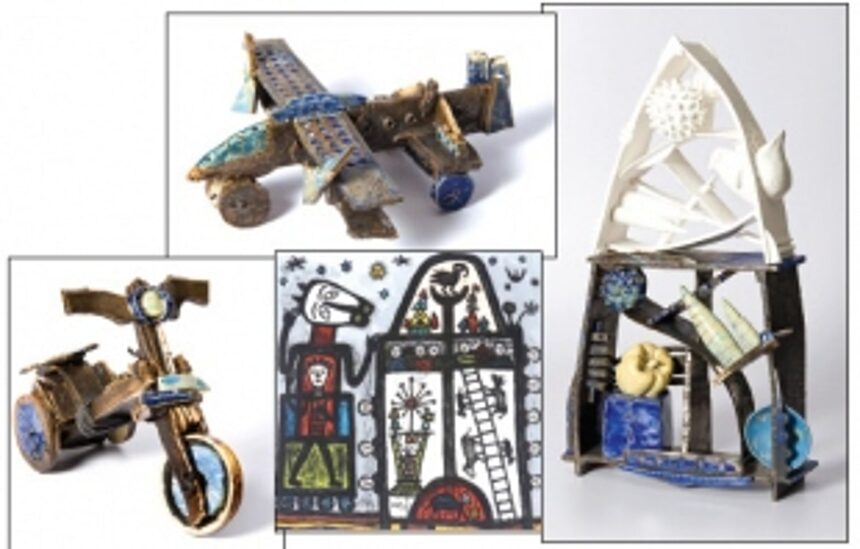
titled Play Room 2 transformed its
venue, Gallery Gitanjali, into a space where fantasy rules. The artist
literally plays with clay to conjure up tea-sets, aeroplanes, little cars and
other quirky pieces that take you straight back to your free spirited
childhood. And while the mood is fun and whimsical, the sheer skill of the
artist in dealing with form, scale, colour and material is instantly apparent.
The Pondicherry-based artist displayed her mastery with paperclay, stoneware,
porcelain, metal, wood and glass, experimenting with mixing oxides, glazes and
underglazes to stunning effect. The adventurous whimsical miniatures led into
the more ‘grown-up’ section of the show with some large-scale installations and
wall mounted pieces inspired by Klee and Austrian born artist and architect
Friedensreich Hundertwasser and fluid mobiles that paid homage to both nature
and Bauhaus.
Born in Russia into an
artistic family, Saraswati’s love for clay started at the age of twelve,
although she only fully dedicated herself to it after she moved to Auroville in
2004. She runs the White Peacock Clay Club at Auroville with her mother Anna,
who paints on porcelain and her daughter Masha who sculpts characters from
Russian fairy tales in ceramic.
Annabel Schenck
Explores the Self & the City
French artist Annabel C Schenck takes on the
challenging task of visually representing a city like Delhi in a series of fine
art prints in A Tribute to Chaos.
Held at the Alliance Francaise, Goa, the show marked
the launch of her book ‘Ville poussière / Dust City’,
accompanied by readings of poems by Christine Guidon.
During a recent artist residency at Ray’s Atelier
in Colva, South Goa Schenck crafted a limited edition of five art books that
form the core of ‘Ville poussière / Dust City’, a series of monochrome original
prints that attempt to decipher the chaos that is Delhi.
In a more psychological and spiritual exploration
of the urban space, Schenck worked with the poet Guidon to make sense of their
own selves within and in response to the dust enclosed city. Schenck digs deep
beneath the architectural layers of the city while Guidon delves into the
psyche. Both women visualise the ‘chaos’ of the urban structures and their
markings on the human presence, explains show curator, Katharina Domscheit-D’Souza.
Replete with organic imagery, Schenck’s engraved
prints are existential encounters between the internalisation of chaos and a
sense of hope in creativity and freedom that continues to feed the soul.
Guidon’s poems also emerge as hopeful flag-bearers of the resilient poetic
spirit. The interesting show successfully brought together the two creative
forces of the poet and the print-maker.
Schenck is a prolific visual artist working in a
variety of media across art books, prints from etchings, large-scale engravings,
paintings and installations. She has exhibited widely across India and Europe
and presently resides between India and France.