The fashion industry as we know it today has evolved over time, going through a number
of changes and innovations to become a giant that generates billions of dollars
in sales, worldwide. But despite the glitz and glamour, it has a rather
unseemly side to it too. No we are not talking of zero size models or the use
of very young girls in suggestive clothing to highlight the values of certain
brands. We are talking about the effects on the environment. Like an
air-conditioner that emits carbon dioxide, which is not good for the
environment, the fashion industry through its practices also adds to the
environmental problems on this planet.
This has given birth to a different kind
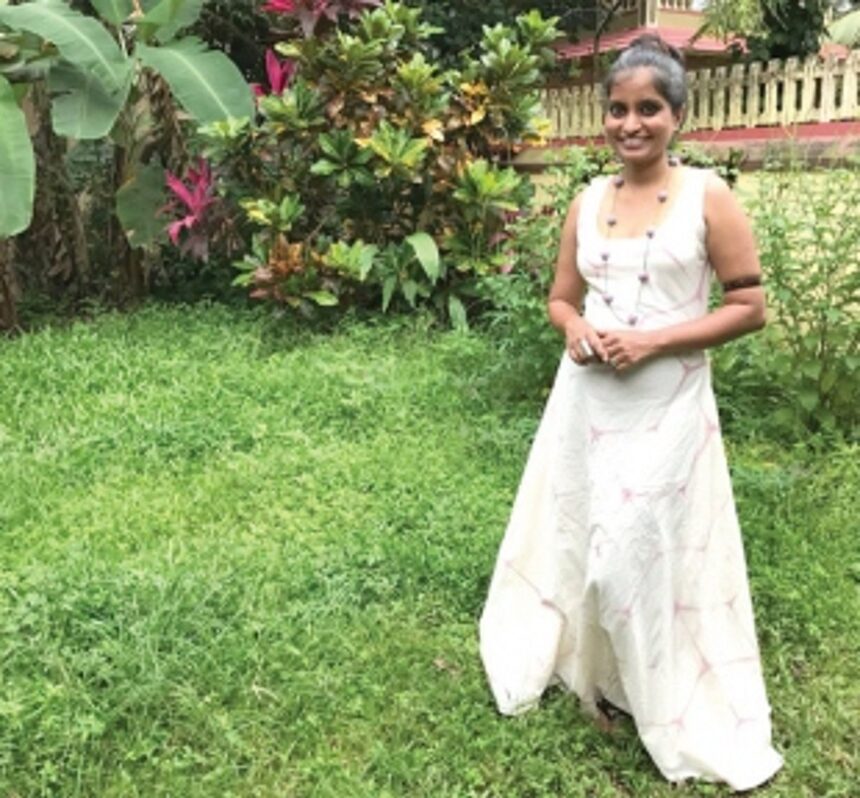
of designer, a person more in sync with their surroundings. Ninoshka
Alvares-Delaney is an Indian fashion designer from Goa who firmly believes in
the principle of fashion with a conscience. All this is a far cry from the days
when she spent her time sketching in books as a child, and yes, even then
designing clothes. This was a far simpler Goa, when clothes were made by a
tailor and the concept of a designer was unheard of. A student who was
interested in what she was learning, she topped her home state in Commercial Garment
Designing and Making at the Higher Secondary level. She received the ‘Best
Student of the Year’ award for the same. A graduate of the School of Fashion
Technology (SOFT), Pune, she specialised in Fashion Apparel Design, Textile and
Clothing. Having an urge to expand her knowledge and expertise in the fashion
world, Ninoshka also earned her Master’s degree in Fashion Management at the
National Institute of Fashion Technology (NIFT).

She went to Mumbai and worked as a Merchandiser cum Designer at
an export house in Mumbai, where she coined and developed samples for some of
the top international brands. In 2009, she joined Mélange, an esteemed fashion
house located in the plush area of Mumbai, as the in-house designer, which gave
her a unique opportunity to experiment and hone her personal minimalistic
style. However, the versatile designer that she is, she also delivered garments
that would suit the client needs. But like any creative and ambitious person,
she wanted to do something that was her own. Thus Ninoshka was born.
She says, “I passionately believe in sustainable fashion. I
believe whatever it is we take from nature, we have to give back. Natural dyes
such as indigo, pomegranate, marigold, onion peels, coconut, etc, which are
earth- and skin-friendly, are personal favourites and used extensively.”
She also believes strongly in fair wages for the artisans and
weavers all over the country, whom she sources materials from. “Design is
moving towards sustainability and it is called slow fashion. All along,
everyone has been chasing fast fashion as envisioned by the big brands that
come out with new designs every week. They are all about volume and huge money.
They buy clothes from their suppliers sitting in countries like Bangladesh,
India and Pakistan that make them for as little as a dollar per dress. This is
then retailed at several hundred times that,” she reveals.
After the collapse of the buildings housing the employees of a
supplier in Bangladesh, the spotlight was firmly on the poor practices of the
industry. One extra dollar would make a dramatic change in the lives of the
workers.
Also, the textile industry uses artificial dyes and is one of
the largest polluters in the world. Her collection, she proudly says, uses only
natural dyes.
She sells in Goa through three stores and business is pretty
good. She stitches the garments in Saligao and is able to make nine shirts in a
day. She also retails in other stores in the country. With each garments
costing anywhere from Rs 2,500 to Rs 4,000, her typical customer is someone who
has travelled and is conscious of a classic style.
Her
challenge in the near future is to find a way to tackle the enquiries coming
from Europe and America, something that needs to be tackled at the earliest.
Fashion, she firmly believes, has to sustain and give back, without which, it
will mean nothing.