Close to Diwali, the demon of Narkasur, in
various stages of construction, can been seen lurking around various lanes
about the city. While clubs, committees and societies create enormous effigies,
children too aren’t far behind with their smaller, but just as artistic,
creations.
Narak Chaturdashi is celebrated to mark Lord
Krishna’s victory over the demon Narkasur and Goa does it best with terrifying
yet amazing creations that bring local talent to the fore. Another ritual of
the festival involves Goan homes lighting a lamp facing the south, inviting
Yamraj to take Narkasur away, after his effigy is burnt at dawn.
Munna Mayekar and his uncle Devanand Mayekar have
been working on a huge Narkasur with the Young Boys of Boca de Vaca. The
youngsters enjoy working by the spring at Boca de Vaca in Panjim, mirroring
their elders who build their demon effigies at that very location, years ago. “We
have grown up watching our elders making creative Narkasurs and we are the
second generation to continue with it. This year, we will be participating in
two competitions: at Mahalaxmi Temple and near Church Square,” says Munna. The
preparations for this Narkasur began 15 days ago and the group is ready for the
face off on the eve of Diwali.
“The age group of those who are working on this
Narkasur is 10 to 40 years; but age is not a factor; it is the enthusiasm that
matters. The entire ensemble will include 50-60 people who will be accompanying
the float. Even our Catholic and Muslim friends join us in making the Narkasur
look more creative and artistic,” adds Muuna. The effigy will be burnt at 5:30am
at the venue at Boca de Vaca.
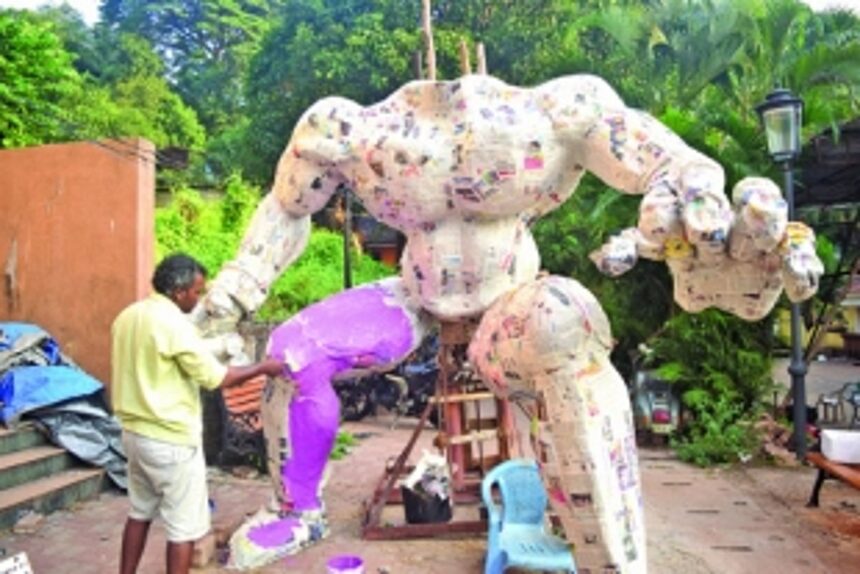
Samir Verekar of Deulwada Sanskrutik Yuvak Mandal
in Panjim was busy putting on a fresh layer of paint to smoothen the arms and
face of the Narkasur that they have designed. Accompanied by children who are
on their Diwali break, they were full of excitement to know how they can help.
“Our association has been making Narkasur for the
last 40-odd years. We start with our preparations soon after Dussehra. First,
we start with the mould of the face and then the wire-frame of the body. Our
main team comprises 12 members, mostly government employees who find time only
from 6pm to 12am to work on Narkasur. Some of us come to work whenever we find
free time. This year, we have used towel material on the body before painting
the Narkasur. The excitement to complete the Narkasur builds up during the last
two days before the festival,” says Samir, as he mixes more colour for the
mask.
For the competition, the Narkasur will have a
chariot and when Lord Krishna strikes him, his neck will break. “We have done
the set up for the mechanical movements and with the sound effects, it will
look even more amazing. Earlier, we used to visit many places for the
competition, but now with the sound restrictions, we will only be participating
in the Mahalaxmi Temple competition and those at the Church Square in Panjim.
Last year, we won the second place at the Mahalaxmi Temple competition and the
third place at the Church Square competition. By 1am the effigy will be brought
back here for display followed by the burning of the effigy,” adds Samir.
One lane away from the Deulwada Sanskrutik Yuvak
Mandal Narkasur, Goldstar Sports Club is putting together their Narkasur with
huge horses. Still adding the final touches, Valabh Chari is busy working on
the face of Narkasur. The planning for the Narksaur begins one and half months
before the day and the actual work starts a month in advance. “The tradition of
making Narkasur will be nearly 45 years old for this club and we are nearly 30
of us working on this single Narkasur,” says Valabh.
Every year, the youngsters take the Narkasur for
a round across North Goa and this year will be no different. “We will start off
with Panjim, Bicholim, Anjuna and Siolim before coming back to Panjim. We reach
back by nearly 10am; the children and youngsters are still full of energy till
the effigy is burnt,” says Valabh.
End your work day early so that you can head out
and see the creativity of not just the moving competition of the Narkasur but
also the standing competition wherein effigies will be on display throughout
the city.