Retiring
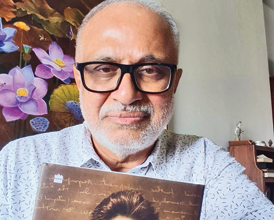
from the IAS after a thirty-year-tenure in 1996, Arvind Bhatikar was keen to
share his wealth of knowledge and experience. His debut Konkani novel ‘Vovllam’
(2011) was an outpouring of his reminisces of service life and public
agitations in Goa.
In his
second book, ‘Rudderless Democracy’ (2015), written over a period of two and a
half years, he however, tapped on his close association and in-depth knowledge
of the mining scenario in Goa to provide a critique of the working of the
Executive and the Judiciary. “The Shah Commission’s report made public in 2012
was a biased report about Goa’s mining and environment and I was keen that the
true picture be brought to light,” avers Bhatikar whose first association with
mining in Goa goes back to 1954-60 when an economic blockade was declared
against the Salazar government who refused to liberate Goa. “At that time, there
was no hardship as we had essential goods imported from abroad with the foreign
exchange earned through mining. I have seen the good effects of mining. But my
actual contacts and information about mining in Goa were formed during my
tenure as Chairman of the Mormugao Port Trust (MPT) from 1990-1996. Six
thousand workers depended on MPT which at that time exported a major bulk (80%)
of the low grade iron ore from Goa,” Bhatikar explains.

The aim
of the book, he maintains, is not to defend illegal mining but to see that
democracy proceeds in the right direction where mining is concerned in terms of
economic and environmental objectives. “The decision to suspend mining did not
consider that one lakh families are dependent on mining. Any government has to consider
its actions on the basis of the lives it affects. Under Parrikar’s stewardship,
six months before the Shah Commission’s report was made public in 2012, he had
taken steps to streamline mining based on his own findings as leader of the
opposition. Why then did he suspend operations after the Shah Commission’s
report? The state government action was neither logical nor consistent. In the
political milieu between the State BJP government and the central Congress
government, one lakh families were forgotten,” he points out.
The
argument of sustainable mining loses momentum when the policy makers are unable
to define the term. “The MOeF only looks after conservation and not the
economic impact on human life. The Ministry of Mines has its own set of rules and
regulations paying scant attention to the environment,” maintains Bhatikar
whose title of the book – ‘Rudderless Democracy’ – is a singeing referral to
the unbalanced policies in the mining scenario.
Thorough
in his research and study of the subject, the book is an eye opener to the
actual mining scenario in Goa and the imminent need to bring about a balanced
operation to sustain both the land and its people.