From March to May, the lush hills are speckled yellow and red as cashew apples decorate
branches like the bobbles on a Christmas tree. There is also that unmistakable
scent of cashews that fills the air, the smell of the fermenting fruit that
heralds the best time of summer.
Goa being the only place in the world where Cashew Feni is
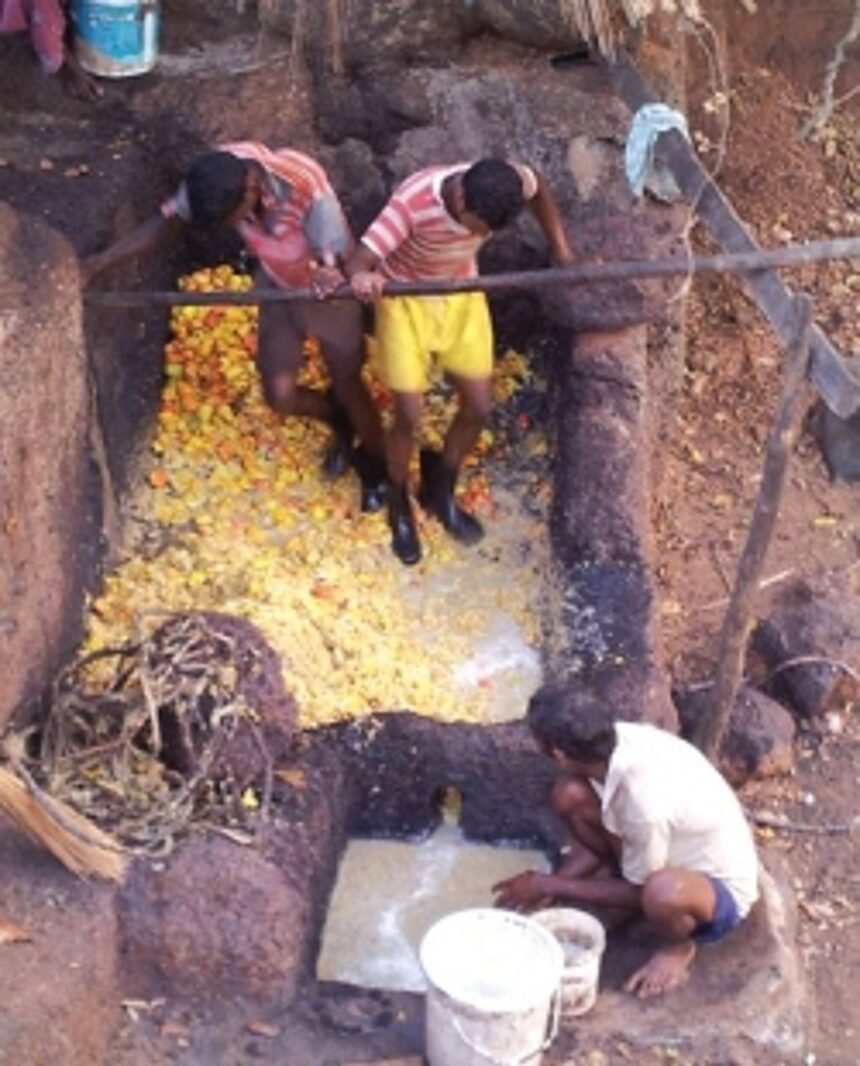
produced, there is always an opportunity to lend a hand, or rather, a foot, at
the old-fashioned cashew stomping during harvest season, generally late March
to early May.
It is a ‘sole bare’ing experience, which you get only in Goa –
to stomp cashews, that is. During the harvest, Cashew Feni distilleries
stretching from Pernem to Polem and Valpoi to Velsao still make Feni the time
honoured way – daily squishing tonnes of cashew apples between their toes. No
need to squirm, because Feni is distilled, so it is pure.
Cashew Feni purists believe that Feni distilled from juice that
has been stomped is by far the best. Cashew stomping is a relatively gentle way
of managing the process of crush, now often replaced with mechanical pulpers
and the hydraulic press. The trick is not to shred the fruit but to gently
squeeze it open so the juices are expressed without releasing the acidic sap
that is not desirable. But even though they may have the latest in gleaming
cashew press technology – Pinjre, parked at their Colmbi-stomping pit, a number
of distilleries still practise the retro charm of stomping cashews in this
fast-changing Goa.
However, there are perceptions that like any other traditional
occupation, the younger generation may not pick up these skills even though the
demand is still very high for Feni and Urack. This, in turn, raises concerns of
whether these Goan grassroots level workers will still be around in the future.
“Thankfully, Cashew Feni is alive and kicking. Contrary to
popular perception, as an industry insider, I can state that Feni is presently
seeing its best days. For the farmers and distillers, the current prices for
Feni are at the highest. And the government support for the upliftment of this
cottage industry has also been highest, with everyone pitching in, from the
Excise, Tourism and even FDA. After a long time, there is probably more than
just one brand selling and marketing good quality Feni. All this means that the
present and future looks very bright,” says Hansel Vaz, proprietor of Cazulo
Premium Feni.
“Goa has a very rich distillation heritage and even though we
have moved with the times to the 21st century, it does not mean we should leave
tradition behind. We cannot lose sight of the true roots of this spirit, a
culture that gives it the character it has today. For a lot of people, Feni is
not just a source of pride or income, or just a way of life; it embodies what
is Goan by tying them down to the land they till. Literally creating spirit
from the fruit of the Goan earth,” adds Hansel, further emphasising on the need
to revive and keep traditional practices alive.
Speaking of traditional practices, at this time of the year, the
focus is on the distillation pot, the most iconic and fundamental focal point
in every Feni distillery. In the old days, these were made of mud; nowadays,
the more robust and easier to source copper pots are used. Unlike the trend in
the West to name the distillery pot, in Goa they are just called ‘Bhann’ (cauldron).
After having spent time stored away, it is brought out at this
time of the year, where the first task for the workers is to patch up the old
furnace with fresh clay collected from termite mounds. This mud is called
‘rounechi mati’ or ant hill mud and this clay is fine and binds really well.
It all happens like clockwork; every task is a skilled
performance that requires craftsmen.
The next task is the fitting of the ‘nollo’ or conduit between
the distillation pot and the condensation coil. It is crucial that this is
fixed right, at the appropriate angle, so that the vapours travel smoothly to
the next stage. The traditional way of doing it is by using the the hollow of
bamboo. A set of metal rods heated till red hot are then used to burn a hole
through the segment of the bamboo. Burning a hole chars the inner sides of the
bamboo, not just curing the inside, but also has the char acting like a
rudimentary charcoal filter. Charcoal filters generally adsorb impurities from
the vapours as they pass through.
After three days of setting up, the surface is covered and
sealed, using natural and eco friendly materials. Besides that, the workers
also have the ‘cashew picks’ or ‘kaantov’, a spike attached to a light stick,
which allows them to spike fallen cashews into the collection basket. As the
cashews have already started falling, and the cashew pulper already in place,
it is time to catch the season. “If you want to make good Cashew Feni, you have
to first begin with picking the right cashews. The local variety, the ‘balli’
coloured in gentle yellows, oranges and vibrant reds, is best suited,” adds
Hansel.
Early afternoon is when ‘cazkars’, workers, organise themselves
to methodically comb the orchards for naturally fallen cashew apples.
Tree-ripened fruit that naturally fall are full of sugars and low in the
astringent sap, so make the best Feni. Dressed like ninjas – covered head to
toe to avoid insect bites and scratches – they arm themselves with the
‘kaantov’ and get going.
Cashew apples are dropped into the ‘colmbi’, stone basins that
have been carved into solid rock, where another set of workers de-seed the nuts
from the apples, to prepare for the stomp.
Trampling baskets of squishy cashews may sound like fun, but it
requires skill, balance and endurance to collect the buckets of sweet cashew
juice.
Men work in pairs and trample fruit to a pulp. The pulp is then
made into in a mound and trussed together with a vine. Heavy rocks are left on
top to press the remaining juice out of the pulp under gravity overnight.
The juice is strained and allowed to naturally ferment in
earthen pots. No nutrients, catalysts or artificial yeasts are added, and
nature takes over from where man left off, converting natural sugars into
alcohols.
After fermentation, when the wash stops bubbling, it is ready
for distillation. This crude cashew wine is transferred into the pot still.
Traditionally, the alcohol vapours were condensed in an earthen pot, by
constantly pouring water over the ‘launi’ with a coconut shell ladle. Now a
copper coil is immersed in a water tank do the same. The vapour phase of the
alcohol is most crucial, while the copper coil removes unwanted sulphates; the
earthen pot imparts a beautiful earthy notes to the spirit.
“The process of crafting Feni is in many ways very similar to
that of making wine. You hand-pick tree-ripened cashews, stomp the juicy apples
and allow the juice to ferment into a crude cashew wine. But that’s probably
where the similarity ends. At this distillation process, the low-strength wine
is converted into a high strength alcoholic spirit, that we could call an
Urrack, Cazulo or a Feni, depending on which stage you are at,” explains
Hansel.
The first distillation is known as Urrack (14-16% alc v/v), a
lovely cooling drink, and is velvety smooth, so lovely that the drinker often
mistakenly over consumes, and what follows is described as a velvet glove!
What is interesting and unique about this distillation process
is that each distillate is re-distilled with fermented juice in carefully
guarded proportions, to give you not just a higher strength alcohol but a more
flavourful next distillate.
The second distillation is the Cashew Feni that is sold today.
However, in olden times, Feni was the third distillation; it was considered to
be too strong to drink, and so it has been discontinued. Cazulo is now sold and
accepted as Feni. What is unique in Feni is that unlike other alcohols, Feni is
directly distilled into 42.8% alcohol.
It
may be common to witness cashew trails that take place at starred resorts and
museums that celebrate this craft and Goa’s prized asset. It is also common to
hear about how Feni has been an age old remedy used to treat various ailments.
Whatever the occasion, Urrack serves as a much sought after local favourite in
the summer throughout the state, be it at Anjuna or Arambol.