A total of 29 research papers based on the cultural and literary heritage of Goa were
presented by both national and international researchers, at the 3rd
International Symposium “Goa: Cultures, Languages and Literatures.
Paper presenters were both from far away
countries like Brazil, Portugal, Macau, etc and from our own land of Goa. While
the focus of several papers was on the variety of literary forms, texts and
languages in Goa such as Marathi, Konkani, Portuguese and English, other papers
focused on theater in Portuguese and Konkani, while still others deliberated on
the aesthetic character of the cultures of Goa found in art and architecture.
The underlying thread of all the papers that were presented was that Goan
cultural identity, formed due to the encounter between various cultures and
civilizations projected Goa as a window to broader, more universal theoretical
debates. The interesting and lively exchanges and discussions opened up new
opportunities for research based on the history/ heritage/ culture/society of
Goa in relation to broader national and international contexts.

The symposium was organized by the Centro
de Lingua Portuguesa, Camoes, Goa and the Xavier Centre of Historical Research
(XCHR), Goa recently.
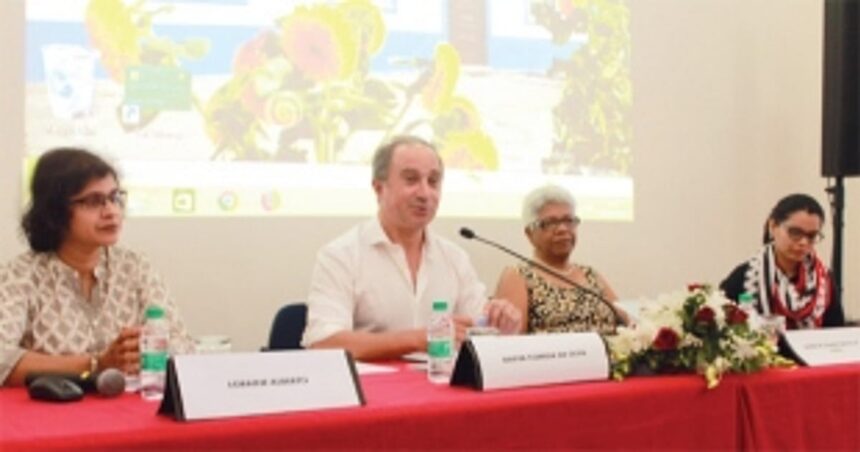
In the Inaugural session, Delfim Correira
da Silva, Director of Camoes welcomed the gathering, while and the Chief Guest,
the Consul General of Portugal, Duarte Azavedo gave his address.
Savio Abreu SJ, Director of XCHR also welcomed the participants
and explained the significance of the symposium.
“The vision and mission of XCHR is to stimulate and foster an intellectual
climate and become a hub of scholarly historical research with an
inter-disciplinary approach and a critical methodology. This fits with the aim
of the symposium – to open up new opportunities for discussion and research
based on Goa, by both national and international researchers,’ said Fr Savio.
XCHR is involved in research on the history/ heritage/
culture/society of Goa in relation to broader national and international
contexts. The entire academic and research programmes of XCHR are based on the
idea that Goa as a geographical and conceptual space offers critical modes of
observing and analyzing the world. Goa is thus a window to broader, universal
theoretical debates.
“Our work matches the conceptual framework of the symposium
which looks at Goa as a meeting point of historical and cultural repute, and
argues that the cultures of Goa are the fruit of a dialogue between various
cultures and this cultural identity of Goa has a lot to offer to cultures and
literatures, both nationally and internationally,” added Fr Savio.
He further stated that Goa is a window thus a window to broader,
universal theoretical debates.
‘Interpreting Goan culture through Marathi short fiction’,
‘Stories from Outside and Inside the Goan Casa Grande: Away from the Community
Romance’, ‘Theatre in Portuguese in the 20th Century’, ‘ Goan Tiatr and
Macanese Theatre in Patua: The Resurgence of Popular Theatre in post colonial
Goa and Macau’, ‘Teaching Disruptively: Hacking Foreign Language Acquisition in
non-native contexts’ and ‘Portuguese and Spanish Texts available in Goa’; were
some of the highlights of the first day of the symposium.
The highlights of the final day of the symposium included:
‘Ancient and Contemporary Templescapes: Sri Santadurga and Hindu Female Deities
in Portuguese Textual Sources from Goa’, ‘Conservation and restoration
practices in Goa in the early 20th century’, ‘Goan Expertise and the Public
Works Departments across the Portuguese Empire’, ‘A Goan read of the cultural
impact of the Colonial Act of 1930: Theory and methodology,’ ‘Blurring genres-
Notes from a woman anthropologists in Goa’ and ‘Approaching the margins of
colonial periodical press: the case of the magazine Seara Nova’.
Tony
da Silva SJ, Administrator of Xavier Centre moderated the Valedictory session
and also proposed the vote of thanks. Helder Garmes, University of Sao Paulo,
Brazil & Coordinator of the Research Group, Pensado Goa delivered the
valedictory address.