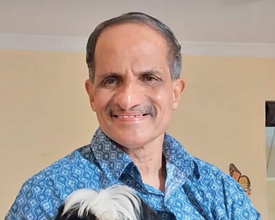
“If use a PowerPoint, there is no power in your point,” asserts Virender Kapoor, an author and
educationist, who inspired principals and teachers at his special crafted
workshop ‘Creating Vibrant Educational Institutions through Effective
Leadership’ that took place in Margao recently. The workshop was organised by S
Chand And Company Pvt Ltd, who has published a couple of books written by
Kapoor. The workshop included principals and faculty coming in from 20 schools
across Goa.
Kapoor is a management guru and former Director of Symbiosis
Institute of Telecom Management, Pune. His bestselling books include
‘Excellence: The Amitabh Bachchan Way’, ‘Succeeding: The Akshay Kumar Way’,
‘Leadership The Gandhi Way’, ‘Innovation: The Einstein Way’, ‘Speaking the Modi
Way’, A Wonderful Wife’, ‘Wonderful Boss’ and ‘What You Can Learn From Military
Principles’. His belief that inculcating values in children from a young age is
beneficial and important led him to write a series of value education books for
schools, called ‘Life with Value’.
Virender Kapoor has influenced thousands of management and
corporate students who are now in high places. At the workshop, principals and
teachers learnt about creating effective and deliverable leaders from the
master himself.
In a chat with Café, Virender Kapoor spoke
about his ideas, beliefs, work and achievements…
Herald Café: What
was the aim behind ‘Creating Vibrant Educational Institutions through Effective
Leadership?’
Virender Kapoor: The
main aim behind the workshop was to ingrain creative teaching methods and good
leadership skills. The primary topics discussed during the workshop included
understanding emotional intelligence, leadership in education institutes,
building organisational culture, politics is dangerous, managing people,
emotional sensitive leaders, delayed gratification, loyalty and determination
in the light of EI, inculcating values and EI in children.
HC: Based on the focal
theme of your workshop, what is the responsibility of a principal?
VK: The most important
job of a principal is the task to build a strong foundation based on values and
culture. It is essential for a futuristic, creative and understanding person to
be given the seat of the principal. Mind you, it is not an easy job! The
principal has to wear different hats while dealing with each department in an
organisation. The behaviour and correspondence with the staff, the
interconnection with students and the interaction with the parents require
different roles accordingly. Teaching values in schools is a burdensome task,
as the children spend more hours at home and less in the institute.
HC: What is your opinion
on the education system today?
VK: Let me tell you
something striking. I find the use of ‘PowerPoint presentations’ impractical.
It is an undeniably stupid action. If you use PowerPoint, there is no power in
your point. Students learn to be confident when they are taught to stand up and
speak, and this is the work of educationalists. Having practical experiences,
conducting subject-related activities and giving real life examples are best
ways of learning, through which the teacher and learner enthusiastically enjoy
the atmosphere. Moreover, a bond between the teacher/principal and student is
built.
HC: Emphasising on
values, ‘Life with Values’ is one of your books for school students; according
to you, how important is it to teach moral values to children?
VK: Value education is
often given less importance in schools than other mainstream subjects. But
naturally, value education should receive more credits, as it structures the
right discipline in a child to be a better citizen of the nation tomorrow. When
no boundaries are set, disciplining a youngster is difficult; they grow up to
create menace by forgetting simple basic ethics.
HC: What difference do
you find between the ethics of India compared to the Western countries?
VK: Honestly, in India,
we take pride in breaking rules, while they take pride in making rules. Hence,
the next time citizens remember to criticise India, one must keep in mind that
each individual is responsible for their actions.
HC: When it comes to
teaching values and inculcating good habits, is it an easy task?
VK: No. As an
educationist, I agree that it is easy to teach subjects like science,
mathematics, chemistry, etc as these subjects are based on facts. But
inculcating values in children is a tedious procedure.
HC: How would you prefer
teaching a child moral values?
VK: Giving examples of
historic figures like Mahatma Gandhi or Mother Teresa is unhelpful. The past
lies in the past and might even get boring. Youngsters today believe in seeing
more than hearing, hence having a historic person as a role model would be
futile. However, when one looks forward to bring the best in a child, common
examples of their favourite inspirations or celebrities, perhaps even a good
film would help them learn and grow with indefinite values.
In my books of ‘Life with Values’ I have given examples of
famous modern people. Children like these people; it helps them build an
attachment.
HC: What are the books
you are currently working on?
VK: My series began with
‘Leadership the Gandhi Way’ and I am currently working on the new edition-
‘Winning the Chanakya Way’.
HC: What message do you
have for educationalists?
VK: This is something
what I always say during my workshops: Whether it is a company position or a
principal’s seat, don’t’ worry about the cost of the chair; when you sit on the
chair, you create the value of the chair. Sitting on the chair of a high
position doesn’t make one eminent, but the kind of personality you define
yourself into is what makes you a person of great importance.
Every
teacher aspires to be a principal one day and therefore needs to learn what it
takes to become a remarkable school leader.