What is Grinding Stories?
Do you remember in
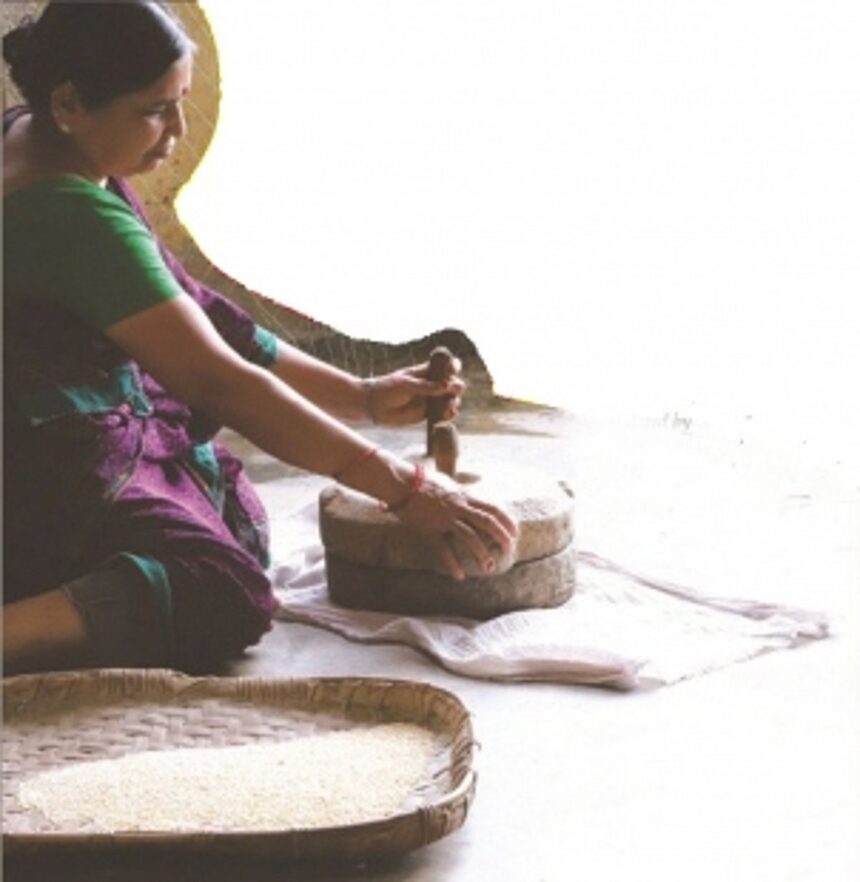
the olden days how women used the cylindrical rounded stone and a round
wedge-shaped stone with a pit in the middle? In those days, women expressed
their emotions through the stories and experiences in the form of a poetic
songs called the oviyo songs. The significance of oviyo songs is still not
lost. We all must have probably heard our grandmothers hum a peculiar rhythm
that’s very unusual from the rest. It could be an oviyo song.
‘Grinding stories’ is also a book written by Heta Pandit that
explores the poetic expression of women’s voices, bringing together vernacular
and translated renditions of ‘oviyo’ songs that are sung over the grinding
stone by women in rural Goa.
Tribute to Grinding
stories
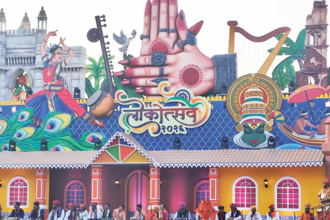
At Sunaparanta, Goa
Centre for the Arts in association with India Foundation for the Arts (IFA) and
Heritage Network paid tribute to Goa’s women and the unique oviyo tradition
According to Lina Vincent the entire event was not just
honouring the oviyo songs, but the grinding stone being a symbol of the layered
discussion revolves around gender and women’s experiences. “There where there
are a multitude of objects from Goa’s socio-cultural history, provided by the
Goa Chitra museum in Benaulim and the traditional ‘oviyo’ sung over the
grinding stone, that have been translated in the book ‘Grinding stories’. I saw
this as a collective attempt to explore aspects of Goa’s living heritage, in
its material objects and oral histories,” says Vincent.
There’s more to Life
than a House in Goa – Heta Pandit
As the author of the
book Grinding Stories, Heta Pandit, heritage advocate, explains that the book is
a translation of 26 songs from the Sattari taluka of Goa, collected over the
course of a year. Some of these stories in the book are ancient well-known
legends and some are composed and sung by the three women mentioned in the
book.
Oviyo Discovery by the
Author
Heta Pandit narrates
her discovery and inspiration behind writing Grinding Stories. She discovered
these songs from Goa on a chance visit to the Shri Mauli Temple in the forest
village of Zholambe in neighbouring Maharashtra. The rich stock of kaavi art on
the temple walls were originally from Goa and part of an on-going research
project. One of the complex figures was that of Garuda holding up a serpent.
The eagle and the serpent were assumed enemies in the normal lexicon. However,
in this illustration on the temple wall, the expression of Garuda was benign.
The serpent appeared unharmed and under Garuda’s protection. Dr Rajendra
Kerkar, who had guided the team and Heta to the temple, then began to recite
the Goa version, the “oviyo” version of the legend.
“The story was as
intriguing as the poem and thus began my fascination for the songs sung over
the grinding stone,” says Heta.
A Set of Glass
Bangles
There may be
thousands of oviyos composed in the olden days by women in Goa while grinding
in the kitchen or backyard. Here is one example:
In A Set of Glass
Bangles, the storyteller obliquely refers to the whole village in the context
of her in-laws. When she marries a man from a certain village, it is as though
she has married a whole village (of in-laws). Everyone sees the new bride as
easy game. The reference to the 100 Kauravas from the epic Mahabharata is
especially significant here. It is a younger brother who has sent the bride a
set of glass bangles for his sister and yet, she says, her in-laws sit in
judgement, as one hostile body. The reference to the set of glass bangles
arranged as a fancy package – like a palanquin – indicates the love and care
that a younger brother has lavished on a gift for his sister. The new bride
also calls herself ‘beautiful’ to imply that she has brought not just expensive
gifts with her but also her own physical beauty.
The Theatrical
Presenters at Grinding Stories event
The program opened
with an introduction to the project and the songs were rendered in a
Marathi-Konkani dialect, with English reading of the translations, as well as
theatrical interpretation of selected pieces. The stage was set with selected
objects of domestic life, identifying the living/disappearing heritage of Goa,
and connecting with the idea of gender-imbued objects and spaces.
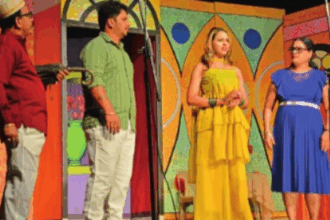
The
event features storyteller Sarojini Bhiva Gaonkar, vocalist cum
environmentalist Shubhada Chari and performer Ruchira Verekar presented a
theatrical act of the grinding stories. The act was directed by Anagha
Deshpande (for Abhivyaktee, Panjim) along with India for the Arts (IFA) fellow
Lina Vincent and of course Heta Pandit.