“In 1755, there was a major earthquake in the epicentre in Lisbon, which destroyed
two-thirds of Portugal. The King started living in a very big tent as he
refused to go to the palace. He decided to rebuild Lisbon patterned after Madrid
and Paris and gave instruction so that the newer part of Panjim would be
planned like a European city. That was how the city of Panjim came into
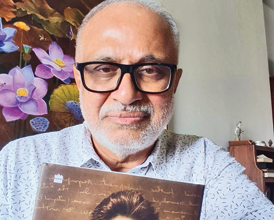
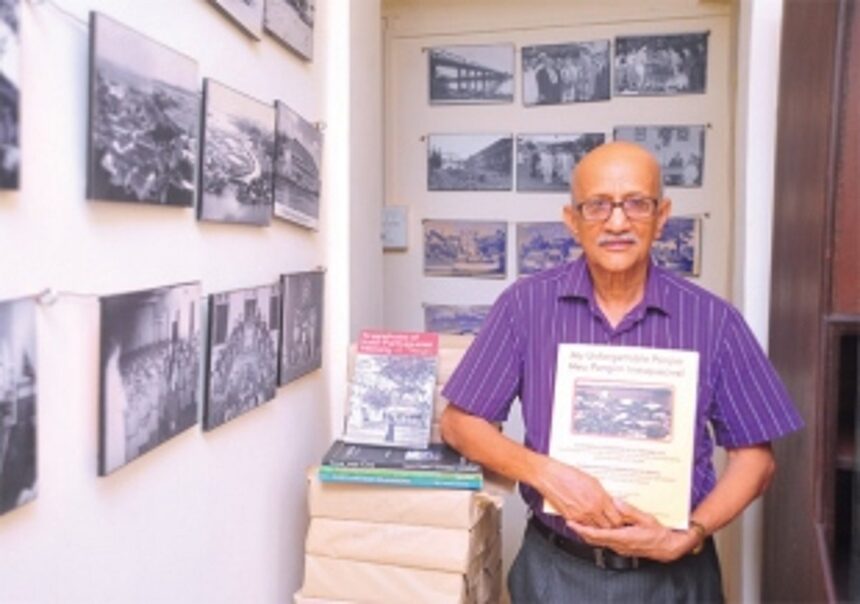
existence,” says Vasco Pinho, as he points out to various sepia photographs of
Panjim dotting his walls. The first thing that catches your eye when you walk
into his home is the hard work that went into building this treasure of
archival photographs.w
Speaking about ‘My Unforgettable Panjim’/ ‘Meu Pangim
Inesquecível’, Vasco explains, “The book is more elaborate and exclusively on
Panjim city. It is written in English and Portuguese which became a heavy
effort. There are some very helpful city plans which I have included in the
book and the names and details of old streets of Panjim. My friend Alvaro Leao Fernandes,
helped me put things into perspective. He was my classmate from primary school.
We usually sit together and discuss different aspects for the books.” He has
included 350 photographs in the book.

He has been working on typing out the book on his computer for
the last three years, however, his research for his books goes back decades. “I
have some valuable books in my family which I refer to, like the geographical
dictionaries of Portuguese colonies. I have a collection of about 3000
photographs of Goa which are digitalised, which I have been collecting for
years; some 100 are from Souza & Paul.”
The first medical college in Asia was in Goa, where is it now?
“No sooner the Portuguese arrived, they built the first hospital in Old Goa
because they needed a hospital to treat their sailors. Then it was transferred
to Panjim when they thought of abandoning Old Goa. The Goa Medical College in
Panjim built the maternity ward in 1930 which eventually became a general
hospital. People miss the fact that when the Portuguese arrived they built a
hospital and school in Old Goa which had no name but used to give diplomas in
the name of His Majesty to the doctors. This older Medical School in Old Goa
came into existence around 300 years before the Harvard University had its
medical college. There was no money to maintain those old structures,” Vasco
gives his insight.
He further adds, “When they built the new city here in Panjim,
they started bringing building materials from Old Goa, like the massive door at
the Old Central Library, which is a door from a church. It was a slow and
expensive process with transportation by bullock carts and the river. They
brought materials like beams and doors, massive stones for buildings like Clube
Vasco De Gama, the Police Station, Central Library and many of the old houses.”
Vasco studied Portuguese Literature in school and was fascinated
with history from childhood. His father collected stamps while his mother had a
huge collection of paper cuttings on film actors from Hollywood. Vasco has his
own collection of over 3000 photographs from his family archives and sketches
of Goa by Antonio Lopez Mendes from his published work ‘A Índia Portuguesa’
dating back to 1886.
“I grew up in Panjim. However, there was some period of time, when
I lived in Ponda and Quepem. My family is originally from Chorao and then they
moved to Pilerne and Candolim. My father was working at Fazenda in Panjim and I
studied at the Liceu School,” says Vasco, who was a professor of Economics for
23 years at St Xavier’s College, Mapusa.
After retirement, he taught Economics to students at VM
Salgaocar College of Law, Miramar for six years while simultaneously writing
books for those who want to learn Portuguese. He is also the author of the
‘Snapshots’ series (4 vols).“To those who were working in offices in Panjim
during the Portuguese era, it was made compulsory that they should reside in
Panjim. Panjim has a lot of people coming from Bardez and Salcete and the
villages around like Batim, Goa Velha, Siridao, Ribandar and Merces who are now
residents of Panjim,” he says.
Vasco
is enthusiastic of sharing his immense knowledge of the history of Goa to his
readers, “I don’t think I will easily stop writing. Many people have asked me
to write about Old Goa. Though there are many books already written, I will put
in different inputs about the place. However, the book will take another three
years,” concludes Vasco. The book, ‘My Unforgettable Panjim’/ ‘Meu Pangim
Inesquecível’ is available with Vasco Pinho, Singbal Book House etc.