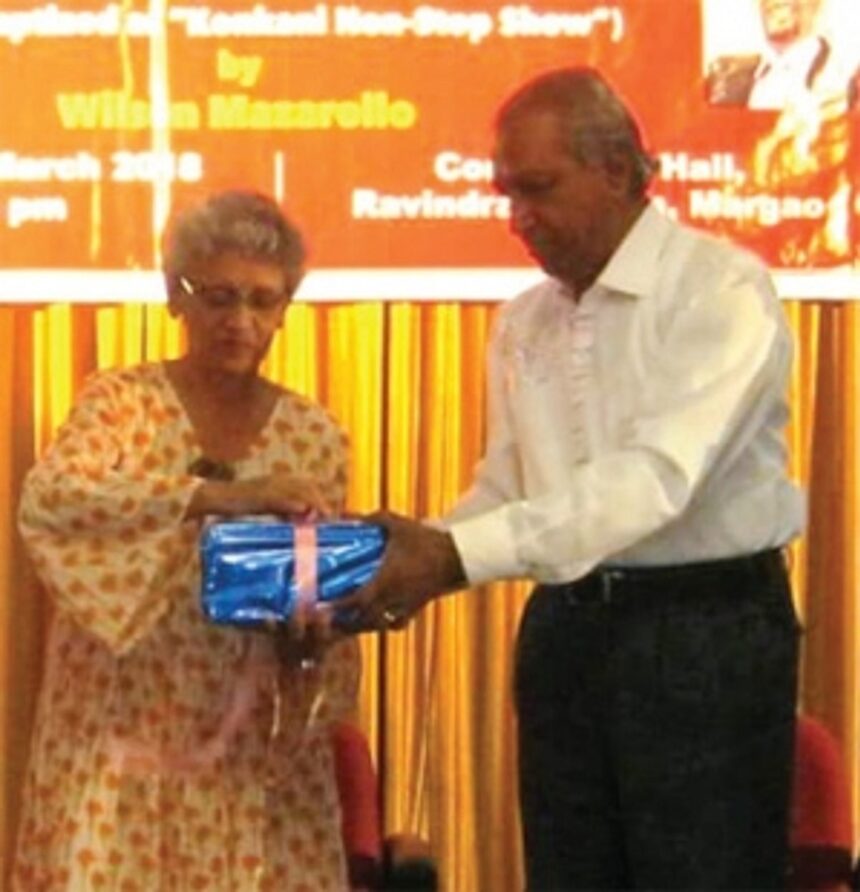
The book ‘Konkani Khell Tiatr’, written by Wilson Mazarello, famously known as Wilmix, and published by
Dalgado Konknni Akademi, was recently released at the hands of noted theatre
personality and guest faculty at Goa University, Isabel Santa Rita Vas, at
Ravindra Bhavan, Margao.
It may be recalled that Wilmix had earlier
published a book called ‘100 Years of Konkani Tiatr’, and now, 18 years later,
he took up the initiative of documenting the rich history of Khell Tiatr, to
allow the future generations to learn about one of Goa’s most unique forms of
theatre.
“This book gives detailed information on the history of Khell
Tiatr, including dates, events and people. In fact, the information is more
accurate than that in my last book as this comprises more recent history than
the tiatr started by Lucasinho Robeiro,” says Wilmix, adding, “The format used
for noting the sequence of events in this book is better than the one I
followed earlier. I got an opportunity to make this book more interesting to
read whereas the earlier book only had information.”
“Khell tiatrs were very popular for various reasons, including
the fact that tiatrs were performed only during two seasons, namely, October to
February and April to May. There were many new actors and writers who were part
of khell tiatr. The information and the extensive field work involved was too
much to be included in the same book (100 years of Konkani Tiatr). I had
mentioned at that time that if I get an opportunity, I’d write a separate book
on khell kiatr.”
Speaking about what sparked this effort, Wilmix recalls how
nobody had responded to his statement in 2000, when his previous was released,
that the history of khell tiatr also needed to be chronicled. “Over time, I
forgot about it, thinking someone from the same field may write about it.
However, years passed by and and no one had documented khell kiatr. Then with a
gradual decline in popularity and with people wanting tiatr with kantaram all
over again, there was a fear the khell kiatr would be converted into tiatr with
songs, which would result in this art form disappearing into oblivion. It is
then that decided to work on documenting the khell kiatr, which later came to
be called Konkani Khell Tiatr (Konkani Non Stop Show).”
On the occasion of the book launch, Isabel congratulated Wilmix
for his exemplary work in recording the origin, development and future of this
form of theatre. She said that the well researched book would spin off more
research, particularly among the student community that has to do project
reports and dissertations.
Wilmix then shared some of the unforgettable and inspiring
anecdotes that some of the khell kiatr artistes had shared with him when he
interviewed them for the purpose of the book. “Quite a few families of those
responsible for bringing the Zomnivoilo Khell on to the stage are still around,
whereas those responsible for starting the tiatr of seven acts passed away a
long ago,” he added. Wilmix interviewed around 78 theatre personalities to
bring out this 252 page book.
During his rounds of research, he met with the Dalgado Konknni
Akademi and that was when the idea of publishing the book under their banner
came into play.
At
the book launch, Dalgado Konknni Akademi General Secretary Vincy Quadros, in
his welcome address, assured that the book will be translated into Konkani by
the DKA in the near future. Various speakers explained that the book has been
written in English so that it attracts a wider readership and is read even in
other parts of the world. Prof Edward D’Lima, who edited the book, also
reviewed it at the function and said that it was a real treasure trove of Goan
culture.