Goa, a land with a confluence of cultures, is home to various
traditions and practices. According to a school of thought, the
Veerabhadra worship and the Veerabhadra dance performed
in Goa is a tradition that has travelled to Goa from Karnataka.
Even today, while addressing Veerabhadra, Kannada terms like ‘Kailasvalige’, ‘Houdu’
and ‘Veerabhadra Anna’, are used. It is believed that the tradition of Veerabhadra was
established in Goa during the Vijaynagar Empire. In Bicholim, the Veerabhadra dance
takes place one day prior to Gudi Padwa – the commencement of the Hindu New Year.
On the last day of Shigmo, there is a presentation of Veerabhadra
in Atil Peth Bicholim, Bordem Bicholim, and in Vithalapur near
Sanquelim, which coincides with the last day of Chaitra Utsav or the
full moon day during the first month of the Hindu calendar.
It is believed that Shri Vithal temple of Karapur was established
in Vithalapur in 1392 AD. Shri Vithal is a popular form of Lord Vishnu,
responsible for promoting the Bhakti cult in Goa, Maharashtra,
Karnataka and other parts of south India. Shri Vithal mainly helped
in bridging the gap between the two sects, namely Shaivaites and
Vaishnavites, and that is why Veerabhadra dance is performed in the
vicinity of Shri Vithal temple near Sanquelim.
According to Vijaykumar Verenkar, a theatre artist turned politician,
“Though Shri Vithal temple is situated in Karapur village on the right
bank of River Valvont, Sanquelim town is culturally and religiously
associated with the festival of Chaitra and Veerabhadra folk dance.”
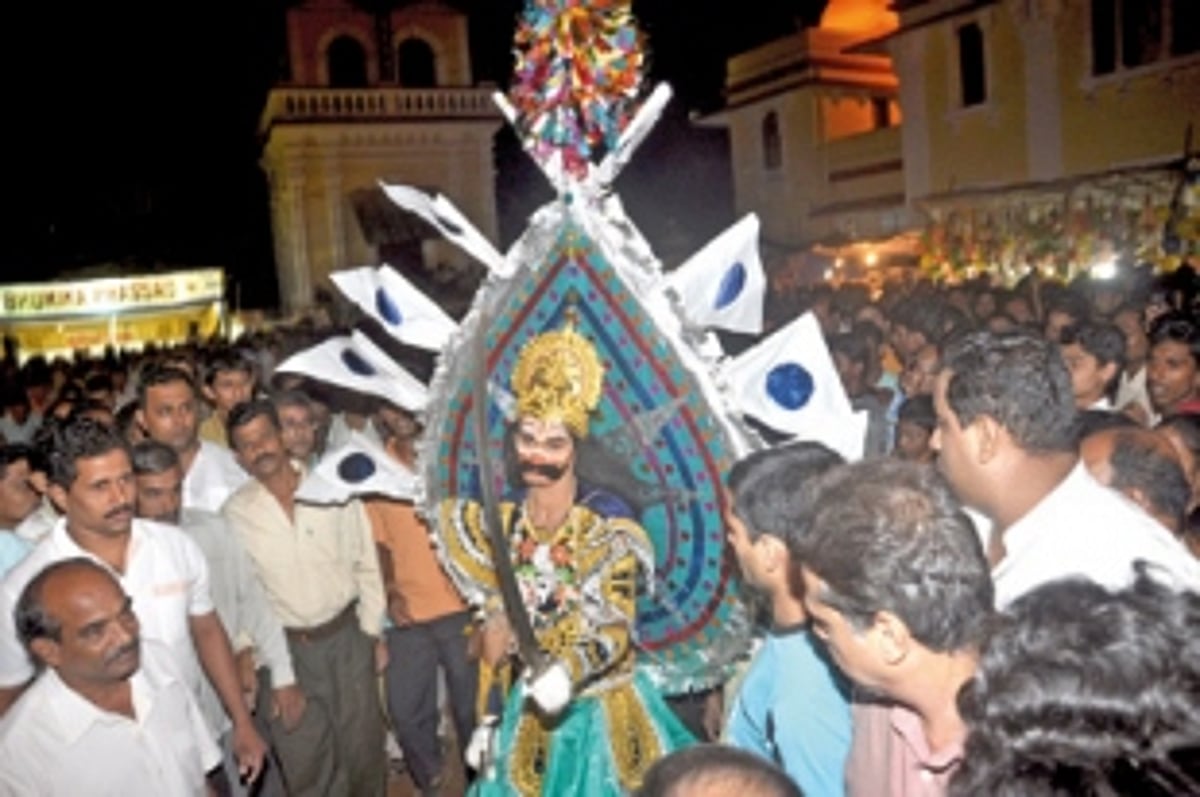
The Veerabhadra folk dance performance of Vithalapur that is
followed by a chariot procession garners large crowds. To the beats
of the traditional Goan musical instruments like ‘dhol’, ‘tashe’ and
‘kasale’ (cymbals), a designated person from the village sheds his
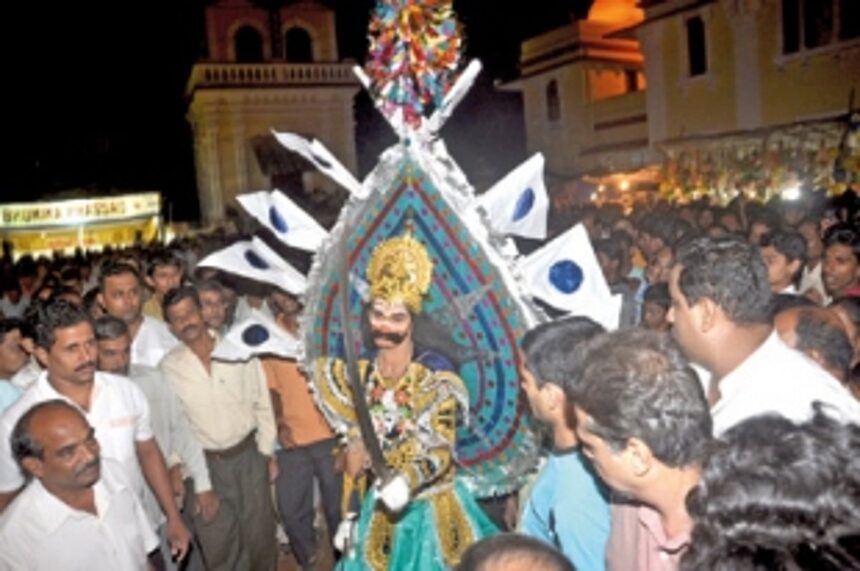
identity and transforms into Veerabhadra. The peculiar costume of
this figure involves a royal costume, with a cardboard with small flags
tied to his back. Furthermore, Veerabhadra is seen wearing a crown,
his long hair untied and his face painted to resemble the iconic figure.
Sudatt Mandrekar, a resident of Atil Peth Bicholim, says, “The
Veerabhadra folk dance, which is performed in many parts of
Goa, reflects the martial arts tradition of the
land. Veerabhadra is the representation of a
deity associated with the battlefield and his
performance of dance is said to inspire the
warriors.” When Veerabhadra enters the arena
and starts dancing, two swords are handed to
him. The dance is akin to a warrior dance and the
stance is aggressive. After taking a few rounds,
in most cases, the person slips into a state of
trance and starts dancing violently. As such, there
is a high possibility of him falling onto his back
because of the heavy costume but the elders of
the village see this as a bad omen. According to
the elders, Veerabhadra should not be allowed
to fall on his back; if this happens, there is a high
possibility of him going out of control. To ensure that this does not happen, there are
two-three people holding Veerabhadra at the back who then rock him back and forth to
the beats of traditional musical instruments